Ed Bennett’s Razor Blade Art: A Lifelong Dream in Bucks County
I have met some fascinating people during my travels, but I don’t believe I’ve ever met another artist who built an entire creative practice around a 150-pound collection of discarded razor blades. That’s exactly how Ed Bennett’s story began, and when he explained it to me during my visit to Galvanized America Inn & Art Gallery in Bucks County, Pennsylvania, I couldn’t help wondering how someone even comes up with such an idea.
What made our conversation especially interesting was learning that Ed had been an artist long before he discovered his unusual medium. His fascination with art began in childhood, continued throughout a 25-year career in advertising, and eventually led him to transform a historic barn into the gallery he had dreamed of owning for most of his life.
As we talked, I discovered a story about creativity, experimentation, family support, and the determination to keep doing something you love, even when life takes you in other directions. And, of course, I wanted to know what in the world had inspired him to start making art with razor blades!
An Artist Long Before the Razor Blades
When I asked Ed whether he had always been an artist, his response came without hesitation. “Yes, I have. I was born an artist,” he told me, before explaining that someone had recognized his artistic ability when he was only five years old.
“Really?” I asked, surprised that his talent had been identified so early. “Yes,” he answered. “So you were a prodigy?” “Kindergarten, yep, I was.”
I laughed at his confidence, but as Ed continued talking, I began to understand how important those early years had been in shaping his creative identity. He told me that he had excellent art teachers who encouraged his abilities and helped him develop his skills. His mother also played an important role, recognizing that her son had a talent worth nurturing and making certain he had access to the right opportunities.
“My mom was a big proponent of my career and always made sure I had the right instructors and got to the places that I needed to be,” he explained.
I found that particularly meaningful because talent alone doesn’t always determine whether someone gets the opportunity to develop their abilities. The encouragement children receive, the people who recognize their potential, and the resources available to them can make an enormous difference in the direction their lives take.
Ed was fortunate to have adults who took his artistic interests seriously, and that foundation stayed with him as he entered adulthood and began building a professional career. After college, he found work in advertising in New York City, where an unexpected encounter with his studio manager would introduce him to the material that eventually became his artistic signature.

The 150 Pounds of Razor Blades That Changed Everything
Ed’s story took a rather unusual turn when he started describing his first job after college. “I got a job in New York City right out of college, and I was in what was called the bullpen,” he explained. “I was in the basement of the agency, and I did all the grunt work for the people upstairs.”
About three weeks into the job, he noticed his studio manager, Henry Jacobs, wrapping up a collection of materials that he intended to throw away. Naturally, Ed wanted to know what was inside.
According to Ed, Henry told him that it was his 20-year collection of used razor blades and offered to let him take it rather than throw it away. “I don’t know what I’m going to do with it, but I’ll take it,” Ed remembered telling him.
At this point in the story, I was already amused by the idea of someone collecting used razor blades for two decades, but the next part was even better. Ed had apparently agreed to take the collection without realizing how much it weighed.
“I didn’t know it weighed like 150 pounds,” he told me, explaining that he hauled the blades onto the subway and then carried them thirteen blocks to his apartment. After all that effort, he simply put the collection in a corner and forgot about it.
I couldn’t help imagining a young artist dragging an enormous collection of used blades through New York City without having the slightest idea what he intended to do with them. Several months passed before Ed finally returned to the box.
One Friday evening, he found himself home with little money and nothing much to do. Remembering the blades he’d brought home from the agency, he pulled some out and began experimenting. “A few months later, I was bored and broke on a Friday night,” he told me. He saw the box, pulled out some blades, and started creating.
“Wow,” I responded. “Just serendipity.”
What fascinated me was that Ed hadn’t set out to invent an unconventional art form or develop a signature technique. He had simply accepted a collection of discarded materials, kept them around long enough to become curious about them, and eventually allowed his imagination to take over. Sometimes the most interesting creative ideas begin without a carefully constructed plan.

Finding Color in Metal, Rust, and Gun Bluing
Of course, coming up with the idea of using razor blades was only the beginning. I wanted to understand how Ed developed the technique and eventually moved beyond the silver metal that originally defined his work.
“Originally, I just used the silver blades for patterns and textures,” he told me. That approach allowed him to explore arrangements and visual effects, but eventually he began feeling limited by what he could achieve with a single metallic color.
So he started experimenting with chemical oxidation. The process introduced two additional colors into his work: reddish tones created by rust and a blue-black finish produced with gun bluing liquid, a treatment commonly associated with firearms.
“The blue is actually gun bluing liquid,” Ed explained, telling me that the substance could be used to protect rifle barrels. “Oh, wow,” I responded, intrigued by yet another unexpected element of his artistic process.
With silver, red, and blue-black available, Ed found himself working with a palette that naturally suited patriotic imagery. “So then I had three colors, and patriotic just seemed to be the way to go,” he explained.
His razor blade compositions became closely associated with American flag imagery and other patriotic themes, using the distinctive appearance of metal to create patterns, shapes, and visual depth. What impressed me was Ed’s willingness to keep experimenting rather than accept the limitations of his materials. Even after developing a recognizable approach, he continued looking for ways to expand what the blades could do.
When an Artist Needs More Than Three Colors
After roughly twenty years of working with his original color palette, Ed reached another turning point. He was ready to do something different.
“And then I got bored with that after about 20 years,” he told me, explaining that he began researching other ways to introduce color into his work. At one point, he consulted a metallurgist, hoping that her expertise might help him discover new possibilities.
Her assessment, however, was less encouraging than he had hoped. “Ed, your colors are your colors,” he recalled her telling him. She explained that a few additional colors might be possible, but the chemicals required to produce them would be prohibitively expensive.
For some artists, that might have been the end of the experiment. Ed, however, had another source of knowledge to draw upon. He had an automotive background from working with his father, and that experience eventually led him to investigate products used in automotive finishing.
During his research, he discovered a transparent spray paint designed for automotive applications. Unlike an opaque coating that would conceal the metal underneath, this paint allowed the surface of the razor blades to remain visible. Even better, it came in six colors.
“It allows the metal quality of the blade to show through,” he explained. That discovery opened up an entirely new direction for his artwork. “So now that’s what brought me into doing the wildlife and the portraits, the landscapes, and whatever,” he told me.
Suddenly, Ed had a much wider range of subjects available to him. The additional colors enabled him to move beyond the patriotic compositions that had dominated his earlier work and experiment with different images while preserving the metallic qualities that made his technique distinctive.
“It also opened up a whole new color palette for me,” he explained, describing how the discovery helped him move past the creative boredom he had begun experiencing.
I especially enjoyed this part of our conversation because it demonstrated how knowledge from seemingly unrelated experiences can become valuable in unexpected ways. Ed’s artistic training helped him imagine what he wanted to create, but his experience with automotive materials gave him a practical solution to a problem that had limited his work for years.
The Art of Seeing Possibility in Discarded Materials
As someone who works in sustainable food systems and has spent years thinking about how we use resources, I found Ed’s approach to materials especially interesting. He had taken something another person planned to discard and transformed it into the foundation of an artistic practice that continued evolving over decades.
I wouldn’t describe his work as an environmental project simply because it incorporates reused materials. Ed didn’t present it to me that way, and I think his artistic motivations deserve to be understood on their own terms. Still, there is something compelling about the way he recognized creative potential in objects that had already served their original purpose.
His work also demonstrates how the value we assign to materials can change depending on who’s looking at them. To Henry Jacobs, the razor blades were a collection he was finally ready to throw away. To a young Ed Bennett, they became an opportunity to experiment, even before he fully understood what he might make with them.
Decades later, those experiments had developed into a recognizable artistic practice involving compositions that could represent wildlife, landscapes, portraits, and other subjects.
The gallery also reflects Ed’s broader interest in giving existing materials new uses. Reclaimed wood, salvaged architectural elements, and weathered metal appear throughout the restored barn, connecting the physical environment with his creative sensibility. I appreciated the relationship between the artwork and the building because both emerged from a willingness to look at something old and imagine what else it might become.
The Barn He Had Dreamed About Since Childhood
Although Ed had developed his artistic career over many years, one ambition remained particularly important to him: having a barn where he could establish his own gallery. His wife, Sherri, explained that the dream had been with him since he was a little boy.
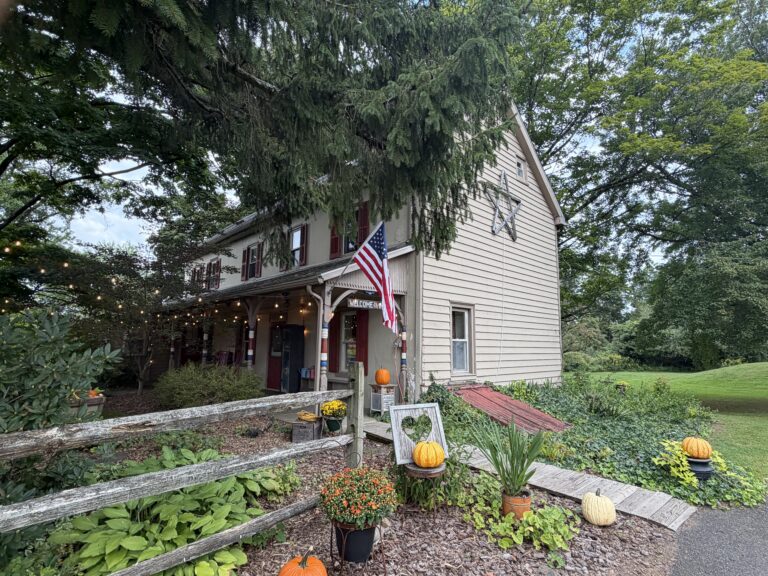
When they began searching for property in Bucks County, finding the right barn was central to their plans. The farmhouse that eventually became Galvanized America Inn was almost an unexpected bonus.
As Sherri remembered it, they arrived looking for a place where Ed could pursue his art and realized that the farmhouse might make a wonderful bed-and-breakfast. They decided to take the opportunity, creating a business that would combine their interests in hospitality, historic preservation, and artistic expression.
The gallery itself occupies a restored early-nineteenth-century bank barn on the property, with Ed’s studio and exhibition spaces surrounded by reclaimed architectural materials. Visitors can find his razor blade art alongside watercolors, drawings, limited-edition prints, handmade furniture, and selected works from other artists.
The setting is particularly appropriate for someone whose creative process has always involved finding possibilities in unconventional materials. But what stayed with me most wasn’t simply the restoration or the artwork. It was the satisfaction Ed expressed when he talked about finally having the space he’d imagined for so long.
“So voilà! At 60 years old, I have my dream gallery,” he told me. I found myself smiling when he said that because there was something wonderful about hearing a person speak so comfortably about a dream that had taken decades to realize.
Twenty-Five Years in Advertising and a Life Beyond Work
During our conversation, Ed explained that his artistic ambitions had existed alongside the practical responsibilities of building a career and supporting his family. “I worked in advertising for 25 years, raised my kids and everything to support our family,” he told me.
“Now it’s your time,” I responded. “Yep,” he said, before mentioning that he was still working on his own longer-term plans for retirement.
I appreciated that exchange because we often frame personal fulfillment and professional responsibility as though they must compete with one another. Yet Ed’s story suggests a more complicated relationship between the two. His advertising career provided professional experience and supported his family, while his artistic interests remained part of his life throughout those years.
Even the discovery of his razor blade technique happened because of his work in an advertising agency. Had he never taken that first job in New York City, he might never have met Henry Jacobs or encountered the unusual collection of blades that inspired his signature work.
I also found it interesting that Ed never stopped describing himself as an artist, even when discussing the years he spent working in another profession. For him, art wasn’t something he eventually decided to pursue after retirement. It was part of his identity from childhood, regardless of what other responsibilities occupied his time.
Sometimes the opportunity to devote more time and space to something we love arrives much later than we originally imagined. That doesn’t make the dream any less meaningful.
My DG Speaks Take: Creativity Doesn’t Follow a Timetable
Meeting Ed Bennett reminded me why I enjoy spending time with artists and other creative people when I travel. I’m fascinated by the ways individuals interpret their experiences and the different paths they take toward expressing themselves.
Ed’s journey included a childhood surrounded by encouragement, formal artistic development, an advertising career in New York City, and a remarkable encounter with materials that most people would never consider using to create art.
Over the years, he experimented with metal finishes, consulted specialists, drew on his automotive experience, and expanded his technique whenever he felt ready to explore something new. Eventually, he and Sherri found the historic Bucks County property that allowed him to bring another part of his vision to life.
His dream gallery now occupies a restored barn beside the farmhouse where the couple welcomes guests to Galvanized America Inn & Art Gallery. I was fortunate to experience both sides of their business during my visit, enjoying the hospitality of the inn while learning about the art and personal histories that make the property so distinctive. For more stories about the people and places I encounter, explore my United States travel coverage.
What I enjoyed most about Ed’s story was how comfortably he spoke about the many years it took to reach this point. There was no suggestion that the decades he spent working in advertising had somehow taken away from his identity as an artist. Instead, those years had contributed experiences, relationships, and practical knowledge that eventually became part of his creative journey.
When I think back on our conversation, I keep returning to that young man carrying 150 pounds of razor blades through New York City, with no idea that the collection would become such an important part of his life. I wonder what Henry Jacobs would have thought if someone had told him those discarded blades would eventually help inspire an entire body of artwork exhibited in a Pennsylvania barn.
Ed certainly didn’t seem to have any grand plan for them at the time. He simply saw something interesting, took it home, and eventually decided to see what he could create. And decades later, I had the pleasure of listening to him tell me the story inside the gallery he’d wanted since childhood.
Visit Ed’s gallery: Galvanized America Inn & Art Gallery is at 6470 Durham Road, Pipersville, Pennsylvania. See the official website for current visitor details and appointments.
Disclosure: I visited Galvanized America Inn & Art Gallery as a hosted guest. My conversations, observations, and opinions are my own.