
CES 2019 Showed Me the Future Is Never Neutral
My CES 2019 experience began with a question that has followed me throughout my career: How does technology shape culture, and how does culture shape technology?
That relationship has always fascinated me. New tools change how we work, travel, communicate, eat, shop, learn, and build relationships. Meanwhile, our values influence which ideas receive funding, who designs them, and whose problems companies choose to solve.
As a cultural critic, I study that constant exchange. A device may impress me, but I also want to know what it reveals about the society that created it.
Curiosity ultimately brought me to Las Vegas for CES 2019.
I genuinely love technology and the possibilities it creates for humanity. At its best, innovation helps us overcome physical limitations, share knowledge, strengthen communities, protect resources, and expand our human potential.
At the same time, unchecked technology can cause harm. Companies can use it to deepen inequality, invade privacy, encourage endless consumption, and place profit above people or the planet.
That tension made CES the perfect playground for both my excitement and my questions.
Why CES 2019 Felt Like a Playground for My Curiosity
CES brings corporations, startups, investors, journalists, designers, engineers, and entrepreneurs into one sprawling marketplace of ideas. Each participant arrives with a different vision of how people might live next.
Some companies aim to transform transportation. Others hope to redesign the home, automate work, improve healthcare, modernize agriculture, or place artificial intelligence inside everyday objects.
According to the official CES 2019 Attendance Audit Summary, the event welcomed 175,212 attendees and covered 2.9 million net square feet of exhibit space. Artificial intelligence, 5G, transportation, resilience, and healthcare ranked among the year’s major areas of innovation.
Those numbers communicate the scale. However, they cannot capture the sensory overload of actually being there.
Rather than feeling like one conference, CES felt like an entire city devoted to technology. Every hallway, ballroom, and exhibition floor revealed another product, demonstration, business model, or competing vision of the future.
I wanted to see everything, which quickly proved impossible.
The event stretched across Tech East, Tech West, and Tech South. Therefore, moving between sections required planning, patience, comfortable shoes, and acceptance that I would miss far more than I could see.
Even so, the enormous scale added to the excitement. Instead of following one narrow track, I could wander, observe, and chase whatever sparked my curiosity.
Technology and Culture Keep Rewriting Each Other
No technology enters the world as a neutral force.
Designers choose what to build. Investors decide which ideas deserve money. Corporations identify profitable customers. Governments determine what they will regulate, encourage, or ignore.
Culture shapes every one of those choices.
Our fears, desires, ambitions, habits, and prejudices influence the products that appear before us. Once those products enter our lives, they begin changing our behavior in return.
Consider the smartphone. It gives us directions, entertainment, work tools, information, and immediate access to other people. Yet it also reshapes our attention, shopping habits, relationships, travel, and experience of public space.
Social media offers another example. These platforms can give people a voice, build communities, and help social movements reach global audiences. However, the same systems can reward outrage, spread misinformation, and transform our personal lives into valuable corporate data.
Innovation expands what people can do. Nevertheless, every new possibility carries cultural consequences.
While walking through CES, I kept returning to that exchange. Each exhibit represented more than a gadget. Behind every demonstration sat assumptions about what people want, what society values, and what the future should become.
Every CES Booth Was Selling a Version of Tomorrow
The strongest CES exhibits did more than present products. They created stories.
One company promised safety. Another sold convenience, freedom, efficiency, sustainability, entertainment, or control.
Those promises matter because most consumers do not buy technology based on specifications alone. We also buy what we believe a product will allow us to feel, accomplish, or become.
A connected home offers comfort and control. Smart vehicles suggest freedom and protection. Wearable health tools promise deeper knowledge of our bodies. Agricultural technology presents the possibility of higher yields and more efficient resource use.
Still, every promise deserves scrutiny.
Does a connected home simplify life, or does it give corporations another stream of personal data? Will automation protect workers from dangerous tasks, or remove jobs without creating fair alternatives? Can agricultural technology support farmers, or will it make them dependent on costly machines and proprietary software?
Innovation becomes meaningful when it solves a real human problem. Otherwise, it risks becoming an expensive performance designed mainly to attract attention and investment.
Watching Familiar Brands Imagine Their Next Chapter
Seeing familiar companies imagine their futures added another layer of excitement to CES.
Brands such as Ford, John Deere, Amazon, and Airbnb interest me because they already influence my daily life and work. Furthermore, each operates in an industry undergoing rapid technological change.
Ford leads me to think about mobility, cities, energy, infrastructure, and personal freedom. In contrast, John Deere connects technology with farming, food production, labor, land, and rural communities.
Airbnb has transformed how people travel and temporarily inhabit other communities. Meanwhile, Amazon has reshaped shopping, logistics, entertainment, publishing, cloud computing, and the way entrepreneurs reach customers.
During CES 2019, Amazon used Alexa and Amazon Web Services to show how its ecosystem could connect homes, vehicles, devices, and daily routines. Its official Amazon at CES 2019 overview demonstrated how voice technology had moved beyond the smart speaker.
That expansion fascinated me, although it also raised serious questions.
As one platform becomes embedded in our homes, cars, businesses, and personal habits, convenience grows. Corporate influence grows alongside it.
I do not view these brands as simple heroes or villains. Their impact remains far more complicated. Instead, I want to understand what they build, what opportunities they create, and what responsibilities come with that level of power.
I explore some of those tensions in my article about how Amazon can empower women and minority-owned businesses. Large platforms can expand access, yet entrepreneurs must still protect their independence, ownership, and customer relationships.
Agriculture Belongs in the Technology Conversation
Many people still imagine farming as separate from advanced technology. My work in sustainable food systems has taught me otherwise.
Modern farmers use sensors, satellite imagery, artificial intelligence, drones, weather data, mobile applications, automated equipment, and digital marketplaces. As a result, technology influences what growers plant, how they use resources, and how food moves from farms to consumers.
Companies such as John Deere interest me because agricultural machinery now sits at the intersection of mechanical engineering, software, data, automation, and environmental management.
Used thoughtfully, these advancements can help farmers conserve water, fuel, fertilizer, and labor. Better information may also reduce waste and improve decision-making.
However, the newest option does not automatically represent the most sustainable one.
A smallholder may benefit more from reliable market information than from an expensive machine. Likewise, a women’s cooperative may need refrigeration, affordable financing, or better roads before adopting a complicated digital platform.
Effective technology must respond to the lived realities of the people expected to use it.
When companies build first and listen later, they often create solutions that communities cannot afford, maintain, repair, or control.
For that reason, true innovation begins with listening.
Sustainability Cannot Remain an Afterthought
Technology can help humanity accomplish extraordinary things. Yet progress cannot come at the expense of the planet that sustains us.
Every device begins with materials extracted from the earth. Manufacturing consumes water and energy, while global supply chains move products across enormous distances before many of them eventually become waste.
Therefore, lower energy use during operation does not automatically make a product sustainable.
Responsible analysis must also consider material sourcing, labor conditions, manufacturing, packaging, repairability, transportation, and disposal.
Planned obsolescence creates another serious concern. Companies release exciting products, then encourage customers to replace them soon afterward. Consequently, that constant upgrade cycle fuels consumption and creates growing mountains of electronic waste.
CES celebrates whatever is new. Sustainability, however, requires us to ask whether new always means better.
A responsible technological future should prioritize durability, repairable designs, renewable energy, ethical sourcing, and systems that prevent waste rather than simply hiding it.
Who Gets to Design the Future?
Beyond the products, I paid close attention to who appeared on the stages, staffed the booths, led the companies, and controlled the ideas.
I wanted to see what Black and brown innovators were bringing to the table. Equally important, I wanted to discover entrepreneurs who understood problems that larger companies often overlook.
Diversity in technology should never function as decoration. It directly affects the quality, usefulness, and fairness of what gets created.
People draw from personal experience when defining problems. Therefore, teams made up of people with similar backgrounds may also share the same blind spots.
A Black engineer may recognize that facial-recognition software performs poorly on darker skin. Women may identify safety concerns that male designers missed. Likewise, a person with a disability can reveal barriers that an able-bodied team never considered.
People from rural communities, developing countries, and low-income neighborhoods may also raise different questions about cost, connectivity, repair, and access.
Inclusion strengthens innovation because it expands the range of human experiences represented during design.
Nevertheless, representation alone cannot create equity. Black and brown innovators also need access to capital, patents, contracts, leadership roles, and ownership.
The future should not merely include our faces. It should also include our ideas, authority, and economic participation.
Global Startups Made CES Even More Exciting
Large corporations naturally attract attention at CES. Still, global startups often captured more of my curiosity.
Young companies frequently approach familiar problems from unexpected directions. In many cases, limited resources force founders to create practical and efficient solutions.
I feel especially drawn to entrepreneurs who build around problems they understand personally. Their ideas often carry a level of urgency that products created solely to fill a market category lack.
One founder may design a health tool after watching a relative struggle to receive care. Another may develop agricultural software because farmers in her community cannot access dependable market information.
Stories like those matter because innovation has never belonged exclusively to Silicon Valley.
Brilliant ideas emerge across Africa, Latin America, Asia, the Caribbean, rural America, and communities that rarely receive equal access to venture capital or global media.
CES gives some of those entrepreneurs entry into an international marketplace of ideas. Even then, simply reaching the exhibition floor does not guarantee attention.
Startups must compete with enormous corporate installations, established media relationships, and brands backed by massive marketing budgets.
Independent journalists and cultural critics therefore serve an important purpose. We can look beyond the largest displays and ask whose ideas deserve a closer examination.
A Star Trek Translator Made Science Fiction Feel Real
One particular exhibit combined my love of travel, culture, and science fiction.
Travis introduced its translation technology with a sign announcing, “The Universal Translator from Star Trek has landed at CES.” Naturally, that message captured my attention immediately.
For me, the universal translator represents one of technology’s most hopeful possibilities. Language differences shape travel, business, relationships, education, cultural exchange, and our ability to understand people beyond our own communities.
A portable device that translates spoken conversation could help travelers move with greater confidence. Moreover, it could support immigrants, educators, international entrepreneurs, aid workers, and families separated by language.

Travis used artificial intelligence to translate speech between languages. By bringing near-instant communication into a pocket-sized device, the company tried to move a familiar science-fiction idea closer to daily life.
Because I have worked internationally and traveled through places where I did not speak the dominant language, that possibility felt deeply personal.
Of course, meaningful translation requires more than exchanging one word for another. Tone, humor, history, body language, local expressions, and social relationships all carry meaning.
No device can fully replace the effort involved in understanding how another person communicates. Even so, translation technology can create an important first bridge.
That distinction captures what interested me most throughout CES. The best technology should not erase the need for human connection. Instead, it should make connection easier to begin.
The Travis display also demonstrated the influence of culture on invention. For decades, Star Trek imagined a future where people from different worlds could communicate across vast cultural and linguistic divides.
Eventually, engineers began turning that fictional possibility into a physical product. Culture inspired the technology, and the resulting technology began changing what people believed could become real.
That cycle explains much of my fascination with CES. Our stories often shape the future long before new technology reaches the exhibition floor.
The American Express Display Understood the Human Experience
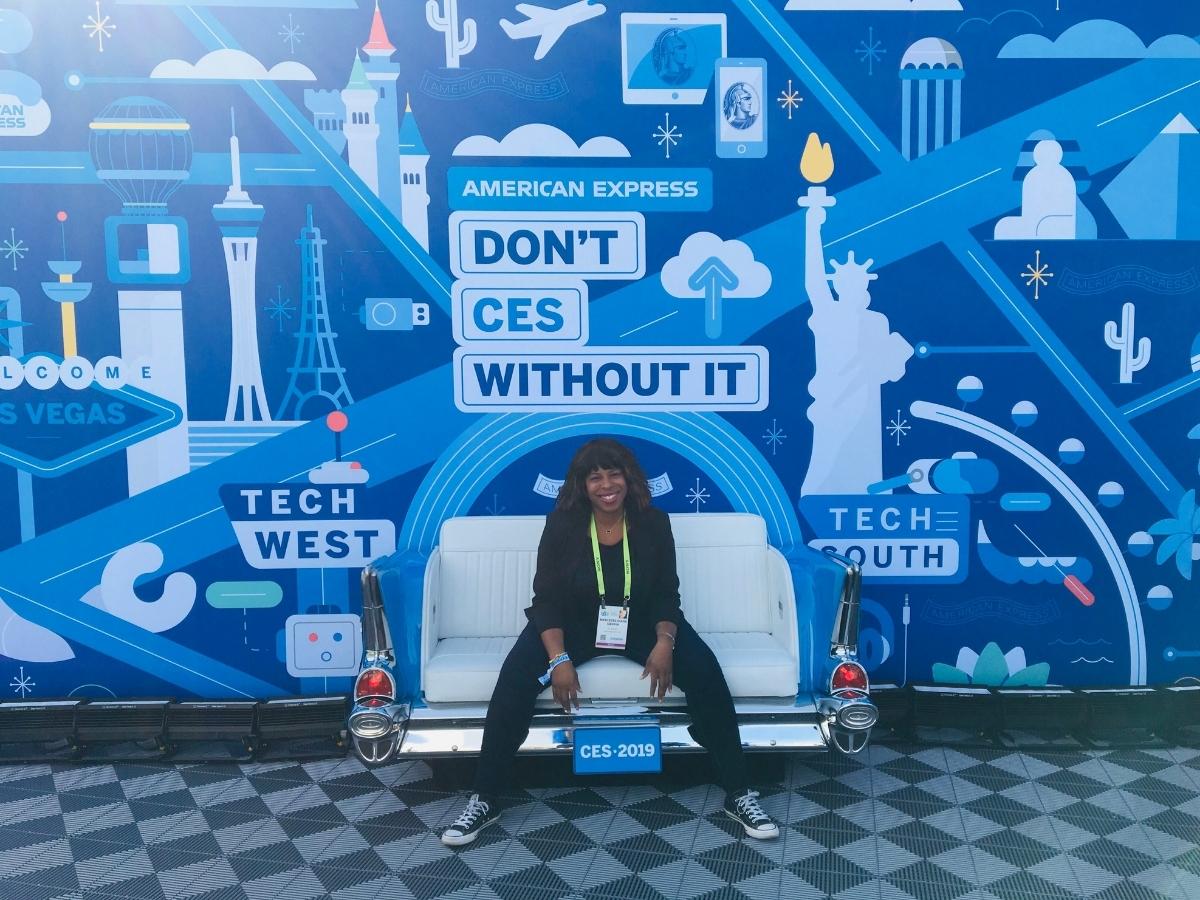
After hours of navigating CES, the American Express “Don’t CES Without It” installation offered a welcome place to pause.
Its bright blue mural featured Las Vegas landmarks, airplanes, mobile devices, and signs pointing toward Tech East, Tech West, and Tech South. In front, a vintage automobile seat invited attendees to rest and take photographs.
What made the activation effective was its understanding of the actual CES experience.
Attendees felt tired. Many carried devices, rushed between appointments, navigated unfamiliar venues, and tried to process an overwhelming amount of information.
Rather than competing with robotics companies or television manufacturers, American Express responded to a simple human need.
That strategy offered a valuable business lesson. Successful companies do not always begin by asking, “What can we sell?”
Sometimes, the better question becomes, “What are people experiencing right now, and how can we improve it?”
I encountered a similar focus on access, relationships, and entrepreneurship at the American Express Summit for Success. Both experiences showed how brands can create meaningful value by understanding the people they hope to serve.
Convenience Always Comes With a Cost
Many CES technologies promised to remove friction from everyday life.
Voice assistants could respond without a screen. Connected devices could adjust homes automatically. Smart vehicles could interpret road conditions and help drivers avoid danger.
These developments offer genuine benefits. For example, technology can increase independence for older adults and people with disabilities. Automation can also reduce repetitive work and free people to use their time differently.
However, convenience often requires an exchange.
Consumers may trade privacy for personalization. Businesses may surrender local control to gain access to a global platform. Meanwhile, households may replace repairable objects with products that depend on software and ongoing corporate support.
People deserve to understand those exchanges before accepting them.
Companies should not hide serious risks inside complicated agreements that few users will ever read. Instead, consumers need meaningful choices regarding privacy, data collection, participation, and control.
Technology should serve humanity. Humanity should never quietly become raw material for technology companies.
CES Also Revealed the Power of Corporate Storytelling
Although CES centers on technology, it also operates as one of the world’s largest storytelling stages.
Companies invest tremendous time and money into turning technical products into emotional narratives.
A vehicle becomes a promise of freedom. Household technology creates a vision of family life. Software transforms into a story about productivity, connection, or personal power.
As a writer and content creator, I study how those narratives work.
I notice which fears brands address, which desires they encourage, and which details they leave outside the polished story.
That same curiosity draws me to South by Southwest, where technology, business, culture, music, and film constantly overlap.
Independent filmmakers often provide a necessary counterweight to corporate messaging. Their work can reveal what happens after the dramatic product launch or carefully staged demonstration.
My coverage of independent film at SXSW explores how filmmakers use human stories to examine innovation, business, power, and social change.
The Future Is Built Through Human Choices
CES 2019 made the future feel close enough to touch. At the same time, it reminded me that the future never simply arrives.
People build it through decisions involving investment, ownership, design, labor, policy, access, and sustainability. We also shape it by deciding which problems deserve attention and whose lives matter enough to improve.
Technology can connect people across borders, expand access to knowledge, strengthen food production, protect health, and give individuals tools that earlier generations could never imagine.
Nevertheless, innovation can also amplify humanity’s worst patterns.
Biased software can automate discrimination. Extractive business models can damage communities more quickly. Disposable products can spread waste around the world.
Innovation alone cannot guarantee progress. Progress requires values, accountability, and intention.
What I Took Away From My CES 2019 Experience
I left CES energized by the possibilities ahead.
Just as importantly, I left with more questions than answers. For a cultural critic, that may represent the most valuable outcome of all.
Across the event, companies imagined new relationships between people, homes, machines, vehicles, farms, cities, and information. Meanwhile, startups from around the world reminded me that creativity belongs to no single country, region, or demographic.
The experience strengthened my belief that Black, brown, female, disabled, rural, and globally diverse voices must help shape technology.
Efficiency cannot remain our only measure of progress. Innovation must also protect dignity, equity, sustainability, freedom, privacy, and human connection.
I plan to keep exploring new products, studying the brands that influence my life, and seeking out entrepreneurs whose work deserves wider attention.
My love of technology remains strong. So does my determination to question it.
Excitement and criticism do not contradict each other. Together, they help ensure that innovation serves people instead of demanding that people serve innovation.
The best technology should help humanity reach its potential without destroying the planet or sacrificing the values that make life meaningful.
That is the future I want to explore. More importantly, it is the future I want us to build.
