Dodge Poetry Festival: Some Stories Were Meant to Be Heard Out Loud
I have always loved people who know how to use words.
Not simply people who can write beautiful sentences, although I appreciate those too. I mean the people who understand that language can challenge, seduce, disturb, comfort, provoke laughter, preserve memory, and occasionally make an entire room sit up straighter.
That is why the Dodge Poetry Festival immediately caught my attention.
The festival returns to Newark, New Jersey, from October 15 through 17, 2026, bringing poets, spoken word artists, musicians, writers, students, families, and people who simply love language into the same city for three days.
And this is not poetry presented as something precious that we must approach with our hands folded.
There will be hip-hop.
There will be open mics.
There will be music.
There will be young people.
There will be writers talking about craft and artists using language to wrestle with culture, identity, justice, and whatever else refuses to stay neatly contained on a page.
Now that sounds like my kind of poetry festival.
Poetry Has Never Belonged Only to the Page
I think many people learn poetry incorrectly.
We encounter it in school as something we are supposed to decode.
What does the poet mean?
What does this symbol represent?
Find the metaphor.
Write the essay.
Pass the test.
Then somewhere along the way, we forget that poetry existed in human culture long before anyone handed a student a worksheet about it.
People told stories aloud.
They sang.
They chanted.
They used rhythm to remember history.
Communities passed knowledge between generations through oral traditions because human beings have always understood that words become different when a living person carries them into a room.
The Dodge Poetry Festival seems particularly interested in reclaiming that experience.
Organizers describe the festival as increasingly focused on poetry as a performing art and a tool for social justice. Its programming pairs poets with musicians and other performers while placing workshops, spoken word, family activities, and professional development alongside more traditional readings.
That combination excites me because language does not have to choose between art and participation.
It can be both.
Patti Smith, Def Poetry and a Room Full of Possibilities
The 2026 lineup already gives the festival an extraordinary range.
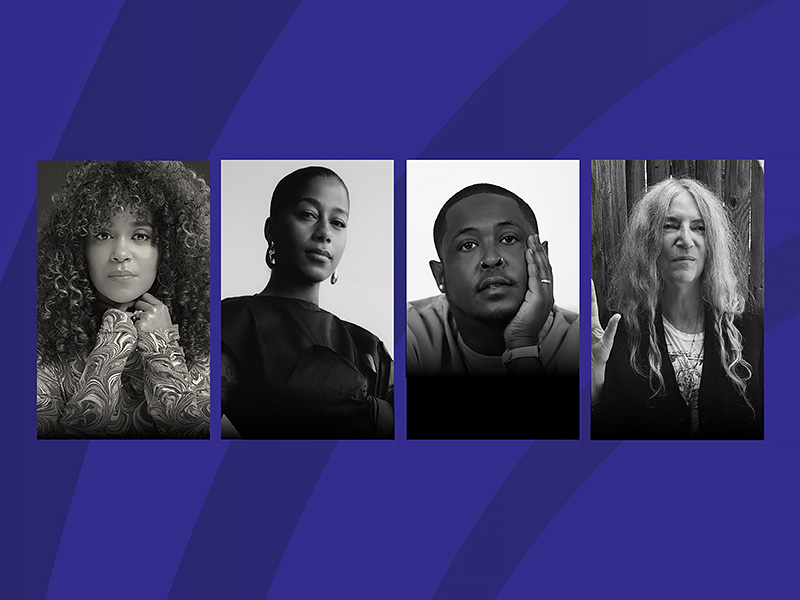
Patti Smith will bring “Songs and Stories” to Newark, connecting poetry with the punk-rock tradition that has defined so much of her creative life.
U.S. Poet Laureate Arthur Sze will participate alongside Pulitzer Prize winner Tyehimba Jess, poet and novelist Elizabeth Acevedo, Terrance Hayes, Naomi Shihab Nye, Aja Monet, Danez Smith, Frank X Walker, Evie Shockley, and many others.
There will also be a Def Poetry Reunion featuring artists connected to Def Poetry Jam.
That one immediately took me somewhere.
For an entire generation, Def Poetry Jam helped demonstrate that poetry could be urgent, contemporary, Black, Latino, political, funny, sensual, angry, theatrical, and completely alive.
You did not need to whisper it in a library.
You could step onto a stage and make people feel something.
Spoken word has always had that power.
The body becomes part of the poem.
Voice becomes part of it.
Timing becomes part of it.
So does the audience.
When Black and Brown Writers Build Their Own Rooms
One of the strongest parts of the Dodge Poetry Festival program is its attention to literary communities that have deliberately created space for writers historically pushed toward the margins.
The festival will feature poets affiliated with Cave Canem, which supports poets of African descent, and CantoMundo, which fosters a community for Latinx poets.
Kundiman, an organization supporting Asian American writers, will also participate.
I am drawn to organizations like these because sometimes inclusion requires more than inviting somebody into an existing space.
Communities also need the freedom to create spaces of their own.
That distinction has followed me through much of my work.
I have seen what happens when people enter a room but do not feel free enough to speak once they get there.
Participation is not simply attendance.
A seat does not automatically produce a voice.
People speak differently when they know the people around them understand their references, histories, humor, frustrations, and cultural language without requiring constant explanation.
Writers need that freedom too.
I Know What Happens When the Room Changes
Years ago, while facilitating training in Egypt, I worked with a mixed group of men and women.
The women participated far less in the larger sessions.
They were physically present, yet presence did not translate into engagement.
So we changed the room.
We held separate sessions with the women, many of whom worked as handcraft artisans while the men primarily worked in agriculture.
The difference was immediate.
Women who had spoken very little became far more comfortable participating in discussions and interactive activities.
Their knowledge had not suddenly appeared.
The environment had changed enough for them to share it.
I think about that experience whenever people assume that creating access automatically creates participation.
It does not.
Sometimes people need spaces where they do not have to fight for permission to finish a sentence.
That is one reason literary communities built around Black, Latinx, Asian American, Indigenous, queer, immigrant, and other identities have played such important roles in American culture.
They give writers somewhere to develop a voice before asking them to perform it for everyone else.
There Is Power in Hearing Someone Tell Their Own Story
I have spent much of my life interested in who gets to tell the story.
Journalism asks that question.
International development asks it.
Gender work asks it.
Media certainly asks it.
Stories about communities can look very different depending on whether outsiders describe them or people speak for themselves.
Poetry gives people extraordinary control over that distinction.
A poet does not need to explain an entire culture.
She can give you one kitchen.
One mother.
One block.
One heartbreak.
One ridiculous family story.
One memory of getting her hair done.
One sentence spoken by a grandmother 30 years ago that somehow survived everything else.
Specificity creates its own kind of universality.
I do not need to have lived your life to recognize something human inside it.
Young People Should Get to Discover That Their Voices Have Weight
The festival is not limiting that experience to established writers.
Young Artists Day will bring thousands of high school students into readings, performances, and programs created for teenage audiences.
I love that.
Young people receive endless messages about preparing for adulthood. Study this. Apply there. Choose a career. Build a résumé. Become productive.
They also need opportunities to discover what they think.
Writing can create that space.
A young person who learns how to shape an idea into language learns something beyond poetry.
She learns that her perspective can occupy space.
He learns that emotion can become expression rather than something to suppress.
They learn that language can help them understand experiences they have not yet figured out how to name.
Those are skills worth carrying into adulthood whether anyone ever publishes a poem.
And Then There Is Something Called Poetry Like Bread
I admit this event won me over almost immediately.
The festival’s “Poetry Like Bread” gathering brings readers together over breakfast with nationally recognized poets.
Food and storytelling at the same table?
You already have my attention.
There is something deeply human about sharing ideas over food.
Across cultures, meals create spaces where conversation changes texture. People linger. Formality softens. Stories emerge that might never appear in a panel discussion.
That is one reason I have always been interested in food as more than nutrition.
Food creates social infrastructure.
A table can become a classroom, a negotiating space, a family archive, or a place where strangers become less strange.
Add poetry and coffee, and I suspect people will leave breakfast carrying more than whatever they ate.
Newark Is Part of This Story Too
The Dodge Poetry Festival has called Newark home through NJPAC since 2010.
I like that the city does not merely function as a venue address.
Newark has its own deep Black, immigrant, artistic, and working-class histories. Holding a festival centered on voice and cultural expression there creates a very different experience than dropping the same event into an isolated convention center somewhere.
If I were traveling to Newark for the festival, I would want to experience more than the performances.
I would leave time to eat, walk around, and understand something about the city hosting all these voices.
For anyone turning the festival into an October getaway, comparing places to stay around Newark through my DG Speaks Expedia shop can help determine whether it makes more sense to stay near NJPAC or somewhere with easy transportation into downtown.
Newark’s proximity to New York can make it tempting to treat the city as somewhere you pass through.
I would resist that.
If Newark is hosting the story, give Newark some attention too.
You Do Not Have to Call Yourself a Poet to Go
This may be my favorite thing about the festival.
You do not need a published collection.
You do not need an MFA.
You do not need to understand every literary reference.
You can simply enjoy words.
The festival includes a free Family Fun Day with poetry, drumming, dancing, and activities at NJPAC’s Chambers Plaza.
An open mic hosted by Newark’s EvoluCulture poetry collective allows festival-goers to listen or step up and share their own work.
Writers who want more structured development can attend Fine-Tune Your Craft workshops created with the Academy of American Poets.
That range makes poetry feel less like a gated cultural institution and more like what it has always been.
A human practice.
Some Words Need a Body Behind Them
I love written language.
I have built much of my own work around telling stories through words.
Still, some language changes when somebody says it aloud.
You hear the breath.
You hear where the speaker pauses.
You notice which word carries anger and which one carries tenderness.
An accent tells you something.
A laugh tells you something.
The moment before an audience reacts tells you something too.
That is the part of the Dodge Poetry Festival I find most compelling.
It treats poetry as something people do together.
For three days in Newark, words will move between stages, classrooms, breakfast tables, outdoor spaces, workshops, and conversations among strangers.
Some will arrive polished.
Others may emerge for the first time at an open mic.
Either way, someone will speak.
Someone else will listen.
And perhaps somebody in that audience will hear a sentence that gives language to something they have carried for years.
That is the beautiful thing about voice.
Sometimes we do not know what we needed to say until someone else says it first.
For schedules, ticket information, and the full lineup as additional events are announced, visit the official Dodge Poetry Festival page at NJPAC.