Black Women Quilts: The Stories Stitched Into Survival
There are some objects that refuse to stay ordinary once you understand who made them.
A quilt can keep someone warm.
It can also carry a family across the country.
That is what drew me into Routed West: Twentieth-Century African American Quilts in California, an exhibition opening September 18, 2026, at the National Museum of Women in the Arts in Washington, D.C.
On the surface, the exhibition is about quilts.
In reality, it is about migration.
It is about Black women.
It is about labor, survival, memory, beauty, family, and the ways people carry pieces of home into places where they are trying to build something new.
Sometimes Home Fits Inside a Suitcase
During the Second Great Migration, millions of Black Americans left the South for cities across the North and West.
Many were escaping Jim Crow segregation, racial violence, and economic limits while searching for work, safety, and opportunity.
Some of the people who traveled west to California carried quilts with them.
That detail stopped me.
Think about what it means to leave somewhere under pressure.
You cannot take everything.
You choose what travels with you.
A quilt can become practical very quickly. It keeps a family warm in a new house or apartment.
But practicality does not explain the whole choice.
Fabric holds memory.
These Quilts Were Never Just Bedcovers
The exhibition brings together more than 80 quilted works spanning roughly 120 years.
Many were made from materials people already had.
Denim.
Work clothes.
Tobacco pouches.
Polyester.
Rayon.
Silk.
Pieces of ordinary life became art.
I love that because women have always created beauty inside spaces that other people dismissed as domestic.
Cooking.
Sewing.
Quilting.
Childcare.
Gardening.
Hair.
Clothing.
We have a long habit of calling things “craft” when women make them in homes and then calling something “art” once institutions decide it deserves a wall.
Routed West challenges that hierarchy directly.
Black Women Have Always Made Art Out of What Was Available
Resourcefulness runs throughout the exhibition.
Minnie Skinner created a “britches quilt” in the late 1940s using repurposed denim, including whole pant legs.
Rosie Lee Tompkins used secondhand jeans in her work, connecting denim to memories of rural Arkansas and her ancestors.
Other artists experimented with satin, nylon, polyester double knits, and whatever materials entered their lives.
There is something deeply Black about that kind of creative resourcefulness.
Make something out of what you have.
Make it beautiful anyway.
Make it useful.
Make it yours.
Then pass it forward.
Women’s Work Has Been Undervalued for So Long That We Barely Notice
This exhibition also forces a larger conversation about labor.
Many of the women represented worked demanding jobs.
Teachers.
Nurses.
Seamstresses.
Truck drivers.
Shipyard workers.
Grocery store managers.
Then they came home and created.
That part feels familiar.
Women have always produced culture around paid work, caregiving, household responsibilities, and everything else required to keep life functioning.
Creative work often happens after the official workday ends.
That does not make it less serious.
For many of these women, quilting offered a space to make something for themselves.
The museum describes that process as meditative, centering, and liberating.
I can understand why.
A Needle Can Carry a Family History
Some of the most moving works in the exhibition are rooted in family relationships.
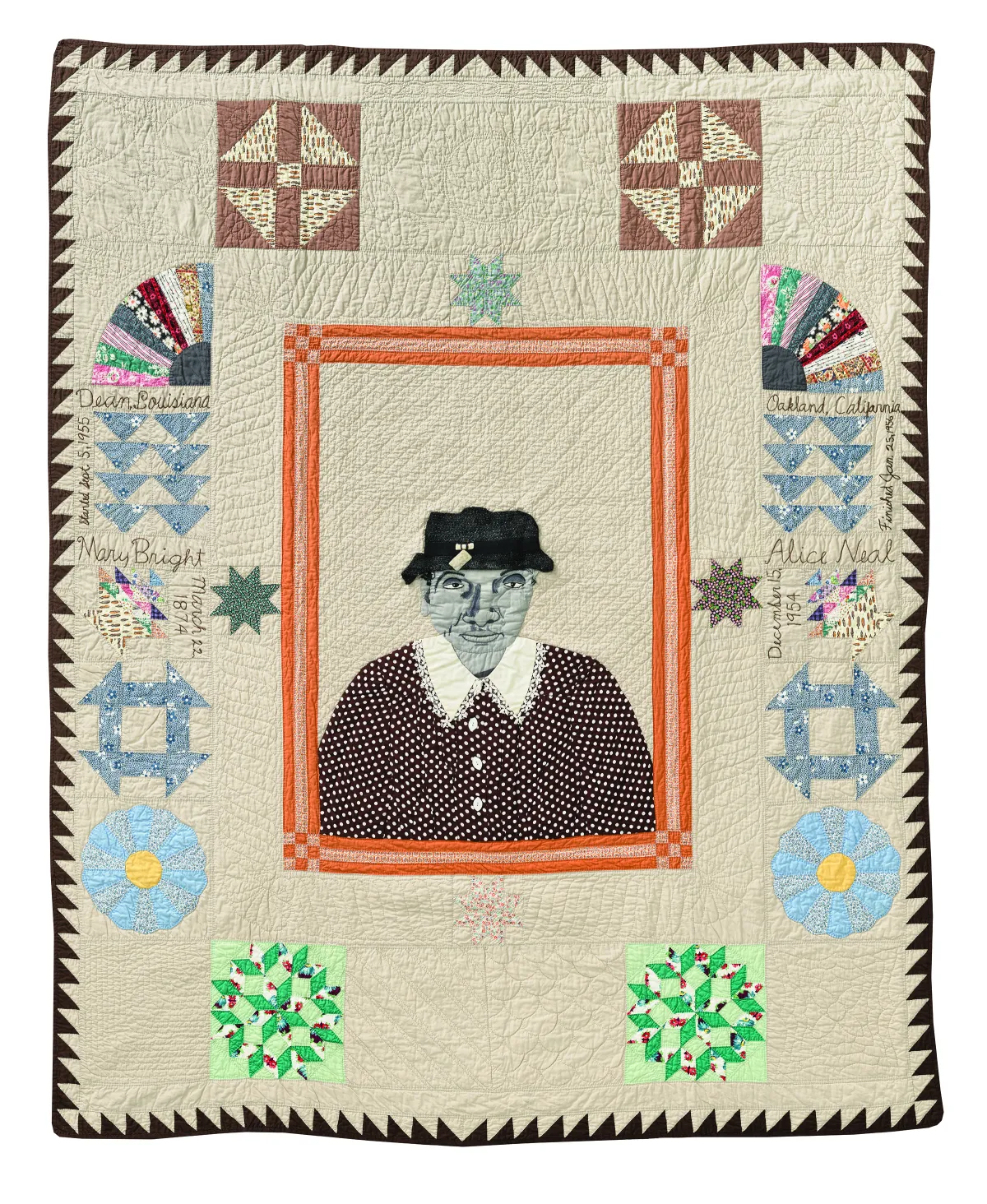
Alice Neal created a quilt in Oakland after her mother died in 1954.
She used leftover fabric from the dress her mother wore in the photograph that inspired the quilt’s portrait.
Even the pattern carried history.
The nine-block design was the first one Neal had learned from her mother.
I cannot think of a better example of an object becoming an archive.
The quilt contains fabric.
It also contains a mother.
A lesson.
A photograph.
A memory.
A relationship.
That is why objects passed through families can carry emotional weight far beyond their monetary value.
We Talk About Archives as Though They Have to Be Written
This exhibition connects directly to something I think about often in my own work.
We tend to treat written documentation as the most legitimate way to preserve knowledge.
Books matter.
Records matter.
Documents matter.
But human beings have always preserved knowledge in other ways.
Through food.
Through songs.
Through stories.
Through farming practices.
Through clothing.
Through patterns.
Through hands teaching other hands what to do.
Quilting belongs to that tradition.
A woman does not need to write a memoir to leave evidence of how she understood the world.
Sometimes she leaves stitches.
Hattie “Strawberry” Mitchell Carried a Whole World Into Cloth
One of the earliest artists represented in the exhibition is Hattie “Strawberry” Mitchell, who was born into slavery in 1854.
Her life crossed extraordinary historical ground.
She lived through slavery, emancipation, Reconstruction, and the decades that followed.
One of her quilts began after a transatlantic journey in 1906.
She created repeating botanical forms based on leaves she collected during the trip and embroidered information about their origins into the work.
I find that astonishing.
Here is a Black woman born into slavery using textile work to document travel, observation, memory, and place.
That is not simply craft.
That is visual storytelling.
The Great Migration Was About More Than Movement
We often describe migration through numbers.
Millions moved.
People left one region and entered another.
Demographics changed.
Labor markets changed.
Cities changed.
Those facts are important.
But migration is also intimate.
Someone leaves a mother.
A church.
A neighborhood.
A recipe.
A dialect.
A familiar landscape.
People carry whatever pieces of that world they can.
For some Black families moving west, quilts became part of that carrying.
Black California Did Not Appear Out of Nowhere
The exhibition focuses on California, which adds another important layer.
Black communities in Oakland, Richmond, Los Angeles, and other parts of the state grew significantly during migration from the South.
People came for shipyard work, defense industries, education, and new possibilities.
They also brought culture with them.
That culture changed once it reached the West Coast.
Migration never leaves traditions untouched.
People adapt.
They mix.
They create something new without completely severing what came before.
One quilt in the exhibition is literally called Cultural Merger at Crossroads, USA.
That title captures migration beautifully.
Sometimes Art Is a Conversation Between Grandmothers and Granddaughters
The section titled Tending Generations may be the part of the exhibition I find most compelling.
It follows quilting knowledge across families.
Mothers teach daughters.
Sisters develop their own approaches.
Grandmothers work with grandchildren.
Technical knowledge becomes relational knowledge.
Lily Chiles created a quilt featuring the African continent with her grandchildren in 1991.
They embroidered the names of African countries into the work together.
That becomes more than a sewing project.
It is an intergenerational conversation about identity.
Who are we?
Where did we come from?
What should you remember after I am gone?
Black Women Have Been Archiving Us All Along
That thought keeps returning to me.
Black women have carried so much cultural memory.
Recipes.
Family stories.
Names.
Photographs.
Funeral programs.
Church histories.
Clothes.
Furniture.
Hair traditions.
Quilts.
Sometimes preservation happens because institutions value something.
Other times, a woman puts it in a drawer because she knows somebody is going to need it later.
That is archival work too.
Craft Is a Gendered Word More Often Than We Admit
NMWA explicitly positions the exhibition as a challenge to the hierarchy between fiber arts and art forms such as painting and sculpture.
I appreciate that framing.
For generations, creative work associated with women has often received less cultural prestige than creative work associated with men.
A painting enters an art history textbook.
A quilt goes on the bed.
Yet both involve composition, color, technique, imagination, symbolism, and extraordinary skill.
The distinction often has less to do with artistic quality than with who traditionally produced the object and where the work took place.
That deserves scrutiny.
These Women Were Not Waiting for the Art World to Approve Them
One thing I love about these stories is that the women were already creating.
They were not waiting for a curator.
They were not waiting for a museum wall.
They were not waiting for somebody to declare that what they were doing counted.
They made things because the work had purpose.
Warmth.
Beauty.
Memory.
Rest.
Family.
Self-expression.
Connection.
That is enough.
The institution arrived later.
I Wish More People Understood Culture This Way
Culture is not only what gets performed on a stage.
It lives in ordinary practices.
How people decorate a home.
What gets cooked on Sundays.
Which fabrics someone saves.
How a grandmother teaches a child to make something.
Which stories get repeated at family gatherings.
These are the places where identity survives when people move.
That is why migration does not erase culture.
People carry it.
Then they reshape it in response to wherever they land.
Some Quilts Carry Labor History Too
The exhibition also connects quilting to Black labor in California.
One contemporary work, United We Win!, emerged from a larger project about the history of Hunters Point Shipyard.
Artists Stacey Carter and William Rhodes worked with African American seniors who had been employed at the shipyard during and after World War II.
That collaboration uses quilting to preserve labor history through the people who actually lived it.
I find that especially powerful.
Workers are often reduced to employment statistics.
How many people worked there?
What did they earn?
When did the industry decline?
Those questions are useful.
But workers also had families, ambitions, discrimination, friendships, routines, and memories.
Art can hold those things in ways a spreadsheet cannot.
This Is Not a Story Frozen in the Past
The exhibition does not end with historical quilts.
Contemporary artists and collectives continue the tradition.
The museum notes that roughly two dozen African American quilt guilds have formed across the United States since 1980.
That continuity feels important.
Black quilting is not simply a tradition we admire because women did it long ago.
Artists are still using fabric to talk about identity, politics, family, history, and the present.
Niambi Clay’s 2025 work Education’s Promise, for example, draws inspiration from Jacob Lawrence’s Migration Series while engaging contemporary civil rights concerns.
The conversation keeps moving.
I Want to See These Women in the Center of American Art History
NMWA Director Susan Fisher Sterling says the exhibition asks audiences to see these quilt-makers not at the margins of art history but as essential figures within American art.
I think that is exactly where the conversation needs to go.
Adding Black women to an existing story is not enough.
Sometimes the story itself changes once we recognize what Black women were already creating.
American art looks different.
Migration looks different.
Women’s labor looks different.
Family history looks different.
Even the idea of an archive starts to look different.
These Quilts Were Keeping More Than Bodies Warm
That is the sentence I keep returning to.
Yes, quilts kept people warm.
But they also carried memory across state lines.
They preserved fabric from people who had died.
They gave women space to create after long workdays.
They taught grandchildren where they came from.
They recorded migration.
They held pieces of old lives inside new ones.
And they survived long enough for a museum audience to look at them and understand that Black women had been making American art all along.
Routed West: Twentieth-Century African American Quilts in California runs from September 18, 2026, through January 17, 2027, at the National Museum of Women in the Arts in Washington, D.C.
For exhibition details and related programming, visit the National Museum of Women in the Arts.