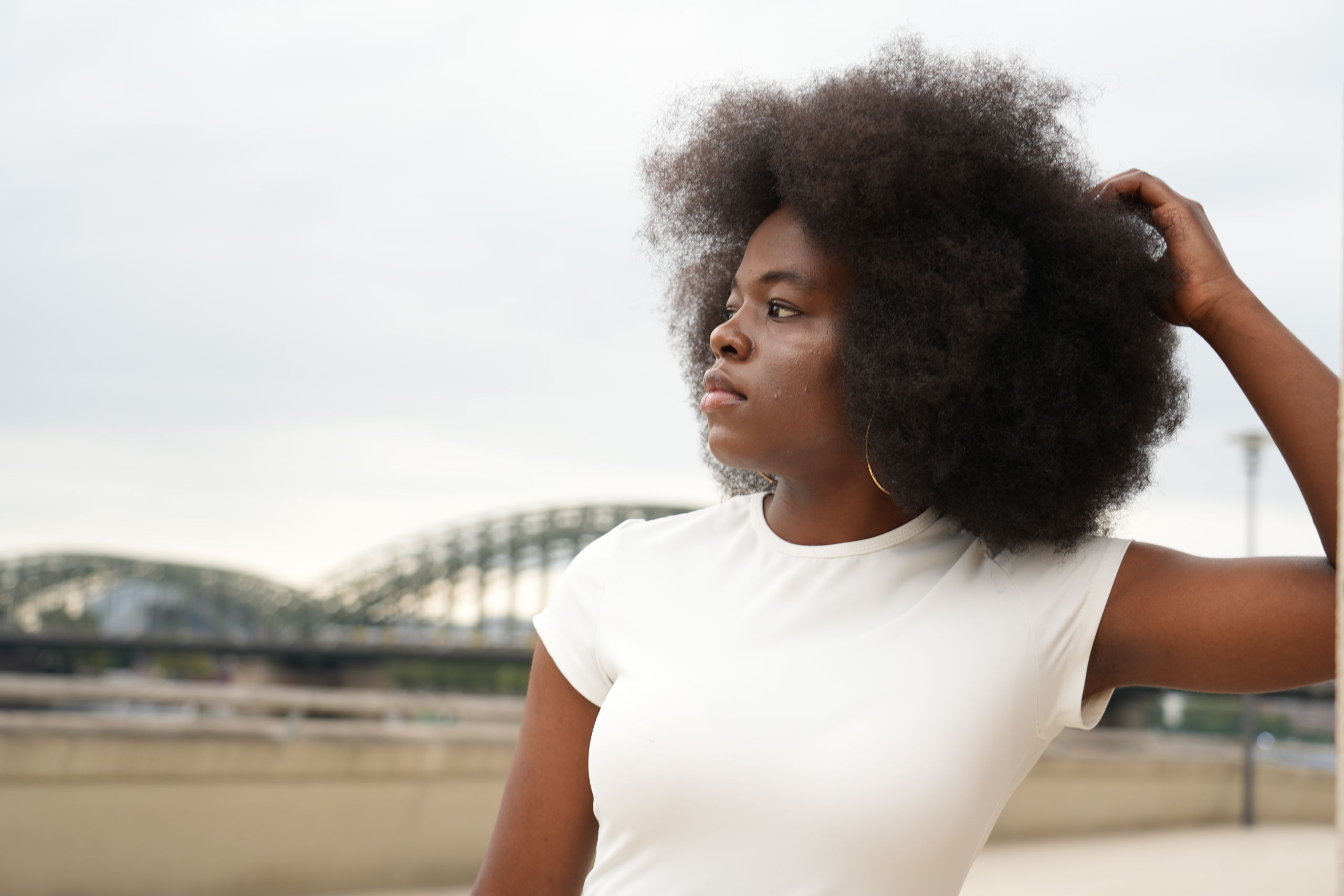
Cutting the Ties: Why Your Hair Doesn’t Define You (And Why That’s a Good Thing)
When My Hair Fell Out, I Had to Find Myself Again
I rarely talk about this period of my life because it is still painful to revisit. Even now, I can remember the fear I felt when I realized my hair was coming out in clumps.
I woke up one day and saw strands everywhere. They were in my hands, around me, and falling away faster than I could understand what was happening.
At that moment, I did not feel calm or rational. I felt mortified. Honestly, I felt as though a part of me was disappearing.
My reaction did not begin with that morning, however. It came from a lifetime of complicated feelings about my hair.
For as long as I can remember, I wanted my hair to look different. I compared it with the long, straight hair of my cousins in Colombia. Meanwhile, I saw my own tightly textured hair as something that needed to be pressed, relaxed, colored, covered, extended, or controlled.
Like many little Black girls of my generation, I spent far too many Saturdays sitting in beauty salons instead of playing freely with my friends.
Those salon visits became part of my routine before I could fully understand the messages behind them. Straight hair looked polished. Long hair looked feminine. Smooth hair looked manageable. Therefore, my natural texture often felt like a problem that adults needed to solve.
By the time my hair fell out, I had spent years connecting my appearance, femininity, and confidence to what grew from my scalp.
Losing it forced me to confront a painful question: Who was I when my hair could no longer carry all the meaning I had placed on it?
Black Women and Hair Loss Carry a Particular Weight
Black women and hair loss cannot be discussed only as a matter of appearance. Hair occupies a powerful cultural, emotional, political, and economic place in our lives.
Black hair can express heritage, creativity, resistance, status, belonging, and personal style. At the same time, society has often treated our natural textures as unacceptable unless we alter them.
For generations, Western beauty standards presented long, straight, silky hair as the ideal. Those standards followed Black women into classrooms, workplaces, military settings, television studios, and professional spaces.
The pressure did not always arrive as an openly racist statement. Sometimes, it appeared through words such as “polished,” “neat,” “professional,” or “presentable.”
Yet those seemingly neutral words often rewarded hairstyles associated with whiteness while treating afros, braids, locs, twists, and other Black hairstyles as inappropriate or distracting.
The U.S. Equal Employment Opportunity Commission states that workplace grooming rules must respect racial differences in hair texture and cannot prohibit a Black woman from wearing a natural afro that otherwise follows a neutral grooming policy.
Still, formal guidance does not immediately erase generations of social conditioning.
Many Black women learned early that changing our hair could influence how teachers, employers, colleagues, romantic partners, and strangers treated us. Consequently, hair became more than a beauty decision. It became a strategy for moving through the world.
The Impossible Standard of “Perfect” Hair
Black women often receive contradictory messages about what our hair should represent.
When we wear our natural textures, someone may call the style unprofessional, political, messy, or unkempt. However, when we straighten our hair, another person may accuse us of rejecting our culture or trying to appear white.
In other words, we can follow every rule and still face criticism.
The expectation of “perfect” hair requires time, money, physical effort, and emotional energy. It can involve regular salon appointments, chemical treatments, heat styling, wigs, weaves, extensions, braids, edge products, and a bathroom full of specialized tools.
Maintaining that image can become exhausting. Moreover, some practices may place stress on the hair and scalp when used too frequently, applied incorrectly, or combined over many years.
The American Academy of Dermatology explains that tight braids, cornrows, locs, ponytails, weaves, and extensions can contribute to traction alopecia when they repeatedly pull on the hair.
That does not mean every protective style causes permanent hair loss. Technique, tension, frequency, scalp health, and individual risk all matter. Nevertheless, pain, persistent pulling, bumps, broken hairs, and a receding hairline should never become the accepted price of a hairstyle.
I wish more of us had learned that lesson before we learned how to tolerate pain in the name of beauty.
The Black Hair Industry Sells More Than Products
The beauty industry did not create every insecurity Black women carry, but it has certainly learned how to profit from them.
Companies sell relaxers, extensions, wigs, styling creams, edge controls, growth oils, dyes, adhesives, and countless other products. Yet behind many of those purchases sits a deeper promise: Buy this, and perhaps the world will consider you more beautiful, desirable, polished, or acceptable.
I explored that complicated history in The Black Hair Industry: A $2.5 Billion Business Built on Racism and Self-Hate.
That article examines how racism and Eurocentric beauty standards helped create an enormously profitable market. However, this conversation must also include health and product safety.
Black women should not have to trade hair acceptance for physical well-being. Nor should products marketed specifically to us escape meaningful research and scrutiny.
Research has raised concerns about some chemical straightening products. For example, a National Institutes of Health study found an association between chemical hair-straightener use and a higher incidence of uterine cancer among participants.
An association does not prove that one specific product caused an individual person’s cancer. Researchers have also called for further study to identify which ingredients may contribute to the observed risk.
Still, findings like these reinforce the need for better research, transparent ingredients, and stronger product safety standards.
That is also why I support the Safer Beauty for All campaign and the call for stronger cosmetic protections. Consumers should not need advanced scientific training or a luxury-sized budget to choose products they can trust.
When My Hair Fell Out, Everything Else Felt Wrong Too
My hair loss did not happen during an otherwise peaceful period. I was already emotionally vulnerable.
A recent breakup had left me depressed. I had gained a considerable amount of weight, and I no longer felt comfortable in my body. Then my hair began falling out.
Each struggle seemed to confirm the worst things I believed about myself. I did not feel attractive. I did not feel desirable. Most of all, I did not feel like myself.
Looking in the mirror became painful because the woman staring back at me felt unfamiliar.
I wish I could say that I immediately understood hair did not determine my value. I did not.
Instead, I grieved.
I grieved the hair I had. I grieved the version of myself I thought I had lost. In addition, I grieved every old insecurity that returned as soon as I felt exposed.
Hair loss may appear cosmetic to someone who has never experienced it. Yet sudden shedding can affect identity, confidence, intimacy, social comfort, and mental well-being.
For Black women and hair loss, those emotions may carry the added weight of cultural expectations and years spent learning that our hair communicates something important about our worth.
My Friends Helped Me See Beyond the Mirror
Fortunately, I did not face that period alone.
My friends kept my spirits from collapsing completely. They listened when I felt afraid and reminded me that life could continue even when I did not recognize myself.
Most importantly, they helped me remember that anyone who genuinely cared for me would not measure my value by the amount of hair on my head.
They reminded me that hair was a covering, not my entire identity.
Their love did not make my fear disappear overnight. However, it gave me a safe place to rebuild my confidence.
Gradually, I began facing the world again. I learned to separate how I looked from who I was, even when the two still felt painfully connected.
That experience also taught me the importance of community. Sometimes, we cannot see ourselves clearly while we are hurting. Therefore, we need people who can reflect our humanity back to us until we recognize it again.
Why Did My Hair Fall Out?
My hair eventually grew back. Nevertheless, it has never returned to the thickness it had before, and it may never do so.
I may also never know exactly what caused the sudden loss.
Stress may have played a role. Hormonal changes may have contributed. Years of chemical processing, coloring, heat, extensions, or tension could have affected my hair and scalp. More than one factor may have been involved.
However, guessing cannot replace a medical evaluation.
The American Academy of Dermatology advises women experiencing hair loss to seek help from a board-certified dermatologist, particularly one familiar with textured hair and conditions that disproportionately affect Black women.
Different forms of hair loss require different responses. Some involve breakage along the hair shaft. Others affect the follicle or cause inflammation and scarring.
For example, central centrifugal cicatricial alopecia, often called CCCA, can cause permanent hair loss when scarring destroys follicles. The condition primarily affects Black women, and early treatment may help prevent additional loss.
That is why sudden shedding, scalp pain, burning, itching, tenderness, bumps, or a widening area of hair loss should not be dismissed as merely cosmetic.
Hair loss deserves compassionate medical attention. It also deserves emotional support because the person experiencing it may be carrying far more than anyone else can see.
The Experience Changed How I Treat Other People
Losing my hair taught me a lesson that reached far beyond beauty.
You never truly know what another person is carrying.
The woman wearing a wig may be expressing her style, protecting her hair, managing alopecia, recovering from illness, or simply choosing what makes her happy. The person who gained weight may be grieving, taking medication, managing a medical condition, or surviving a difficult chapter.
We do not deserve access to every private explanation before deciding to show kindness.
Comments about someone’s hair, body, skin, age, or appearance may seem harmless to the person making them. Yet those words can land on a wound that remains invisible.
My experience made me more empathetic because I understood how quickly confidence could disappear. I also learned how much courage it sometimes takes simply to leave home and allow other people to see you.
No one should intentionally make another person feel small because of how they look.
Black Women Should Be Free to Define Beauty for Ourselves
Society must continue challenging the standards that taught Black women to view our natural features as flaws.
We should be free to wear afros, braids, curls, coils, locs, wigs, weaves, silk presses, cropped cuts, bald heads, or any other style that makes us feel like ourselves.
Freedom also means refusing to replace one rigid beauty rule with another.
A Black woman does not betray herself by wearing straight hair. Nor does she become more authentically Black simply by wearing her natural texture.
The real goal is choice without shame, discrimination, coercion, or unnecessary harm.
We need workplaces that respect racial differences in hair. We need medical professionals trained to recognize hair and scalp conditions in Black patients. Furthermore, we need companies to create products with safety, transparency, and textured hair in mind.
Finally, we need girls to grow up knowing their hair does not need to imitate anyone else’s before it deserves tenderness.
I Am Not the Hair on My Head
My hair has grown back, but I did not emerge from the experience unchanged.
I still care about my hair. I enjoy styling it, experimenting with it, and feeling beautiful. Losing it did not make me stop caring about my appearance.
Instead, the experience taught me that beauty cannot carry the full weight of my identity.
Hair can change. Bodies can change. Health can change. Aging will change all of us if we are fortunate enough to experience it.
Therefore, I needed to build my sense of self on something more enduring.
To my sisters who are struggling with hair loss, thinning edges, scalp conditions, or the emotional weight of changing hair, I want you to know this:
Your hair is not your glory. You are your glory.
Your mind, courage, humor, creativity, compassion, survival, and spirit make you special. Hair may frame your face, but it does not define the life behind it.
I had to lose part of what I thought made me beautiful before I began understanding that I had always been more than my reflection.
My hair is part of my story. It is not the whole story.
Frequently Asked Questions About Black Women and Hair Loss
Why is hair loss common among Black women?
Black women may experience several forms of hair loss, including traction alopecia, breakage, alopecia areata, pattern hair loss, and central centrifugal cicatricial alopecia. Genetics, inflammation, tight hairstyles, chemical processing, heat, hormones, stress, illness, and other factors may contribute depending on the condition.
Can braids, weaves, and extensions cause hair loss?
Styles that repeatedly pull on the hair can contribute to traction alopecia. Braids, weaves, and extensions should not cause persistent pain, headaches, bumps, or excessive tension. Looser installation, breaks between styles, and avoiding repeated pulling around the hairline may help reduce damage.
Can chemical relaxers cause hair loss?
Chemical relaxers can weaken hair and contribute to breakage, particularly when used improperly or combined with other damaging practices. However, several medical conditions may also cause thinning or shedding. A dermatologist can help determine the type of hair loss and recommend appropriate care.
Are chemical hair straighteners connected to cancer?
Some studies have found associations between chemical straightener use and certain cancers, including uterine cancer. An association does not prove that one product caused a particular person’s illness, and researchers continue studying the ingredients and biological mechanisms that may contribute to risk.
When should I see a dermatologist about hair loss?
Consider seeking medical care when hair loss begins suddenly, progresses, creates bald areas, or appears with itching, burning, tenderness, bumps, scaling, or scalp pain. Early diagnosis matters because some forms of scarring hair loss can become permanent.
How can I support someone experiencing hair loss?
Listen without minimizing the emotional impact. Avoid unsolicited comments about appearance and do not pressure the person to explain their health. Offer practical support, affirm their value, and encourage professional care when appropriate.
References and Related Reading
- American Academy of Dermatology: Hair Loss in Black Women
- American Academy of Dermatology: Hairstyles That Pull Can Lead to Hair Loss
- National Institutes of Health: Hair-Straightening Chemicals and Uterine Cancer Risk
- U.S. Equal Employment Opportunity Commission: Race, Hair, and Workplace Grooming Policies
- What’s Hiding in Our Beauty Cabinets? A Plea for Safer Beauty for All
- The Black Hair Industry: A $2.5 Billion Business Built on Racism and Self-Hate
Editor’s note: This article describes my personal experience with hair loss and does not provide medical advice. Hair loss can have many causes. A qualified healthcare professional can evaluate individual symptoms and treatment options.