
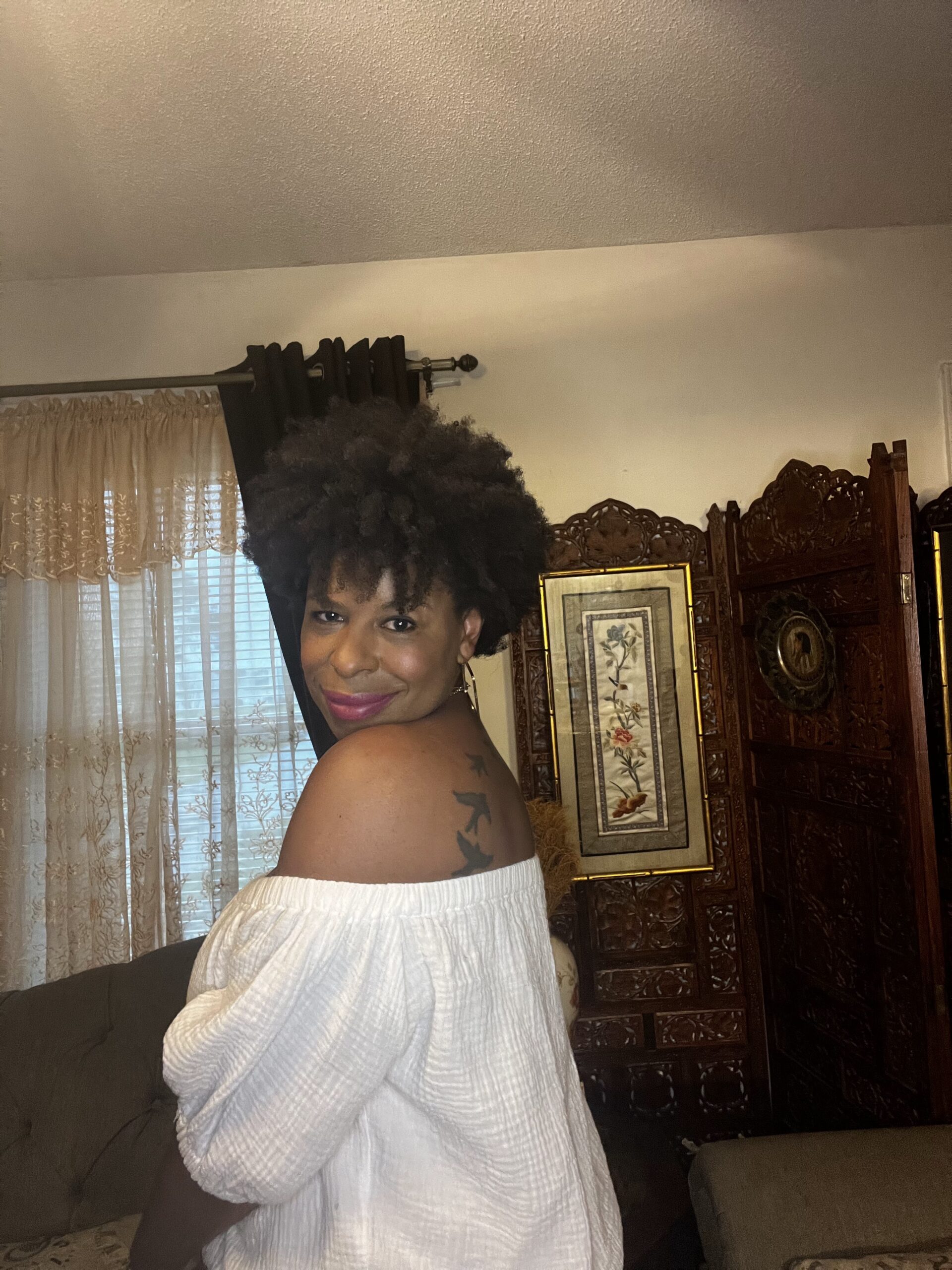
Black Hair Industry – A 2.5 Billion Dollars Built on Racism and Self-Hate
Having a child, particularly a mixed child who struggles with figuring out his place in a racially charged world, has caused me to do a great deal of self-reflection. My approach to parenting has always been grounded in my belief that my job is to guide my child into becoming his best self through the example I set and the experiences we share. I have always raised my son to be a critical thinker, and that has required being willing to engage in uncomfortable conversations.
The Question That Forced Me to Look in the Mirror
Recently, my son has been dealing with the challenge of asserting his identity to other kids who seem to feel as if he doesn’t fit into any of their identity groups. One day, he came home frustrated because several kids at school kept insisting that he wasn’t Black. Then he asked me a question that stopped me in my tracks.
“Did you ever think about the ramifications of having a mixed child before having me?”
The answer was no. I didn’t.
Beauty Standards I Never Questioned
I’m Black, but my mother is Colombian. Black Colombian, but still Colombian. I was raised primarily by her and grew up with a strong connection to my Hispanic culture. My son’s father is Mexican American with Indigenous ancestry, so he has a light brown skin tone. As far as I was concerned, he was also Hispanic.
I never really saw him as separate from me ethnically because I focused on our cultural similarities, not our racial differences. I probably would have viewed things differently had he been white.
That being said, my sister once reminded me that I had always said I didn’t want a child with “nappy hair.” Mind you, I come from a culture and a generation where this is simply how people talked. They may not be so bold as to use the word nappy in public today, but they are definitely saying it at home. I heard countless times growing up that I had nappy hair, and trust me, it was never meant as a compliment.
I think, subconsciously, that might have had something to do with why I fell for my son’s father. I honestly don’t know. What I do know is that I had always imagined my children being lighter than me and having softer hair. It wasn’t necessarily because I believed those traits made someone more beautiful. However, I absolutely associated them with greater social acceptance and an easier life.
The way my son’s father looked probably filled some void in my own identity. On a subconscious level, that may have influenced my desire to be with him. That’s not an easy thing to admit, but it’s the truth.
Growing Up Believing My Hair Needed Fixing
I have had my hair processed for as long as I can remember. Long before I started getting chemical straighteners, I was having my hair pressed. If you’ve never had your hair pressed, consider yourself lucky.
It was a traumatic experience. Someone would slather your hair with grease before forcing it into submission with a scorching hot pressing comb. The comb steamed. It smoked. It burned. If the comb didn’t catch your ear, the steam usually found your scalp. Somehow, all of that pain was simply considered part of becoming presentable.
The $3,000 Wake-Up Call
Last month, I was thinking about my financial goals going into 2020. I’ll be turning 45 this year, and my retirement and long-term financial security have been weighing heavily on my mind. On top of that, my son will be heading off to college in just two and a half years. Believe me when I say that making sure our financial future is secure is not something I’m taking lightly.
As I started building my 2020 budget, I decided to review my spending for all of 2019. I was shocked to discover that I had spent more than $3,000 on my hair alone.
What’s sad is that number only includes the expenses I could easily trace, like wigs, weaves, and braids. Three thousand dollars is a lot of money, y’all.
What’s even sadder is that I probably spent far more than that in previous years because, when I was younger, I practically lived at the salon. Extensions and braids are rarely less than $150. If you want a really good weave, spending $600 on hair isn’t unusual.
If I had invested that same $3,000 every year for the last 20 years at a 6% annual return, I would have accumulated roughly $120,000 instead.
Who Really Profits From Black Hair?
According to Schwartz, the average American spends approximately $89.95 a year on hair care products. A year.
Now tell me this. How many Black women do you know who spend only $89.95 a year on their hair?
According to Nielsen, the Black hair care industry is worth more than $2.5 billion. That figure doesn’t even include hair accessories, wigs, or electrical styling tools, which means the real value of the industry is much higher.
A Women’s Wear Daily report estimated that African American women spend approximately $7.5 billion every year on beauty products.
The sad part is that Black women spend billions on our hair, yet very little of that money finds its way back into our own communities. Much of the hair sold in the United States is imported from countries like India and China, even though the U.S. is one of the world’s most profitable hair care markets.
Even when we’re buying products marketed specifically for natural hair, companies are eager to sell us miracle creams at premium prices. The kinkier the hair, the more moisture it needs. But does that really mean we should spend a small fortune on products that promise to make our curls “more defined”?
There is a reason you rarely see women with tightly coiled 4B or 4C hair featured in natural hair advertisements. Their hair isn’t considered the right kind of natural hair to sell products. That says a lot about the beauty standards we’re still expected to chase.
The $3,000 Wake-Up Call
Last month, I was thinking about my financial goals going into 2020. I’ll be turning 45 this year, and my retirement and long-term financial security have been weighing heavily on my mind. On top of that, my son will be heading off to college in just two and a half years. Believe me when I say that making sure our financial future is secure is not something I’m taking lightly.
As I started building my 2020 budget, I decided to review my spending for all of 2019. I was shocked to discover that I had spent more than $3,000 on my hair alone.
What’s sad is that number only includes the expenses I could easily trace, like wigs, weaves, and braids. Three thousand dollars is a lot of money, y’all.
What’s even sadder is that I probably spent far more than that in previous years because, when I was younger, I practically lived at the salon. Extensions and braids are rarely less than $150. If you want a really good weave, spending $600 on hair isn’t unusual.
If I had invested that same $3,000 every year for the last 20 years at a 6% annual return, I would have accumulated roughly $120,000 instead.
Who Really Profits From Black Hair?
According to Schwartz, the average American spends approximately $89.95 a year on hair care products. A year.
Now tell me this. How many Black women do you know who spend only $89.95 a year on their hair?
According to Nielsen, the Black hair care industry is worth more than $2.5 billion. That figure doesn’t even include hair accessories, wigs, or electrical styling tools, which means the real value of the industry is much higher.
A Women’s Wear Daily report estimated that African American women spend approximately $7.5 billion every year on beauty products.
The sad part is that Black women spend billions on our hair, yet very little of that money finds its way back into our own communities. Much of the hair sold in the United States is imported from countries like India and China, even though the U.S. is one of the world’s most profitable hair care markets.
Even when we’re buying products marketed specifically for natural hair, companies are eager to sell us miracle creams at premium prices. The kinkier the hair, the more moisture it needs. But does that really mean we should spend a small fortune on products that promise to make our curls “more defined”?
There is a reason you rarely see women with tightly coiled 4B or 4C hair featured in natural hair advertisements. Their hair isn’t considered the right kind of natural hair to sell products. That says a lot about the beauty standards we’re still expected to chase.
Beauty, Bias, and the Halo Effect
Even when we don’t have money for food, many of us still feel pressure to spend our last dime on maintaining an appearance that we hope will earn the love and respect that are too often denied to us. Spend one day in the food stamp office and you’ll see exactly what I’m talking about. Those women may be struggling financially, but their hair is done. Better yet, count how many beauty supply stores line the streets in low-income Black neighborhoods, selling products that often contain harmful chemicals while profiting from generations of insecurity.
Toxic ingredients such as lye (found in relaxers) and formaldehyde (found in keratin straightening treatments and Brazilian blowouts) are still commonly used in Black hair salons. Weak federal regulation has allowed cosmetic companies to continue using ingredients that may pose serious health risks.
Source: Sierra Club
I know I need to make changes. I need to do it for my own sense of self-worth, for my financial health, and because I am a mother and an auntie who wants to set a better example. I want my son to know that he can be proud of every part of who he is. I don’t want him growing up believing he has to reject half of himself because his mother rejected part of herself.
People say it’s only hair. I’ve said it’s only hair myself. But we all know that, for Black women, it’s never just hair.
The way I’m treated when my hair is long and straight versus when it’s short and kinky is like night and day. It affects nearly every part of my life. When my hair is long and straight, strangers compliment my appearance throughout the day. When it’s short and kinky, I’m practically invisible except to the occasional construction worker or random man yelling from a passing truck.
I’ve had relationships end because I stopped wearing my hair straight. At one of my previous jobs, my boss nearly had a heart attack because she believed I wasn’t presenting “the right image.”
This isn’t a game.
Research consistently shows that people judged to be physically attractive are also assumed to possess other positive qualities. Psychologists call this the halo effect. Attractive people are often perceived as smarter, kinder, friendlier, and more competent than everyone else.
For Black women, being considered attractive has historically been tied to having straight hair. Even within today’s natural hair movement, the women who receive the most praise often have what society still considers “good hair.”
Experiments have shown that people perceive attractive individuals as more sociable, intelligent, mentally healthy, and socially skilled.
Breaking the Cycle Starts With Me
There is tremendous power and, even more importantly, tremendous pain associated with Black hair. It’s time we stop allowing other people to make billions of dollars from our inability to confront generations of inherited pain and impossible beauty standards.
Two of my goals for 2020 were to improve my mental health and to get my financial house in order. Ironically, those two goals turned out to be deeply connected. Learning to accept myself, including my hair, became part of both journeys.
I know there are many other Black women carrying this same weight. If you’re one of them, I hope you’ll join me.
Let’s break the mold together.
Continue exploring more personal essays, culture, and social commentary on DG Speaks Stories.






This was an amazing piece. Thank you for the honesty.
Incredible article, Mercedes Diane. You are truly an inspiration. Well, I can give a perspective as a Caucasian woman with curly hair. And I can agree with many of your points! Curly hair is thankfully becoming more acceptable now but it is definitely not the standard of beauty in general American culture. Think of any of the movies that involve a makeover- the curly haired girl always ends up getting her hair straightened! (Princess Diaries with Anne Hathaway is a great example. And Hermione! It’s a straight hair bias!) Like most women of any race, I have also gone to great lengths to suppress my curls. When I was in middle school, I knew two curly haired twin sisters who used to iron their hair for each other on the ironing board! I was so jealous that I did not have a twin sister. I fought back my curls for years but eventually I married my husband who is mixed and has sort of kinky hair. He taught me to use ethnic hair products and it made a big difference. How stupid of me not to think of that before! I mostly still tried to pull my hair back but now that I’m older, my face is too angular and I can’t even pull off a ponytail anymore. 😥 I just have to wear two hairstyles all the time. Hairstyle A or Hairstyle B. It’s so repetitive and there is no one in my family to direct me to a salon. But now, from reading your article, I understand that the salon route also may have drawbacks in that it can be costly and time consuming. Is it strange that I carry around a travel-sized bottle of hair product in my purse? Its as important as my wallet!! In some cultures, curly hair is considered beautiful. While living in Peru, I met another pair of sisters with wild curly hair. (Here we would call it frizzy!) They would steal my ponytail holders or playfully slap my hands so that I couldn’t pull my hair back! In 2012, my family and I went to the Philippines to visit my parents who were there for a job opportunity and it was so humid that I had no choice but to wear my hair curly. The weather was hot but there would not be any ponytails for me. Similarly, I hardly ever wear a hat in the cold. As curly haired people know, once you put on a hat, you have to commit to wearing it the rest of the night!! As a parent to kids who are mixed, I have had to sometimes learn things the hard way. You are right it is considered okay and even cute for Caucasian children to have messy hair. Once we had to go to a school play for my son who was 10 or 11. I spent so much time getting him ready that I forgot to take stock of the girls who had been in school all day. My husband was very upset with me when we got into the car and realized that their hair was disheveled. (However, the youngest (strangely) has straight hair so she can get away with more.) Some of my friends with daughters have taught me that Sunday afternoons are for braiding and doing hairstyles, which seems like a really nice weekly tradition. Many of the hairstyles really showcase the curls. Let’s hope this trend continues!