The Cake Slice That Feels Like Permission
I remember sitting at a restaurant table while a generous slice of chocolate cake waited in front of me. The frosting looked almost too rich, and a thin ribbon of sauce curved across the plate. Before I lifted my fork, someone nearby laughed and said, “Well, I guess the diet starts tomorrow.”
I laughed too, although I was not on a diet.
Still, the comment changed the moment. Suddenly, dessert needed an explanation. The cake was no longer simply something beautiful I wanted to taste. It had become evidence in a case against my discipline.
I took the first bite anyway.
The cake was dense, deeply chocolate, and just sweet enough. For a few seconds, every opinion about calories, restraint, aging, and what a woman should eat disappeared. There was only flavor.
That cake slice reminded me how rarely women receive uncomplicated permission to enjoy our appetites. Even dessert can become a negotiation between pleasure and guilt.
I am no longer interested in bringing that argument to every table.
The Cake Did Not Ask for My Confession
Dessert arrives, and women often begin explaining.
We announce that we skipped lunch. Someone mentions the workout planned for tomorrow. Another person asks for several forks because eating an entire portion might reveal too much desire.
The cake remains innocent through all of this.
It did not ask whether I earned it. Nor did it request a complete record of what I ate earlier in the day. It simply arrived on a plate because I wanted something sweet.
I understand the value of nutrition, balance, and caring for my body. However, care and punishment are not the same thing.
A healthy relationship with food cannot grow from treating every pleasurable bite like a moral failure.
Sometimes, I can eat the cake without turning the experience into a public apology.
Women Learn to Make Their Hunger Look Smaller
Appetite carries social meaning, especially for women.
We are encouraged to enjoy food but not too visibly. A woman can appreciate a beautiful meal, yet she should remain controlled, delicate, and slightly detached from her hunger.
Wanting seconds may attract commentary. Ordering dessert after a full meal can inspire jokes about indulgence. Meanwhile, refusing food creates another conversation about restraint, weight, and whether everything is all right.
Our bodies often feel like public property.
People evaluate what we eat, how much space we occupy, and whether our appearance seems to justify our choices. Those judgments become even more intense for women living in larger bodies.
Eventually, many of us learn to monitor ourselves before anyone else can.
We cut the slice smaller, say we are being bad, or pretend we only want one bite.
I want to unlearn that performance.
One Forkful Without a Debate
The first bite of cake can quiet the room inside my head.
I notice the softness of the crumb, the richness of butter, and the way frosting melts across the tongue. Chocolate may carry bitterness beneath the sugar, while citrus adds brightness to a heavier cake.
Those details deserve my attention.
Yet, guilt pulls me away from the sensory experience. Instead of tasting what I chose, I begin calculating consequences.
Presence asks something different.
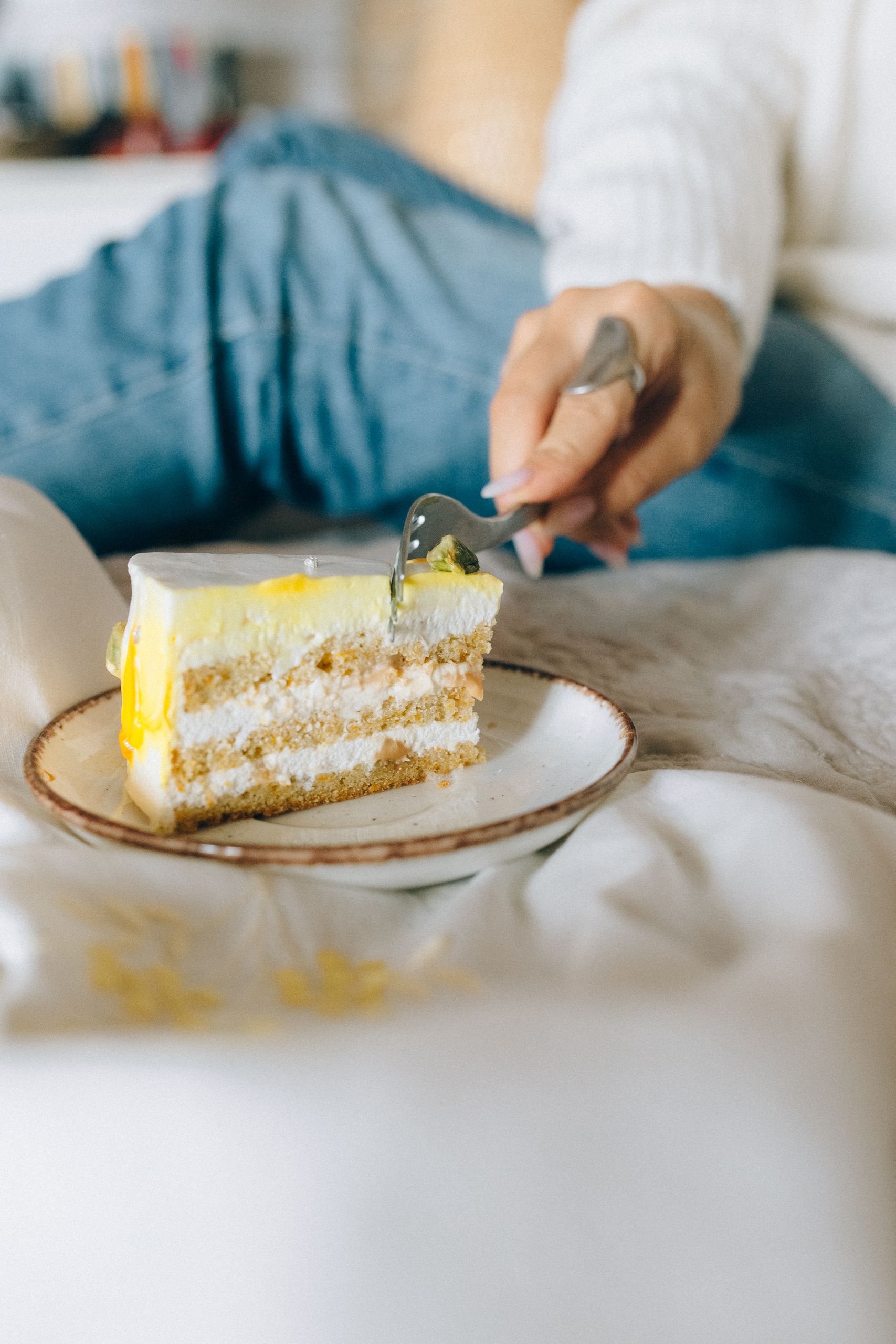
It invites me to place the fork into the cake, take a bite, and remain there long enough to enjoy it.
No sermon needs to follow. I do not have to transform dessert into a lesson about discipline or balance before the plate is cleared.
Sometimes, the fork goes in first, and pleasure gets the final word.
A Birthday Candle Carries More Than Sugar
Cake often marks time.
We serve it when someone enters another year of life. Candles glow, people sing in different keys, and the person at the center of the table makes a private wish.
The recipe may remain the same while everything around it changes.
A childhood birthday cake tastes different years later because memory has joined the ingredients. The frosting may remind me of a relative who always ordered the same flavor or decorated cakes by hand.
Even the imperfect cakes matter.
A layer may lean. Someone spells the name incorrectly, or the candles begin melting before the song ends. Still, the cake becomes part of the story.
Food does that beautifully. It carries emotion long after the final piece disappears.
I explore that connection further in my reflection on how food memories continue to follow us home. Flavor often becomes the doorway through which an entire moment returns.
The Cakes That Lived in Family Kitchens
Not every meaningful cake comes from a bakery.
Some emerge from kitchens where recipes live on stained cards, in memory, or through measurements that sound like “a little more” and “until it looks right.”
Family cakes carry personality.
One person makes the layers too thin but creates the best frosting. Another relative insists on a particular brand of vanilla because the cake never tastes right without it.
These details become tradition.
As children, we may not recognize the labor behind the dessert. Someone bought ingredients, prepared pans, waited for layers to cool, and cleaned a kitchen covered in flour and sugar.
Years later, the cake means more because we understand the care involved.
A homemade dessert can become love translated into butter, eggs, and time.
The Slice That Belonged to a Place
Travel has introduced me to cakes and pastries tied closely to particular cultures.
A dessert may reflect local fruit, religious traditions, colonial history, migration, or ingredients that grow well in the surrounding region. Even familiar cakes can taste different when prepared according to another community’s preferences.
Some cultures favor less sweetness. Others use nuts, spices, cheese, honey, or liqueur in ways that surprise me.
Trying dessert abroad gives me another path into the destination.
I learn when people eat it, which celebrations require it, and whether the recipe belongs mostly to home kitchens or professional bakeries.
A food tour or cooking class can add valuable context. I browse culinary experiences through GetYourGuide when I want to understand the history behind what I am tasting.
The strongest experiences offer more than samples. They explain why the dessert matters.
Pleasure Has Never Needed to Be Productive
Modern life often asks pleasure to justify itself.
A walk should burn calories. A hobby needs the potential to become income, while travel must produce content, growth, or a life-changing lesson.
Even rest gets presented as a strategy for becoming more productive later.
Sometimes, I want pleasure without an assignment.
I want cake because it tastes good.
That desire does not need to improve my résumé, increase my discipline, or teach me something profound. Enjoyment can exist as a complete experience.
This idea connects with my reflections on women, rest, and why softness is not surrender. Women deserve experiences that do not require us to produce, prove, or perform.
Pleasure belongs in that freedom.
Dessert Is Not a Personality Test
Food choices do not reveal someone’s entire character.
Ordering cake does not make me reckless. Skipping dessert does not automatically prove discipline. A person may decline because she feels full, dislikes sweets, or simply wants something else.
Similarly, eating dessert says very little about what the rest of her life looks like.
We create unnecessary moral categories around food.
Salads become good, while cake becomes bad. People feel virtuous after one meal and ashamed after another.
Food affects health, of course. However, reducing every choice to goodness or failure creates anxiety instead of wisdom.
I want room for context.
A cake slice may be part of a celebration, an ordinary afternoon, or a meal shared with someone I love. Its meaning cannot be measured through sugar alone.
The Small Slice Is Not Always the Noble Choice
There is nothing wrong with wanting a small portion.
Sometimes, a few bites provide exactly enough sweetness. At other times, I want the entire slice.
The problem begins when I choose less only because I fear judgment.
I have watched women divide one dessert among several people while quietly wanting more. Everyone takes a tiny bite, praises the cake, and then leaves the table unsatisfied.
Sharing can feel communal and joyful. Yet, it should remain a choice rather than a ritual of public restraint.
I am allowed to order my own dessert.
Likewise, I can stop eating when I have had enough, even when cake remains on the plate.
Freedom moves in both directions.
My Body Is Not a Problem Dessert Created
Women often experience dessert through a larger cultural anxiety about our bodies.
We receive messages about shrinking, correcting, tightening, and controlling ourselves from a young age. The ideal body shifts slightly over time, but the pressure remains.
Food becomes one of the places where that pressure gathers.
A woman may enjoy a meal, then look at a photograph and decide the pleasure was a mistake. Her body becomes evidence against her right to eat freely.
I reject the idea that my body must earn softness, sweetness, or celebration.
My health matters to me. Movement, nourishment, strength, and energy matter too.
Still, health does not require hatred.
I can care for my body without speaking about it as an enemy that needs constant punishment.
Sometimes Comfort Comes With Frosting
Food cannot solve every emotional problem.
Cake will not repair a broken relationship, erase grief, or remove the stress waiting tomorrow morning.
Nevertheless, comfort has value.
A familiar dessert may soften a difficult day. Baking can create a calming rhythm, while sharing cake gives people a reason to gather during moments when words feel inadequate.
Comfort should not become the only tool I use to handle emotion. However, refusing every soothing experience does not make me stronger.
Human beings have always connected food with care.
We bring meals after loss, prepare favorite dishes for celebrations, and offer something sweet when we want another person to feel remembered.
Frosting does not fix life.
It can still make one moment gentler.
The Cake Case Knows How to Make Me Pause
I love walking into a bakery and studying the glass display.
Each cake offers a different promise. Chocolate appears rich and dramatic. Lemon looks bright, while red velvet carries its own nostalgia.
The visual pleasure begins before I taste anything.
Layers, swirls, fruit, glaze, and frosting reflect skill. Someone considered structure, texture, and how the slice would look once the knife moved through it.
Choosing becomes part of the experience.
I may ask what the baker recommends or choose the flavor I rarely make at home. Occasionally, I return to something familiar because memory has already made the decision.
The bakery case invites desire without apology.
I want to meet it with the same openness.
A Beautiful Cake Still Needs to Taste Like Something
Social media has turned cake into visual theater.
Designers create towering layers, sculpted flowers, metallic finishes, and decorations that barely seem edible. I admire the artistry.
Still, appearance cannot replace flavor.
I have tasted beautiful cakes that felt dry, overly sweet, or strangely empty. The photograph promised an experience the fork never delivered.
Meanwhile, a plain sheet cake can become unforgettable when the texture, sweetness, and frosting come together perfectly.
That contrast reminds me not to confuse presentation with pleasure.
The cake must eventually leave the camera and enter the mouth.
Beauty may invite me to the table. Taste determines whether I remember the slice.
Baking Requires More Precision Than My Personality Prefers
Cooking allows improvisation.
I can add more seasoning, adjust the heat, or change direction halfway through the meal. Baking often demands greater obedience.
Measurements matter. Butter needs the right temperature, and opening the oven too early can undo the work.
That precision can frustrate me.
It also teaches patience.
I cannot rush a cake into cooling. Frosting warm layers creates exactly the kind of disaster experience should have prevented.
Useful equipment makes the process easier. I keep some of my favorite kitchen and baking finds in my Amazon shop for anyone building a more practical home kitchen.
Still, tools cannot replace attention.
Cake responds to care, timing, and the humility to follow instructions when necessary.
The Last Piece Always Creates a Decision
A final slice in the refrigerator has its own power.
Everyone knows it exists. People open the door, look at the container, and begin negotiating silently.
Should I leave it for someone else? Divide it? Eat it before it dries out?
The last piece reveals household politics.
Someone may write a name on the container. Another person cuts the slice in half and leaves behind a portion too small to count as generosity.
These moments make me laugh because cake becomes more than dessert.
It represents fairness, desire, and whether anyone feels comfortable claiming what they want.
Sometimes, I eat the last piece.
I simply try not to pretend I was helping everyone by doing it.
I Want a Table With Room for Greens and Ganache
Balance does not require a joyless table.
I enjoy vegetables, nourishing meals, and foods that help me feel strong. I also enjoy butter, chocolate, cream, and sugar.
One pleasure does not cancel the other.
A full life can hold many kinds of nourishment.
Some meals support the body through protein, fiber, vitamins, and energy. Others provide tradition, celebration, connection, or delight.
Often, the same meal offers several of those things at once.
I no longer want to divide food into a battle between health and pleasure.
Instead, I want curiosity, awareness, and enough self-trust to make choices without turning every plate into a crisis.
Let the Woman Have Her Cake
I am tired of watching women shrink their desires before anyone asks.
We say we only want a taste. Then, we praise the dessert while explaining why we should not be eating it.
That language may seem harmless. Repeated over time, however, it teaches us that pleasure requires shame.
I want to speak differently.
The cake looks good, so I ordered it.
I enjoyed the first bite and may enjoy the last one too. Nothing dramatic needs to happen afterward.
Tomorrow does not require punishment because tonight included frosting.
Desire can remain simple.
Sweetness Deserves a Place at the Table
A cake slice can hold celebration, culture, memory, comfort, and pleasure.
It may remind me of a birthday kitchen, a bakery discovered while traveling, or someone who always made the same recipe. Another slice might carry no deeper meaning beyond tasting delicious on an ordinary afternoon.
Both experiences count.
I do not need to earn sweetness through deprivation. Nor must I defend every appetite before allowing myself to enjoy it.
Living fully requires more than avoiding harm.
It also means creating room for delight.
I want tables with nourishing food, honest conversation, and something beautiful waiting at the end. Let the dessert arrive without a confession.
When the fork goes in, I want to taste the cake rather than the guilt someone taught me to serve beside it.
Pleasure deserves its own plate.
I plan to make room for it.
Explore more stories about flavor, memory, and the emotions carried through food in DG Speaks Food. You can also read reflections on womanhood and living freely through DG Speaks Culture and discover desserts, traditions, and culinary experiences around the world through DG Speaks Travel.