The London I Want to See This Time: Romans, Shakespeare, Windrush, and Magic
When I first visited London as a young backpacker, I wanted to see everything. I moved through the city with the urgency of someone who did not know when she might return. Landmarks felt like proof that I had made it there.
Years later, I came back with a partner and experienced another version of the city. Now I am returning alone, with different interests and a much clearer sense of what draws me into a place.
I no longer need London to become a checklist. I want to follow the stories that interest me now: Roman ritual, Caribbean migration, theater, fantasy, food, architecture, and the complicated ways a city remembers itself.
My cultural London itinerary will move between ancient ruins, living neighborhoods, theatrical worlds, and places where history remains visible beneath the modern city. I will not see everything. That is not the goal. I want each experience to deepen the next.
Returning through Brixton and the Windrush story
I want part of my return to London to begin in Brixton. That feels more meaningful than starting only with royal monuments or symbols of empire.
Too many travel itineraries present cities as collections of buildings while overlooking the people whose labor, migration, music, food, and creativity transformed them. Brixton offers a way into London through Black British history and contemporary culture.
The Windrush generation is not a side note in London’s story. Its history opens a much larger conversation about postwar Britain, Caribbean migration, race, citizenship, labor, belonging, and the meaning of home.
As an Afro-Latina traveler and cultural storyteller, I always notice who receives space in the official story of a place. Who becomes a monument? Who gets reduced to a paragraph? Whose food, music, language, and labor shape a city without receiving equal recognition?
Brixton allows me to enter London through a living community rather than through imperial grandeur alone.
Looking across London before entering a fictional world
One part of my itinerary will take me from a panoramic view of London into an entire day of theater. From Sky Garden, I expect to see the physical city spread below me: glass towers, historic buildings, the Thames, crowded streets, and neighborhoods stretching toward the horizon.
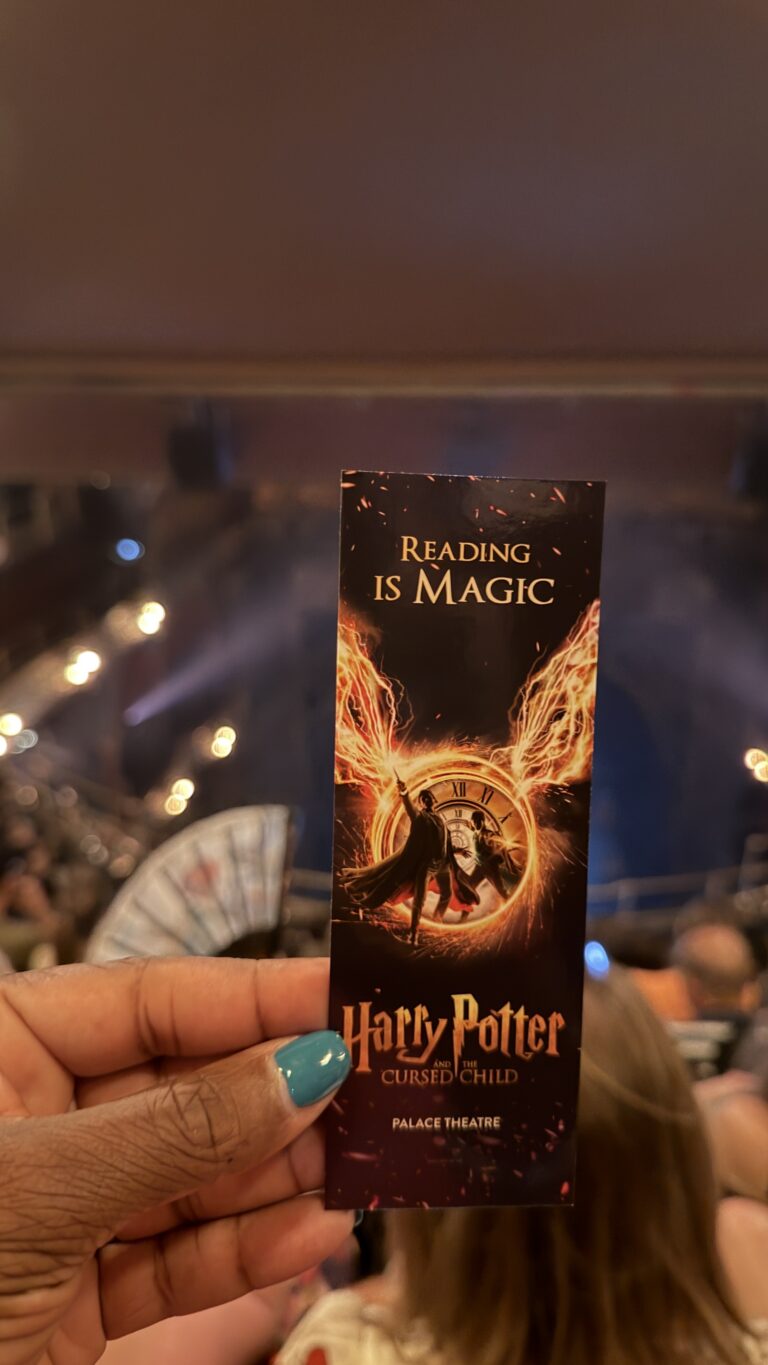
Later, the Palace Theatre will pull me into a fictional version of Britain through Harry Potter and the Cursed Child.
I love that contrast. One experience asks me to look outward across the real city. The other invites me to suspend disbelief and enter a carefully constructed world.
Seeing both parts of the play in one day is a commitment, but immersive theater appeals to me for exactly that reason. For several hours, strangers agree to sit together, focus on the same story, and allow lighting, movement, sound, performance, and imagination to reshape the room.
Theater creates a temporary community. Everyone sees the same performance, yet each person leaves carrying a different interpretation.
Travelers creating their own cultural London itinerary can browse tours, theatrical experiences, and day trips through GetYourGuide or my Viator partner shop.
A day inside Shakespeare’s London
My visit to Shakespeare’s Globe will combine a guided tour, a meal beside the theater, and a performance of A Midsummer Night’s Dream.
This is exactly the kind of day I want in London. I can learn about the history of performance, sit down for a meal connected to the setting, and then watch actors bring a centuries-old play back to life.
The Globe matters because it is not a preserved relic pretending that theater ended with Shakespeare. It remains a working performance space.
Culture stays alive through use. Each generation interprets, challenges, adapts, laughs at, and argues with the stories it inherits. A play survives not because people leave it untouched, but because performers and audiences continue finding new meanings inside it.
The experience also connects naturally to my upcoming walk toward Canterbury. Chaucer and Shakespeare belong to different literary worlds, but both remind me that stories travel. They cross centuries, borders, languages, and social classes. Ordinary people keep reshaping them through performance and retelling.
The London Mithraeum and the spiritual worlds beneath the city
I am especially determined to visit the London Mithraeum. The remains of the Roman Temple of Mithras now sit beneath a modern financial district, creating one of the clearest examples of London’s historical layers.
My interest goes beyond the age of the site. I have always been fascinated by religions and spiritual traditions outside the Judeo-Christian framework that later became dominant across much of the world.
European conquest, colonialism, and slavery helped spread and normalize certain religious traditions while suppressing, replacing, or recasting many others. Ancient sites remind us that human spiritual expression has always been more varied than the traditions that eventually gained global power.
At the Mithraeum, I want to think about ritual, secrecy, community, masculinity, empire, and the movement of religious ideas across Roman territories. The temple cannot provide a complete explanation of what its worshippers believed, but that uncertainty makes the site more compelling.
The visit also connects with my fascination with Stonehenge. The two places come from completely different periods and spiritual worlds. Still, both allow me to consider how people understood the sacred before the religious landscape became familiar to us in its current form.
Stonehenge turns my attention toward nature, astronomy, ancestry, and ceremony. The Mithraeum raises questions about initiation, loyalty, empire, and hidden ritual. Together, they remind me that belief has never taken only one form.
Once I publish my review of the Mithraeum, I will connect it here so the two articles can continue that larger conversation.
Food helps me understand where I am
Food is never separate from culture for me. I have written about why DG Speaks focuses so much on food, and London gives me another opportunity to examine how meals reveal migration, class, labor, neighborhood identity, and history.
A meal near the Globe connects directly to my theater experience. Food in Brixton tells another story, shaped by Caribbean migration and the ongoing evolution of Black British culture.
Cafés will also serve a practical purpose between larger experiences. They give me a place to sit, reset, write notes, observe the people around me, and absorb what I have just seen.
I am not trying to eat everywhere. I want each meal to help me understand where I am.
Building a cultural London itinerary without rushing through it
A short visit requires careful choices. I need enough structure to reach the performances and reservations that matter most. At the same time, I do not want every hour controlled by a schedule.
Some of the best travel moments happen between planned experiences. A walk along the Thames, a conversation over lunch, an unexpected building, or a side street can become as memorable as a major attraction.
I am also traveling with a small amount of luggage because this city stay leads into a multi-day walking journey. Every item needs to work across theater days, cultural visits, travel days, and the road toward Canterbury.
Bagail packing cubes and travel bags can help organize clothing, toiletries, electronics, and walking gear in a limited space.
Reliable mobile data will also help me manage directions, transportation, reservations, and messages. I use Holafly, and the promo code DGSPEAKS is available at checkout.
Travelers looking for accommodation can compare options through my Expedia travel shop or Hostelworld.
The connections matter more than the checklist
At first glance, Brixton, Sky Garden, the Palace Theatre, Shakespeare’s Globe, and the London Mithraeum may appear unrelated. Together, they reveal how London builds new identities over older ones.
Roman ritual sits beneath a financial district. Caribbean migration reshaped neighborhoods, music, politics, and food. Shakespeare’s work continues through live performance. A fictional Britain created for children grew into a global cultural force. Modern glass towers rise above streets carrying centuries of memory.
This layered city is the London I want to experience now.
I am less interested in proving how much I can see than in understanding how the pieces speak to one another. My cultural London itinerary is not a race through famous attractions. It is a conversation among migration, belief, performance, memory, and place.
I want to leave London carrying better questions
London rewards repeat visits because no itinerary can contain it. I will miss important museums, neighborhoods, restaurants, performances, and historic sites. That does not represent a failure of planning. It reflects the scale of the city.
My goal is to leave with something more valuable than a crowded camera roll. I want to understand how London remembers, which histories it elevates, and how living communities continue reshaping the city.
After several days surrounded by theater, migration, ancient ritual, food, and architecture, I will leave London on foot and begin moving toward Canterbury.
The city will remain behind me, but its questions will travel with me. That may be the best result any cultural itinerary can offer: not the feeling that I have finished a place, but the certainty that I now have more reasons to return.