The Hunger Games and the Politics of Food
Every time I revisit The Hunger Games, I notice the food before almost anything else. Not because the meals are glamorous, although the Capitol certainly tries. I notice the food because Suzanne Collins understood something deeply political: hunger is never just hunger when someone else controls the table.
Across Panem, every loaf of bread, every bowl of stew, every lavish Capitol banquet, and every empty pantry tells us who has power and who does not. Food becomes currency. It becomes propaganda. It becomes punishment. Most importantly, it becomes one of the story’s clearest symbols of resistance.
Watching the films now, after years spent working in international food systems and agricultural development, I find myself paying as much attention to the politics of food as I do to Katniss’s arrows. Collins built a dystopian world where hunger is manufactured, dependence is engineered, and abundance is reserved for the people already holding power. That may be fiction, but the questions it raises are painfully real.
The Capitol Controls Dinner Before It Controls the Arena
The Capitol does not control Panem with Peacekeepers alone. It controls people by controlling dinner. District families do not simply experience hunger as an unfortunate condition. They live under a system that makes scarcity part of governance.
That distinction matters. Hunger in Panem does not happen because the land cannot produce enough food. The districts produce coal, grain, luxury goods, technology, and labor for the Capitol. Yet the people doing the work remain dependent, watched, and underfed.
Anyone who has worked around food security knows that hunger often tells us more about power than production. The world already grows enough food to feed people, but access depends on income, conflict, infrastructure, climate, policy, and distribution. The World Food Programme continues to show how hunger connects to inequality and crisis across the real world.
Panem exaggerates that truth until we cannot look away. The Capitol turns food into leverage. It keeps people surviving just enough to work, but hungry enough to remain afraid.
The Capitol Feast Is Not Just Excess
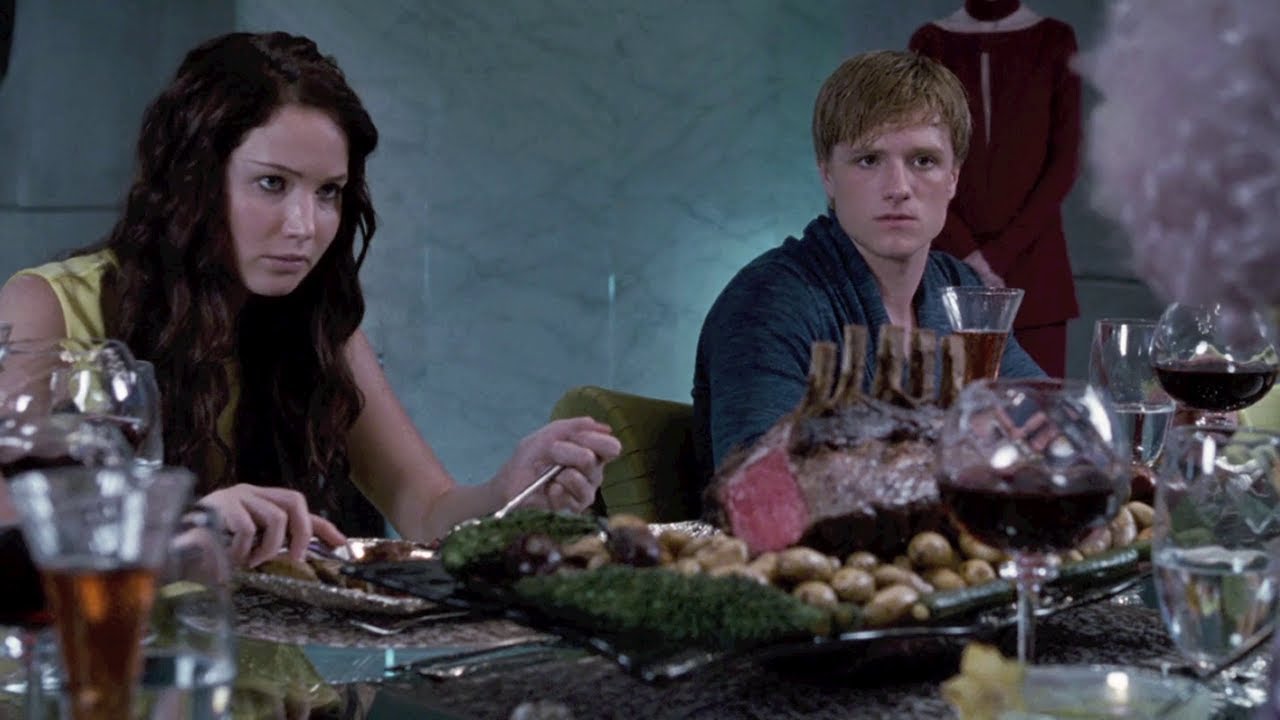
The Capitol’s food scenes are disturbing because they are beautiful. Tables overflow. Colors pop. Costumes sparkle. Plates look like art. Yet the beauty feels rotten because we know who paid for it.
Visually, the films understand that contrast. District 12 feels gray, worn, and practical. The Capitol feels artificial, sugary, theatrical, and swollen with abundance. Production design does a lot of quiet storytelling here. Before anyone explains inequality, the sets and costumes have already shown it to us.
That contrast becomes even sharper when Capitol citizens casually waste food or treat excess as entertainment. Their relationship to food has moved beyond nourishment. It has become performance. They consume because consumption proves status.
Meanwhile, Katniss knows exactly what food costs. She knows the weight of a squirrel, the value of a trade, and the relief of feeding her family for one more day. The Capitol eats for pleasure. District 12 eats against fear.
Bread Carries the Whole Story
One of the most important food moments in The Hunger Games is not a feast. It is bread, burnt and thrown in the rain.
When Peeta gives Katniss bread, he does more than offer food. He offers mercy inside a system designed to make mercy dangerous. That moment matters because kindness becomes a small rebellion before either of them knows rebellion is coming.
Bread also carries memory. Katniss never forgets it. The gesture becomes part of how she understands Peeta, debt, survival, and trust. In a world where hunger teaches suspicion, one loaf reminds her that people can still choose generosity.
Later, when District 11 sends bread after Rue’s death, the symbol grows even larger. A district that has so little still chooses to share. That gift breaks through the Capitol’s divide-and-conquer strategy. Food becomes grief, gratitude, solidarity, and defiance all at once.
Katniss Knows the Food System From the Ground Up
Katniss survives because she understands food beyond the plate. She knows the woods. She knows plants, animals, snares, hunger, barter, and risk. Her knowledge comes from necessity, but that does not make it less sophisticated.
This is where my food systems brain kicks in. Formal systems often dismiss the expertise of people who survive closest to scarcity. Yet Katniss’s informal knowledge keeps people alive. She can read landscape, season, danger, and opportunity because hunger trained her to pay attention.
That kind of practical intelligence reminds me of the conversations I have had with farmers, cooks, mothers, traders, and rural organizers around the world. Many of them may not use academic language, but they understand resilience because they practice it daily.
That is why I often return to women’s wisdom in sustainable food systems. Food knowledge does not only live in laboratories or policy papers. Sometimes it lives in the person who knows how to stretch a meal, read the weather, find food in a hard season, and keep a family moving.
The Arena Turns Scarcity Into Entertainment
The Hunger Games are cruel because they turn survival into spectacle. Tributes do not only fight one another. They fight thirst, hunger, exposure, injury, fear, and the knowledge that someone is watching their suffering for entertainment.
Food inside the arena becomes another form of control. Sponsor gifts can save a life, but they also remind tributes that help depends on performance. Supplies become bait. Scarcity becomes drama. Survival becomes content.
That part feels especially chilling now. We live in a world where hardship can quickly become something people watch, debate, brand, and monetize from a distance. The Capitol simply takes that impulse to its most grotesque conclusion.
Still, Katniss and Rue interrupt the logic of the arena. Their alliance turns care into strategy. Their shared food becomes a rejection of the Capitol’s demand that everyone treat one another as disposable.
Food Reveals Who Gets to Be Human
Food in The Hunger Games also reveals whose humanity the system recognizes. Capitol citizens enjoy culinary excess, aesthetic pleasure, and choice. District citizens receive rationing, hunger, and punishment. That difference tells us who gets treated as fully alive.
This is why food justice cannot be separated from dignity. When people cannot access enough food, they lose more than calories. They lose security, choice, health, time, and sometimes the ability to imagine beyond the next meal.
Collins understands that deeply. She does not use hunger as background mood. She makes it part of character development, worldbuilding, and political critique. Katniss’s hunger shapes how she loves, how she fights, and how she understands the Capitol.
That is also why The Hunger Games sits so naturally beside other food and science fiction conversations. In another imagined future, food technology raises questions about abundance and tradition. In Panem, food asks a harsher question: what happens when abundance exists, but power decides who deserves it?
The Rebellion Begins Before the Mockingjay
Before Katniss becomes a symbol, she feeds people. She hunts for Prim and her mother. She trades. She shares with Gale. She cares for Rue. She recognizes hunger in others because she knows it in her own body.
That matters because rebellion does not always begin with a speech. Sometimes it begins with care. A person refuses to let someone else starve. A district sends bread. A girl covers a child’s body with flowers. A tribute threatens the logic of the Games by choosing love where the Capitol demands spectacle.
Those small acts become politically dangerous because they remind people of their connection to one another. The Capitol depends on isolation. Food creates relationship.
Once people begin to see each other across district lines, the system starts to crack.
What Panem Still Teaches Us
The Hunger Games remains powerful because its dystopia feels recognizable. We may not live in Panem, but we do live in a world where food access reveals power. Some communities face hunger while others waste abundance. Some workers grow food they cannot afford to buy. Some families must choose between meals, medicine, rent, and transportation.
That reality makes the story more than entertainment. It becomes a way to talk about food justice, inequality, labor, gender, and political control without sounding like a policy brief.
Good speculative fiction does that. It exaggerates the world until the truth becomes easier to see. Panem horrifies us because it feels invented, but not impossible.
For more on why food carries culture and power, I also think about the way meals tell stories about place. Whether we are looking at a real table or a fictional one, food always tells us more than people think.
DG Speaks Take
The Hunger Games uses food brilliantly because it understands hunger as political. Bread, hunting, feasting, rationing, and sharing all reveal who holds power and who refuses to surrender dignity.
For me, that is what makes the story endure. Food can control people, but it can also connect them. A loaf of bread can become mercy. A shared meal can become solidarity. A hungry girl with a bow can become the beginning of a revolution.