Éramos Só Putos Review: The Softness So Many Films Are Afraid to Give Young Men
Some coming-of-age films try so hard to capture youth that they end up feeling artificial. Often they are overly polished, dramatic, and very aware of themselves. Éramos Só Putos (We Were Just Brats) is the opposite. I saw this film at the 2026 IndieLisboa Film Festival and was blown away.
The film feels intimate in a way that almost catches you off guard. It doesn’t announce its emotional weight loudly. It lets it build slowly through glances, silence, uncertainty, awkwardness, closeness, and the kind of emotional tension that feels painfully familiar when you’re young and still figuring yourself out.
And honestly, that restraint is what makes the film work so well.
The Film Understands That Identity Is Rarely Simple
One thing I appreciated immediately is that the film never treats identity like a clean or straightforward journey.
The boys in this story are navigating friendship, attraction, masculinity, vulnerability, and emotional belonging all at the same time. And none of it feels neat.
Because for so many young people, especially queer youth, identity is not something that arrives fully formed. It develops in fragments. In moments. In confusion. In silence. In spaces where people are still trying to understand themselves before they ever explain themselves to anyone else.
And Éramos Só Putos understands that beautifully.
The film allows emotional ambiguity to exist without trying to force certainty too quickly.
Masculinity Feels Different Here
As a boy mom, I loved the way the film handles masculinity.
So many films about young men still operate from the assumption that vulnerability is weakness or that emotional softness eventually needs to be corrected.
This film doesn’t do that.
Instead, it creates space for tenderness.
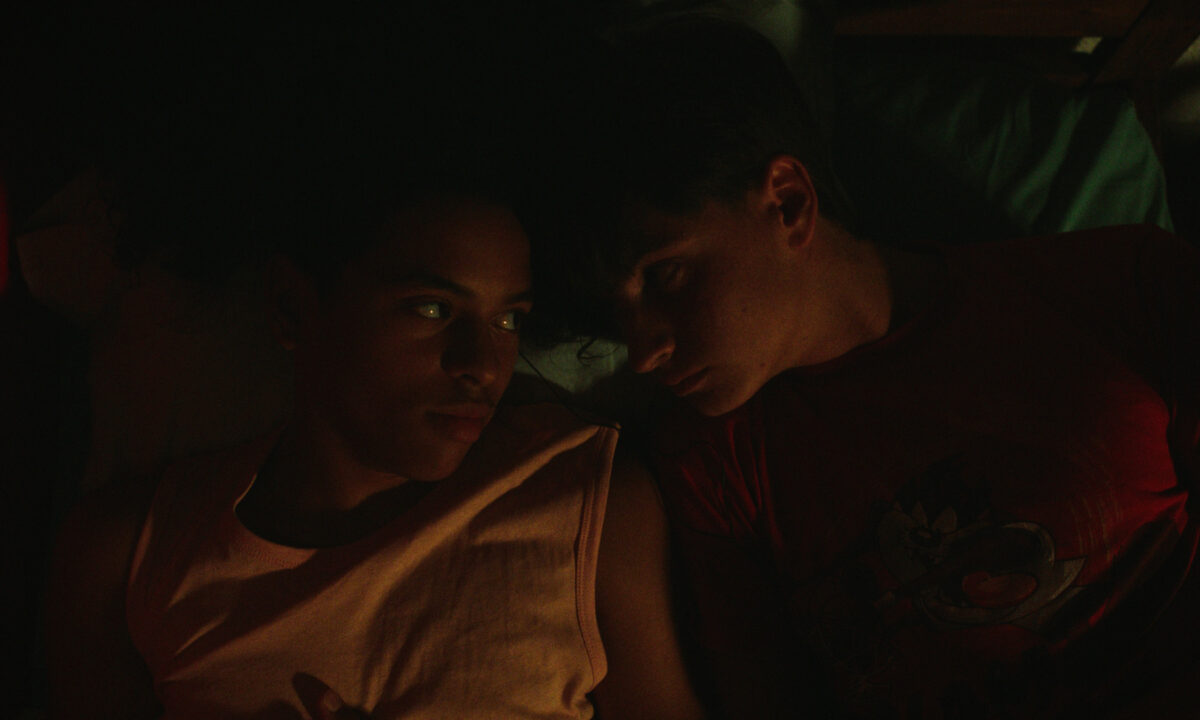
The boys are allowed to exist inside uncertainty without the film punishing them for it. They are emotional with each other. Curious about each other. Protective of each other. And the film treats those moments with care instead of turning them into spectacle.
Honestly, that emotional softness is what gave the story its power for me.
Because we rarely allow boys to simply be emotionally vulnerable without attaching shame to it.
The Quietness of the Film Is Actually Its Strength
There’s something very confident about how restrained this film is.
It doesn’t rely on dramatic confrontations or oversized emotional moments to communicate what the characters are feeling. Instead, it trusts viewers to sit inside the awkwardness and emotional uncertainty alongside them.
And because of that, the relationships feel authentic. A big part of that comes from the incredible performance by Afonso Santos. He brings so much depth to Joal, often saying more through facial expressions and body language than dialogue ever could.
Nothing about the film felt emotionally manipulative to me. It felt observed rather than manufactured.
At times, it almost felt like watching memories unfold instead of scenes being performed.
That naturalism made the emotional moments land harder.
This Film Hits Different
Watching Éramos Só Putos, I kept thinking about how rare it still is to see queer stories centered this gently.
So many films still frame queer identity through trauma, spectacle, conflict, or tragedy. And while those stories absolutely have their place, there is something powerful about a film that simply allows young people to exist inside emotional complexity without forcing them into extremes.
This film understands that vulnerability itself can be cinematic.
And honestly, I think that’s why it connected with me.
What Becoming Actually Looks Like
At its core, Éramos Só Putos is not really a film about dramatic transformation.
It’s about becoming.
It’s about the fragile, uncertain, emotionally messy process of trying to understand yourself while also trying to understand how other people see you.
And the film approaches that process with an honesty and tenderness that feels increasingly rare.
By the end, what stayed with me most wasn’t a specific scene or dramatic moment.
It was the emotional atmosphere. The film was refreshingly about softness, uncertainty, and humanity. That’s what made the it powerful and memorable.