John Deere at CES 2021 Put Smart Farming in the Spotlight
John Deere at CES 2021 offered a powerful reminder that some of the world’s most advanced technology does not sit on a desk or fit inside a pocket. Instead, it moves through fields, responds to unpredictable conditions, and helps farmers harvest the food that sustains us.
CES 2021 took place entirely online because of the COVID-19 pandemic. Although I could not walk through a physical John Deere exhibit that year, I remained interested in what the company brought to the global technology conversation.
My previous CES experiences had already strengthened my fascination with agricultural technology. Therefore, I paid close attention when John Deere’s X Series combines received recognition in the Robotics category of the 2021 CES Innovation Awards.
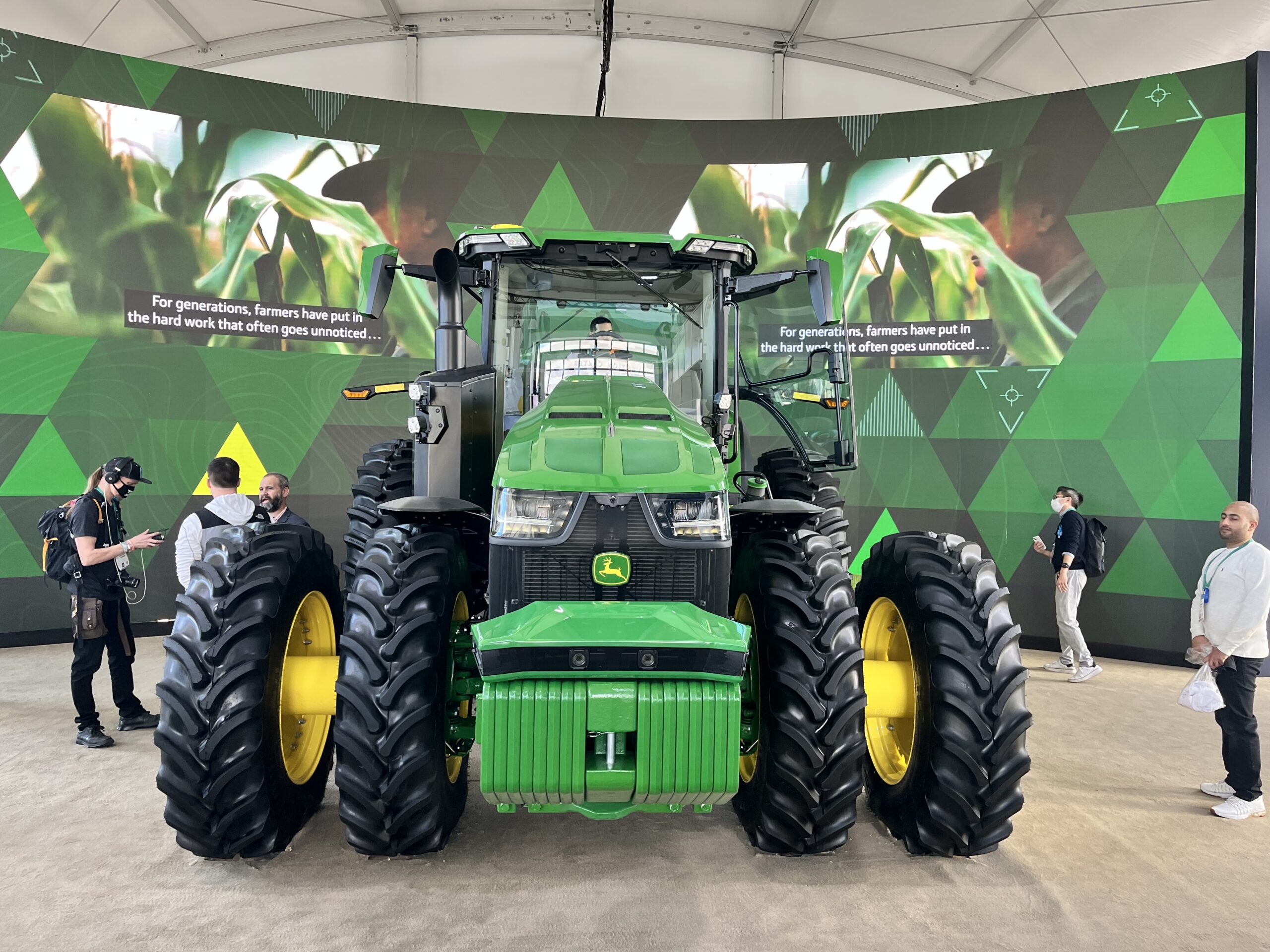
At first glance, a combine may look like an enormous piece of farm machinery. However, the X Series functions as much more than a mechanical harvester.
Artificial intelligence, computer vision, cameras, sensors, automation, connectivity, and machine-to-machine communication help the combine observe changing conditions and adjust its performance. Those systems allow farmers to make more informed decisions while working within one of agriculture’s most critical periods.
For me, the story was not simply about a prestigious award. It was about how quickly farming had become a central part of the technology revolution.
CES 2021 Brought the Technology Show Into Our Homes
The pandemic transformed CES 2021 into an all-digital event. Instead of filling convention centers, hotel ballrooms, and exhibit halls in Las Vegas, companies introduced products through virtual demonstrations, interviews, presentations, and immersive online experiences.
That shift changed the physical energy of CES. Nevertheless, it also gave brands an opportunity to think differently about how they explained complicated technology.
John Deere used the virtual format to bring viewers closer to the realities of farming. Digital experiences helped audiences see machinery, soil, planting systems, and precision technology without physically traveling to a farm.
This approach mattered because most consumers rarely witness food production firsthand. We see groceries on store shelves, yet the machinery, labor, timing, science, and risk behind each harvest often remain invisible.
By participating in CES, John Deere helped place those realities before an audience accustomed to smartphones, televisions, gaming systems, and connected homes.
Agriculture belonged in that conversation because farming increasingly depends on software, data, cameras, sensors, automation, and artificial intelligence.
Why the X Series Combine Earned CES Recognition
John Deere’s X Series combines became 2021 CES Innovation Awards Honorees in the Robotics category. The recognition celebrated the machines’ engineering, design, connectivity, and intelligent capabilities.
John Deere described the X Series as a line of smart, highly automated combines designed to help farmers harvest more efficiently while protecting grain quality.
The largest model, the X9 1100, could thresh, separate, and clean more grain within a limited amount of time. According to John Deere, it could harvest up to 70 percent more wheat per hour than previous models under comparable conditions.
Greater capacity becomes especially valuable when farmers face narrow harvest windows. Rain, wind, moisture, temperature changes, and crop maturity can quickly affect quality and yield.
Therefore, speed does not simply create convenience. It can help a farmer protect an entire season of work.
Still, the X Series recognition extended beyond horsepower or machine size. Its most important advances involved the technology helping the combine see, interpret, communicate, and respond.
John Deere’s official announcement about the 2021 CES Innovation Award details the computer vision, artificial intelligence, sensors, connectivity, and automation included in the X Series.
Understanding What a Combine Does
People outside agriculture may not realize how many tasks a combine performs during harvest.
The machine cuts the crop, separates the grain from the plant, removes unwanted material, and collects the finished grain. Those processes occur rapidly while the combine moves across a field.
Each step requires precision.
Improper settings may crack grain, reduce quality, or send valuable kernels out of the machine with plant residue. Meanwhile, crop density and moisture can change within the same field.
Traditionally, an experienced operator monitored those conditions and adjusted the machine. Farmer knowledge still remains essential. However, modern sensors and software can provide additional information while helping the combine respond more quickly.
In other words, the technology supports thousands of small decisions that influence how much grain reaches storage and how much stays behind in the field.
ActiveVision Let Farmers Look Inside the Harvest
ActiveVision camera technology ranked among the most compelling features of the X Series combines.
The cameras allowed farmers to see inside the grain tank and observe tailings. As a result, operators could monitor harvested grain down to the condition of individual kernels.
That view offered more than an interesting image.
Farmers could examine whether the machine was damaging grain or allowing valuable material to escape. Proprietary algorithms then helped convert visual information into useful guidance.
Because conditions change throughout the day, real-time feedback can support faster adjustments. Farmers no longer have to rely solely on occasional manual inspections after a problem has already affected a large part of the harvest.
Computer vision gives the machine another way to interpret what is happening inside it. Yet the operator still brings context, experience, and judgment to the final decision.
That partnership between human knowledge and machine intelligence represents the side of agricultural technology that excites me most.
Artificial Intelligence Helped the Combine Adapt
Artificial intelligence allowed the X Series to do more than collect information.
The combine could use data from its cameras and integrated sensors to adjust as harvesting conditions changed. Instead of operating with one fixed setting across an entire field, the system could respond to variations in crop flow and machine performance.
That adaptability matters because farming rarely takes place under controlled conditions.
A field may contain wetter areas, heavier crop growth, uneven terrain, or sections affected by weather. As the combine moves, those changes can influence speed, grain quality, and loss.
Automated adjustments can help the machine continue operating near its optimal level. Meanwhile, the farmer can focus attention on the larger conditions surrounding the harvest.
Still, I do not believe artificial intelligence should push farmer knowledge aside.
Farmers understand their fields, histories, crops, markets, and local environments in ways an algorithm cannot fully capture. The strongest systems combine that lived expertise with accurate and timely data.
I explore this shift in greater detail in The Future of Farming: How Precision Agriculture Is Reshaping the Industry. Precision tools create the most value when they improve human decision-making rather than pretending to replace it.
Connectivity Could Protect a Farmer’s Harvest Window
A machine breakdown creates serious consequences during harvest.
Farmers work within narrow seasonal windows, so every hour of downtime matters. A weather system may arrive before repairs finish, or grain quality may decline while a crop remains in the field.
The X Series could monitor its own systems and communicate information about potential problems. Farmers and John Deere service technicians could then review certain concerns remotely.
Remote diagnostics may help technicians understand an issue before reaching the farm. In some situations, the operator may receive guidance without waiting for an in-person visit.
That connection can reduce downtime and protect profitability. However, it also introduces questions that the agricultural technology industry must address honestly.
Who controls the software inside the machine? Can farmers access the information required to diagnose and repair their own equipment? What happens when a connected system loses service during a critical period?
Smart machinery should create more control for farmers rather than increasing dependence on manufacturers.
Precision Agriculture Can Reduce Waste
Harvesting more efficiently can contribute to sustainability when the technology reduces grain loss, fuel use, unnecessary passes, and wasted resources.
John Deere reported that the X Series increased harvesting capacity while using less fuel per unit harvested than earlier equipment. Those gains can lower operating costs and reduce the environmental impact connected with each bushel or ton.
Recovering more of the crop also matters. Grain left in a field represents wasted seed, water, energy, fertilizer, land, labor, and time.
Therefore, better harvesting efficiency can support both farmer income and resource conservation.
Nevertheless, one efficient feature does not make an entire food system sustainable.
A complete assessment must include manufacturing, fuel, materials, maintenance, repairability, software dependence, land management, soil health, biodiversity, labor, and access.
Sustainability requires a systems perspective. Technology can support that work, but it cannot carry the responsibility alone.
Bigger Harvests Do Not Automatically End Hunger
Companies often connect agricultural innovation with the challenge of feeding a growing global population.
That connection makes sense because climate change, water scarcity, soil degradation, pests, and extreme weather threaten food production. Farmers need tools that help them respond to greater uncertainty.
However, hunger does not exist only because the world lacks food.
Poverty, conflict, displacement, poor infrastructure, market failures, food loss, discrimination, and unequal distribution also prevent people from eating adequately.
A more productive combine cannot fix those problems by itself.
Even so, reducing losses and helping farmers protect their harvests can strengthen one important part of the food system. Those improvements become more meaningful when they work alongside fair markets, strong storage, reliable transportation, food-safety systems, and policies that support producers and consumers.
Technology can contribute to food security. It should never become a substitute for addressing the social and economic causes of hunger.
Advanced AgTech Must Reach Beyond Large Farms
The X Series represents extraordinary engineering, yet equipment of this scale will not suit every producer.
Smallholders, urban farmers, cooperatives, and growers in lower-income countries often face different needs. Some require affordable irrigation, cold storage, market information, roads, electricity, financing, or better access to seed.
An advanced combine cannot solve those problems.
That limitation does not reduce the value of the X Series. Instead, it reminds us that agricultural innovation must take many forms.
A large grain farm may benefit from a highly automated combine. Meanwhile, a women’s cooperative may gain more from a solar-powered cold room or a mobile platform sharing local prices.
The most advanced technology is not always the most appropriate option.
Useful innovation begins with the farmer’s actual challenge, available resources, local infrastructure, and ability to maintain the solution over time.
Women Must Help Design the Future of Farming
Gender must remain part of the AgTech conversation.
Women contribute significantly to farming and food production around the world. Yet many still have less access to land, financing, machinery, technology, training, and decision-making power.
Those inequalities influence who can benefit from new agricultural systems.
A product may appear accessible until registration requires land documents or financial accounts that women do not control. Likewise, machinery may exclude certain operators when engineers design it around one assumed body type or level of physical strength.
Women farmers must therefore participate in defining problems, designing products, testing equipment, leading companies, investing capital, and shaping public policy.
Adding women to an advertisement after the development process ends does not create inclusive technology.
True inclusion begins when women’s experiences influence what gets built from the start.
Farm Data Is Becoming a Valuable Resource
Connected combines generate valuable information about yield, moisture, machine performance, harvest conditions, and field variation.
Farmers can use that data to compare seasons, identify patterns, and improve future decisions. However, companies may also find economic value in the same information.
That reality makes transparency essential.
Farmers should know who owns the data, where it gets stored, how companies use it, and whether outside parties can access it. Producers also need meaningful choices about transferring, deleting, or sharing information.
A machine may collect data automatically, but that does not make the information free for unlimited corporate use.
As agriculture becomes more connected, trust will depend on clear agreements, strong security, farmer consent, and respect for ownership.
John Deere Helped Redefine Robotics at CES 2021
John Deere’s recognition in the Robotics category carried cultural significance beyond one product.
Many people associate robots with human-shaped machines, factory arms, or futuristic household devices. The X Series presented a different vision.
Here was an intelligent machine performing specialized physical tasks, interpreting data, adapting to changing conditions, and communicating with other systems.
That is robotics, even when it looks like a combine moving through wheat.
By earning recognition at CES, John Deere helped expand public understanding of where advanced technology exists and whom it serves.
Innovation does not belong only to software companies or urban laboratories. It also takes place on farms, where technology must function under pressure and deliver measurable results.
What John Deere at CES 2021 Taught Me
John Deere at CES 2021 reinforced my belief that agriculture belongs at the center of our conversations about artificial intelligence, robotics, sustainability, and the future of work.
The X Series combines showed how cameras, sensors, algorithms, automation, and connectivity could support the complicated process of harvesting grain.
More importantly, the machines demonstrated how technology can help farmers respond to uncertainty without eliminating the value of human experience.
I remain excited by that potential. At the same time, enthusiasm should never stop us from asking about affordability, access, repair rights, data ownership, gender equity, labor, and environmental impact.
Those questions do not make me anti-technology. Instead, they help me separate meaningful innovation from technological spectacle.
The future of farming will undoubtedly include increasingly intelligent machines. However, a truly intelligent food system must also value farmers, workers, communities, ecosystems, and cultures.
John Deere’s X Series helped bring agriculture into the CES spotlight in 2021. In doing so, the company reminded a global technology audience that feeding the world has always required ingenuity.
Modern AgTech may use cameras and algorithms, but its purpose remains deeply human: helping farmers protect their work and helping communities secure the food they need.