How Super Bock Became More Than a Beer in Portugal
By the time I visited Super Bock Casa da Cerveja, I didn’t need anyone to introduce me to Super Bock.
Portugal had already done that.
I had seen the unmistakable red label on café tables, restaurant terraces and bar counters throughout Porto. I had drunk Super Bock with Portuguese food, encountered those little minis that seem perfectly suited to an afternoon with friends, and begun to understand that this was not simply another beer competing for space behind the bar.
Super Bock had become part of the visual language of Portugal.
What I had not seen was everything behind the bottle.
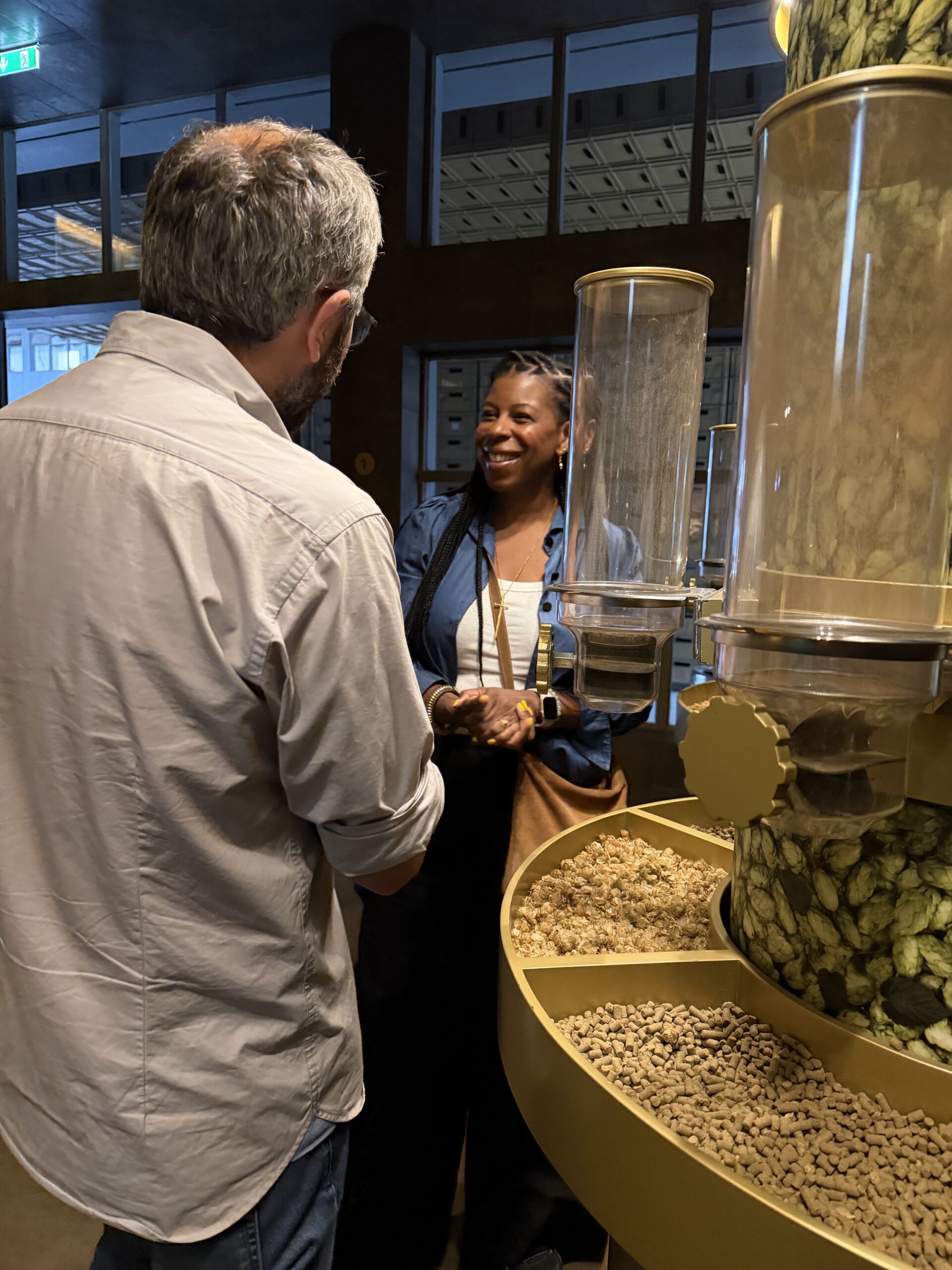
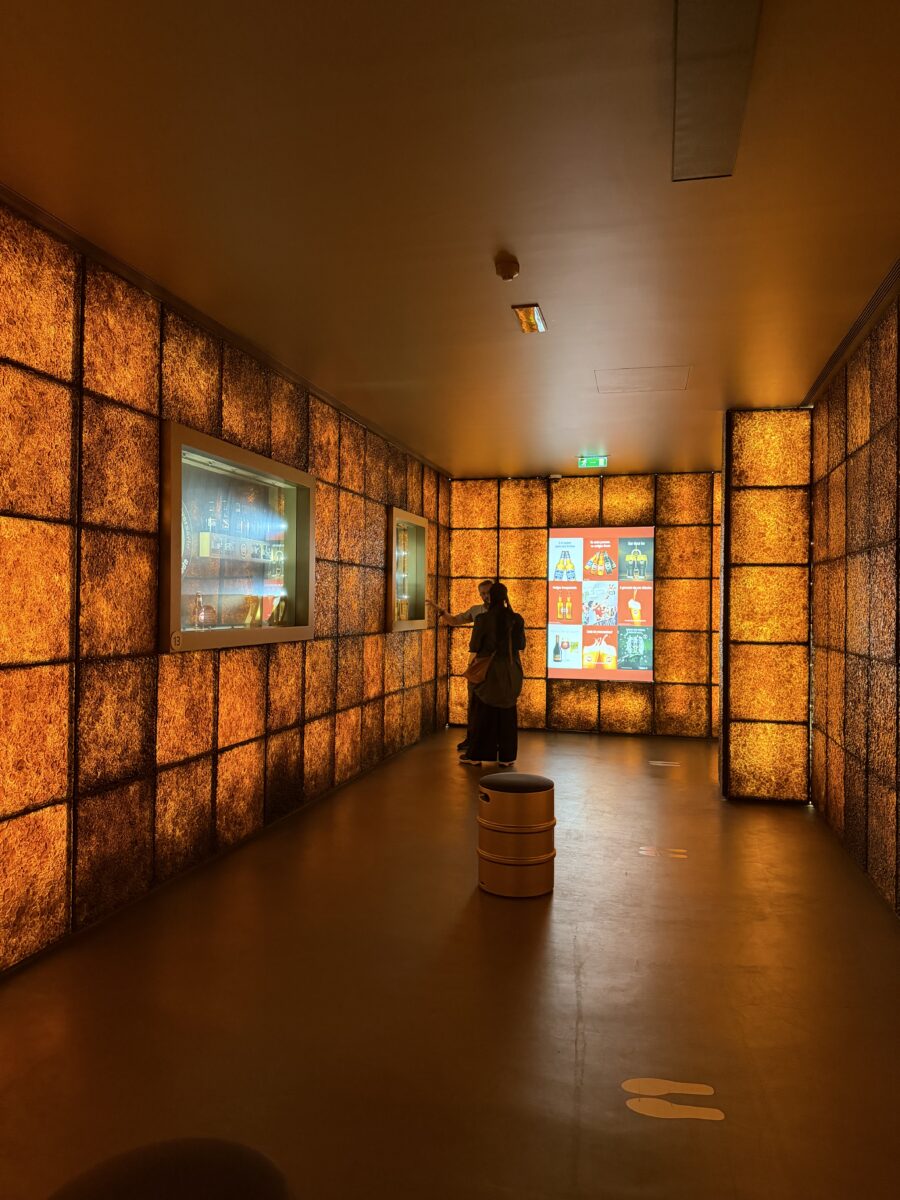
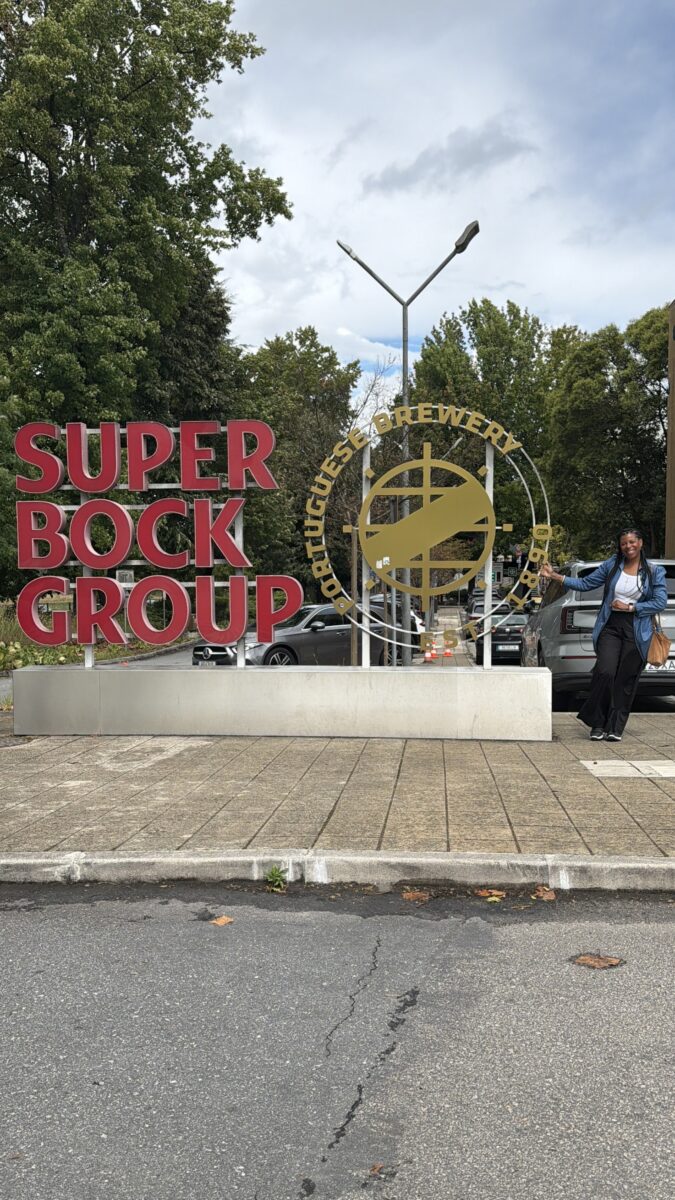
My visit took me just outside central Porto to Super Bock Casa da Cerveja in Leça do Balio, part of the Greater Porto area and home to the company’s working production center. I was able to walk through the history of the company, examine the ingredients used to make beer, stand beside enormous copper brewing vessels, watch the filling operation in action and eventually sit down to taste one of the company’s Selecção 1927 beers.
I already knew quite a bit about brewing when I arrived. What fascinated me most was discovering how a beer born in northern Portugal became so deeply woven into Portuguese life.
Disclosure: My visit to Super Bock Casa da Cerveja was hosted in collaboration with Super Bock Casa da Cerveja and Porto and North of Portugal Tourism. All experiences and opinions shared here are my own.
Before There Was Super Bock, Seven Breweries Had an Idea
The story I encountered at Casa da Cerveja begins before anyone could walk into a Portuguese bar and order a Super Bock.
In 1890, seven beer and soft-drink factories, six from Porto and one from Ponte da Barca, joined together to create Companhia União Fabril Portuense, or CUFP. At the time, its breweries could collectively produce no more than about 400,000 liters of beer annually.
Super Bock emerged from that northern Portuguese brewing tradition several decades later. The beer appeared at Porto’s Industrial Exhibition in 1926, where it received a gold medal alongside the company’s Pilsener Crystal. The Super Bock trademark was formally registered the following year.
Super Bock wasn’t a foreign beer that eventually found a Portuguese audience. It grew from Portugal’s own brewing industry, with roots firmly planted in Porto and northern Portugal.
The company evolved as Portugal evolved. Wars affected access to brewing ingredients. Industrialization transformed production. Political changes reshaped ownership. Technology changed how beer could be brewed, packaged and distributed.
Even something as ordinary as transporting beer tells part of that story. In 1920, the company purchased its first trucks and began replacing the mule-drawn carts it had previously used. That same year, CUFP hired its first female employee, Maria Engrácia.
Suddenly, that familiar red label had a much longer story behind it.
Rodrigo Didn’t Give Me the Short Version
Fortunately for me, my guide wasn’t interested in rushing through that history.
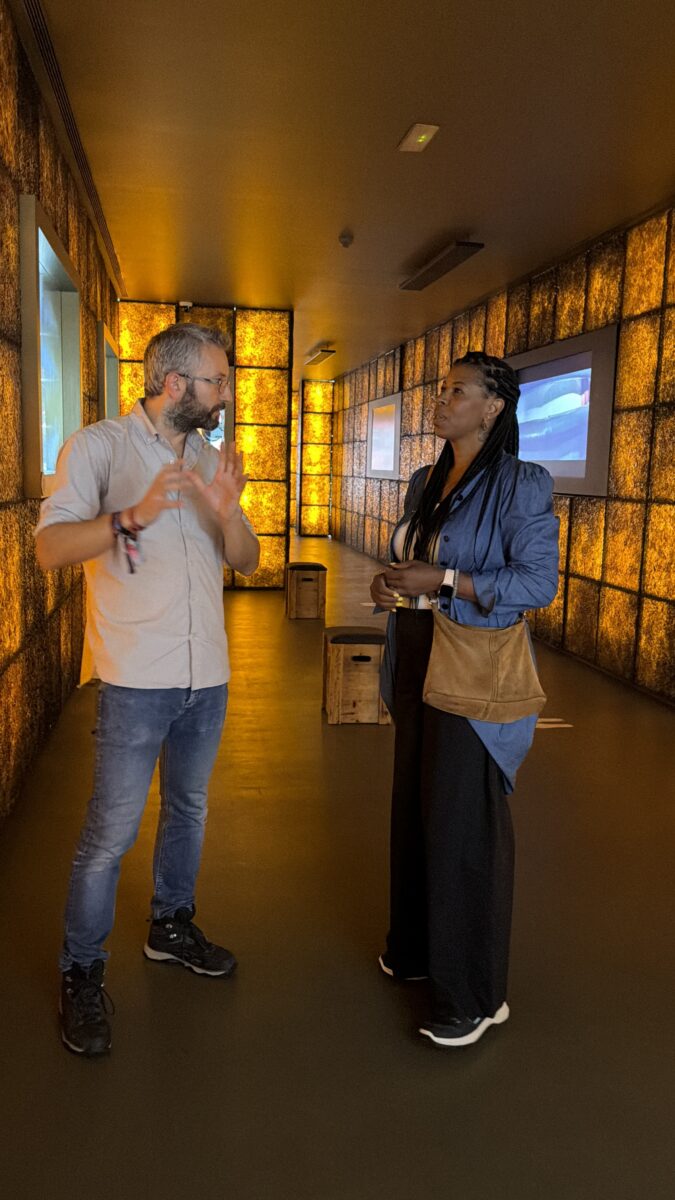
Rodrigo Dahl, who described himself to me as a Patient Manager at Super Bock Group, personally guided me through Casa da Cerveja and the production facility. His generosity with both his time and knowledge transformed the experience.
I ask a lot of questions, particularly when someone gives me access to a working food or beverage production facility. My professional background in food systems means I rarely look at something I eat or drink without eventually wondering about everything behind it.
I want to know where the ingredients came from, how they were processed, how production has changed, what decisions affect the final product and how something eventually moves from producer to consumer.
Rodrigo let me be curious.
We moved through the company’s history, ingredients, brewing process, production areas and filling operation, but the experience never felt like we were simply checking stops off a tour itinerary. When something caught my attention, we could stop and talk about it.
Water became one of those subjects. I understood its fundamental role in brewing, but our conversation about mineral composition and the ways water chemistry can influence beer gave me another layer to think about.
Other conversations took us toward malt, hops, production, packaging and the evolution of the company itself.
I wasn’t simply being shown where Super Bock was made. Rodrigo was helping me understand why it was made the way it was.
Four Ingredients Leave an Extraordinary Amount of Room for Decisions
Beer begins with a deceptively short ingredient list: water, malted grain, hops and yeast.
What happens next is where brewing becomes considerably more interesting.
Grain is selected and milled before water is introduced during mashing. Carefully controlled temperatures allow enzymes to help release sugars from the grain. The liquid is filtered and boiled, hops contribute bitterness and aroma, and yeast eventually takes over the remarkable work of fermentation.
Super Bock Original is a pale lager. The company describes it as using selected malt and hop varieties together with its own pure yeast, creating a beer designed around balance. Malt sweetness, bitterness, aroma, carbonation and a relatively light, dry finish all have to work together.
That balance helps explain something I had already noticed as a consumer.
Super Bock is easy to drink.
Achieving that consistently at industrial scale is considerably harder than drinking it.
People order a familiar lager because they expect it to taste like the beer they already know. Producing millions of liters while maintaining that recognizable flavor requires extraordinary control over ingredients, fermentation and every stage that follows.
Super Bock says its flagship beer has accumulated more than 40 Monde Selection gold medals, including a decades-long sequence of consecutive gold awards. Awards alone cannot explain why generations of people continue drinking a beer, but that record does illustrate the emphasis the brewery places on consistency.
Then the company does something I find even more interesting.
It experiments.
The Giant Brewery Has a Small Brewery Hiding Inside It
Within the enormous production operation is a much smaller brewing facility designed to create room for experimentation.
The company established its mini-factory in 2008 for specialty beer production. Today, it is associated with Super Bock Selecção 1927, a range whose name reaches directly back to the year the Super Bock trademark was registered.
The beers allow Super Bock to explore styles beyond the pale lager for which it became famous.
Over the years, the company has produced beers inspired by styles such as Munich Dunkel, Weiss beer and IPA, while other specialty releases have experimented with techniques including barrel aging.
I loved that contradiction.
On one side of the facility, Super Bock’s success depends heavily on consistency. Someone ordering the flagship beer expects familiarity.
On the other, brewers have room to explore what can happen when they change malts, hops, yeast strains, fermentation approaches or beer styles.
Super Bock has also used other ranges, including Coruja, to introduce Portuguese consumers to a broader spectrum of beer styles.
A company famous for one highly recognizable lager doesn’t necessarily have to encourage people to explore beyond it.
Super Bock chose to do so anyway.
Those Copper Vessels Have Watched Portugal Change
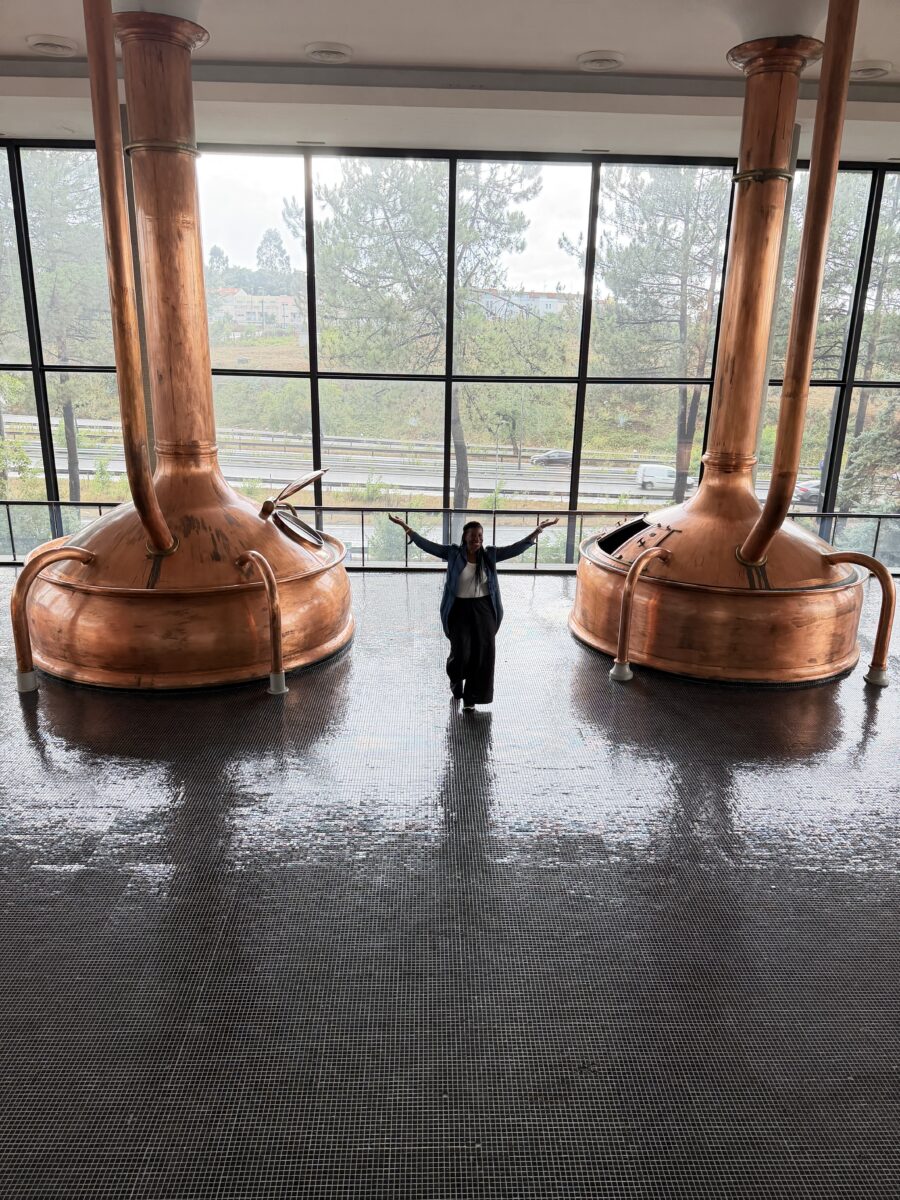
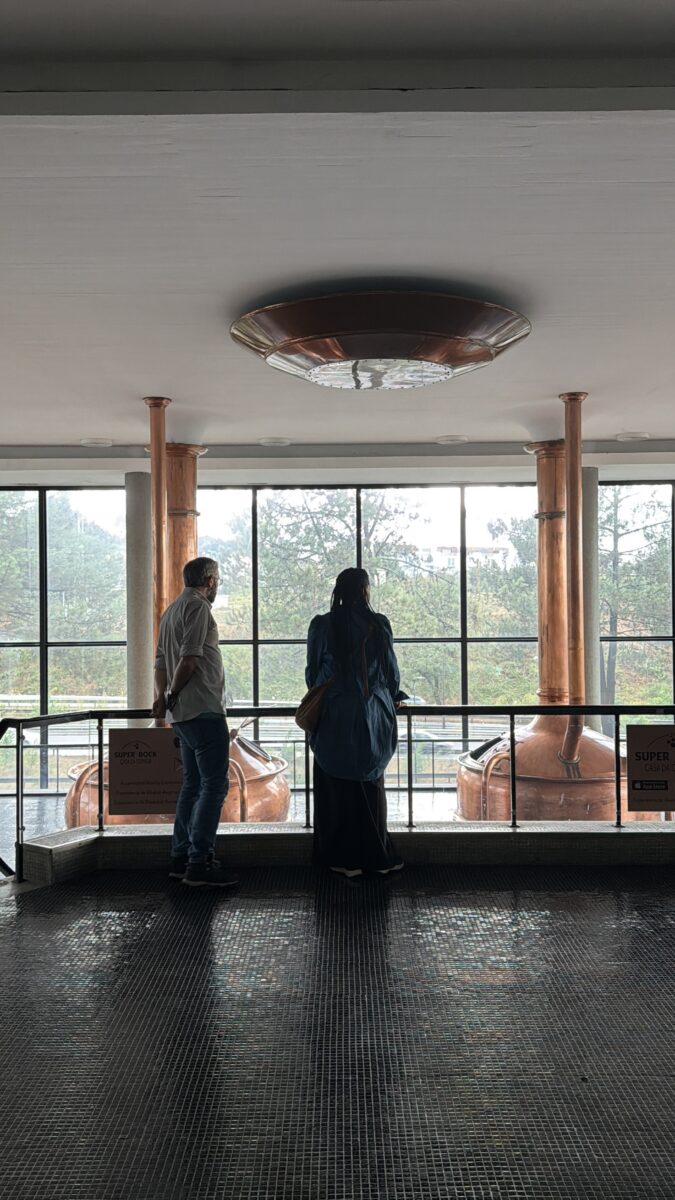
One of the most visually striking parts of my visit was the Sala de Cobre, or Copper Room.
The vessels are enormous. Standing between them made me look almost comically small, but their significance extends well beyond providing a spectacular photograph.
They preserve part of the physical history of brewing at Leça do Balio.
The company moved its brewing operations to the new production center there in 1964. The facility initially had an annual beer-production capacity of approximately 25 million liters, a remarkable leap from the capacity of the company’s earliest breweries.
The Copper Room became the first brewing room of the new production center.
I loved that those vessels were still there.
Food and beverage companies often preserve their heritage through old advertisements, photographs, bottles and packaging. Those objects tell valuable stories, but standing beside the actual equipment creates a different relationship with history.
You can see the scale and imagine the work.
Then you can walk from those copper vessels toward a modern industrial operation and immediately understand how dramatically brewing has changed.
Then I Saw What Hundreds of Millions of Liters Looks Like
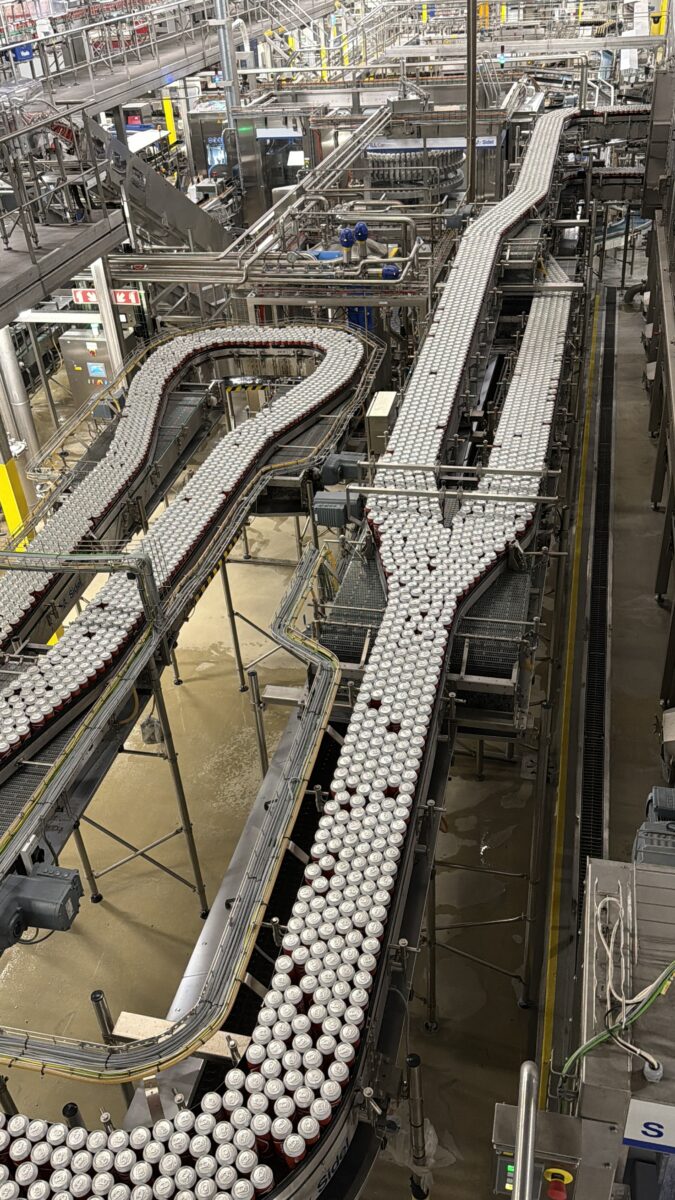
Nothing made the scale of modern Super Bock more tangible than seeing the filling operation.
From above, the production floor looked almost choreographed. Cans moved in enormous streams along conveyor belts, splitting, curving and rejoining as they traveled through a landscape of stainless steel machinery, pipes and platforms.
I could have watched it for a ridiculously long time.
The Leça do Balio facility has changed enormously since 1964. Following major modernization and consolidation of beer production, its annual capacity reached hundreds of millions of liters.
Numbers like that sound abstract until you stand above a production line.
Then you realize that all those cans and bottles aren’t simply disappearing into warehouses.
They are heading toward supermarkets, cafés, restaurants, festivals, football matches, neighborhood bars and Portuguese tables.
I was watching the infrastructure required to maintain a cultural habit.
Somewhere Along the Way, Super Bock Stopped Being Just a Beer Brand
This is where the story becomes particularly interesting to me.
Super Bock has been around long enough to become familiar across generations, but longevity alone doesn’t explain its position in Portuguese culture.
For decades, the brand has repeatedly attached itself to places and experiences where Portuguese people already gather.
Music provides one of the clearest examples.
In 1995, the first Super Bock Super Rock brought acts including The Cure, Faith No More, The Jesus and Mary Chain and Portuguese band GNR to Lisbon. The festival became part of Portugal’s modern music landscape while putting the Super Bock name directly into the experience.
Three years later, Super Bock was the official beer of Expo ’98, the enormous international exposition that became one of the defining Portuguese events of the late 20th century and transformed part of Lisbon.
Then there is football.
The brand has maintained relationships with Portuguese football competitions and major clubs, placing it within another arena that occupies an enormous space in Portuguese social life.
Music. Football. Festivals. Cafés. Restaurants. Friends sitting around a table.
You begin to understand why the brand can feel omnipresent without feeling culturally out of place.
Super Bock didn’t simply put its logo in front of Portuguese consumers.
For generations, it kept showing up where Portuguese life was already happening.
Even the Little Mini Tells a Portuguese Story
I have developed a particular affection for Portugal’s tiny beers.
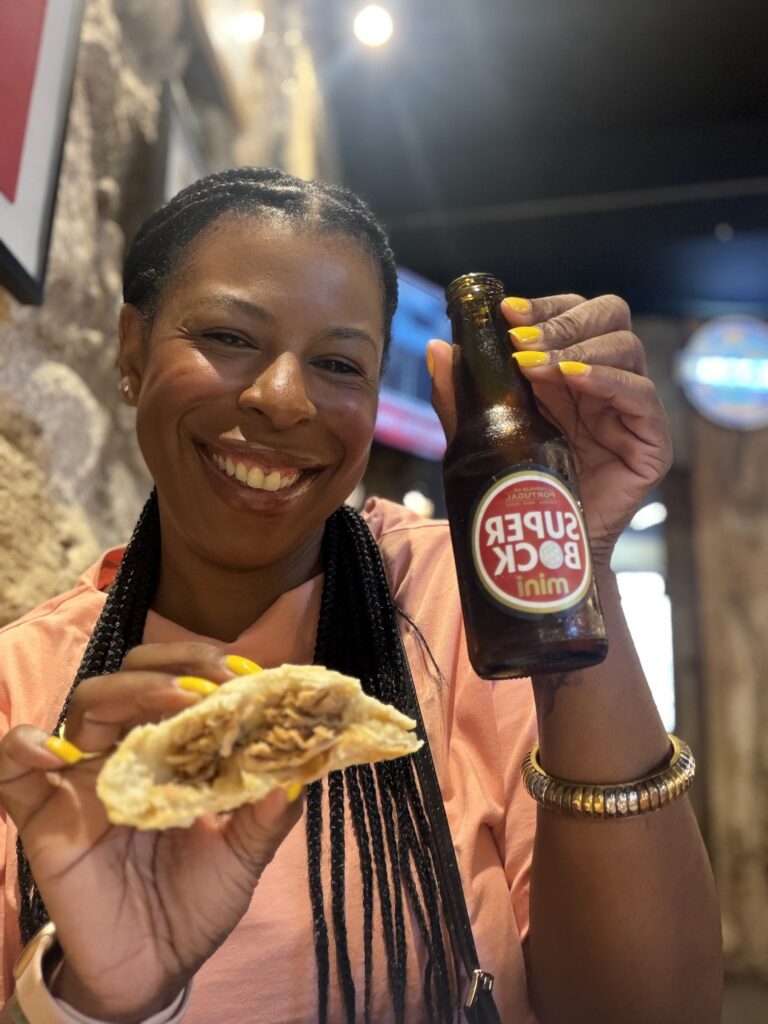
There is something wonderfully practical about the mini. It stays cold, suits a quick drink at a café and works beautifully beside a bifana, as I discovered when I paid €2.50 for my first one with a mini Super Bock at Espaço 77 in Porto.
Super Bock even managed to innovate there.
In 2009, the company introduced a pull-off opening system on its minis, becoming the first beer brand in Portugal to use that easy-opening format.
It is a tiny piece of packaging history, admittedly, but everyday culture is built from tiny things.
The foods people order without thinking, the bottles they recognize from across a room, the brands their parents knew, the music festivals they attended when they were young, and the football matches they watched with friends all become part of shared memory.
Eventually, those associations accumulate into something much larger than a product.
Portugal Changed, and Super Bock Changed With It
One of the most compelling things about tracing Super Bock’s history is how often the story intersects with Portugal’s own.
During World War II, restrictions affecting imported raw materials forced the company to adapt its brewing supply chain and rely entirely on Portuguese malt for a period.
After the 1974 revolution, Portugal’s brewing sector was nationalized and reorganized. CUFP eventually became part of the state-owned company that became known as Unicer, which later returned to private ownership.
Meanwhile, brewing continued.
The facilities changed. Technology improved. Production expanded. New beer styles appeared. Packaging evolved.
Super Bock remained.
That continuity is part of what distinguishes heritage brands from products that simply happen to be old. A brand can preserve its history behind glass and become nostalgic, or it can keep adapting while retaining enough of its identity to remain recognizable.
At Casa da Cerveja, I could see both processes happening at once.
The copper vessels preserve one chapter.
The production lines are writing another.
1927 Finally Made Its Way Into My Glass
My tour ended exactly where a brewery tour should end.
At a table.
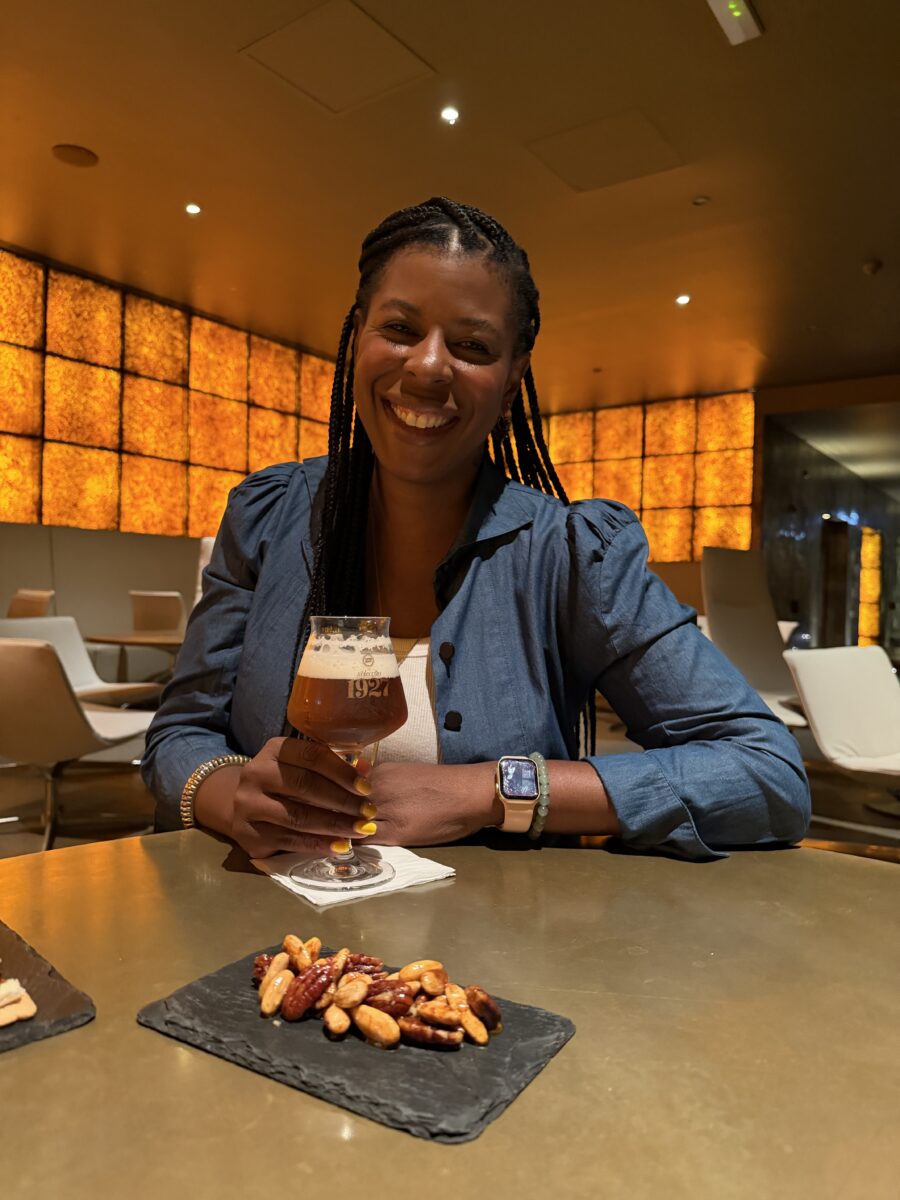
After walking through the company’s history, examining ingredients, discussing the brewing process, standing beside the copper vessels and watching modern production in motion, I sat down with a glass from the Super Bock Selecção 1927range and small food pairings.
The number printed on my glass suddenly meant something.
1927 wasn’t simply decorative branding. It pointed back to the year Super Bock formally entered the Portuguese commercial landscape.
Nearly a century later, the company had attached that date to beers designed to explore beyond the lager that built its reputation.
I liked that enormously.
Heritage can become an excuse for a company to resist change. Here, history had become a platform for experimentation.
And after spending a couple of hours asking Rodrigo questions about brewing, ingredients, history and industrial production, I was perfectly happy to stop analyzing everything for a moment and simply drink the beer.
Now I Understand Why the Red Label Is Everywhere
Before visiting Casa da Cerveja, I already knew Super Bock was important in Portugal.
I could see it.
What I didn’t understand was how many layers sat behind that familiarity.
There is the beer itself, a deliberately balanced lager whose consistency has helped sustain generations of drinkers. There is a brewing heritage stretching beyond the Super Bock name into Porto’s 19th-century beer industry. There is an enormous modern production operation capable of maintaining that consistency at scale, alongside smaller brewing initiatives that allow experimentation with different styles and techniques.
Then there is everything outside the brewery.
The music festivals. Football. Expo ’98. Restaurants. Neighborhood bars. Summer terraces. The little mini beside a bifana.
Super Bock has spent nearly a century moving between industrial production and everyday Portuguese life.
That is ultimately what made my visit with Rodrigo so valuable.
I arrived expecting to learn more about one of Portugal’s most recognizable beers. Instead, I saw what happens when a product survives long enough, remains familiar enough and participates deeply enough in the life of a country that its history begins to overlap with the country’s own memories.
I had seen Super Bock everywhere in Portugal.
After visiting the place where it is made, I finally understood why.