Women Were Already at the Heart of Our Food Systems. I Went to Braga to Talk About Power.
Standing on the Greenfest Braga stage, I wasn’t interested in making another argument for why women should be included in sustainable food systems.
After more than two decades working in international development, agriculture, food systems, and communities around the world, I have seen enough to know that women are already there. They are farmers and entrepreneurs, producers and processors, caregivers and knowledge holders. They grow food, sell it, prepare it, preserve agricultural knowledge, build businesses, and help communities adapt when conditions change.
The more interesting question is what happens after we acknowledge all of that.
Because being essential to a food system doesn’t necessarily mean having power within it.
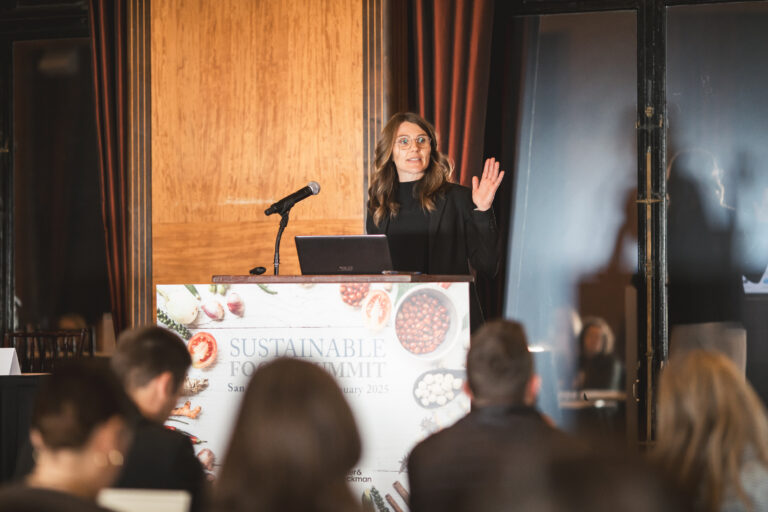
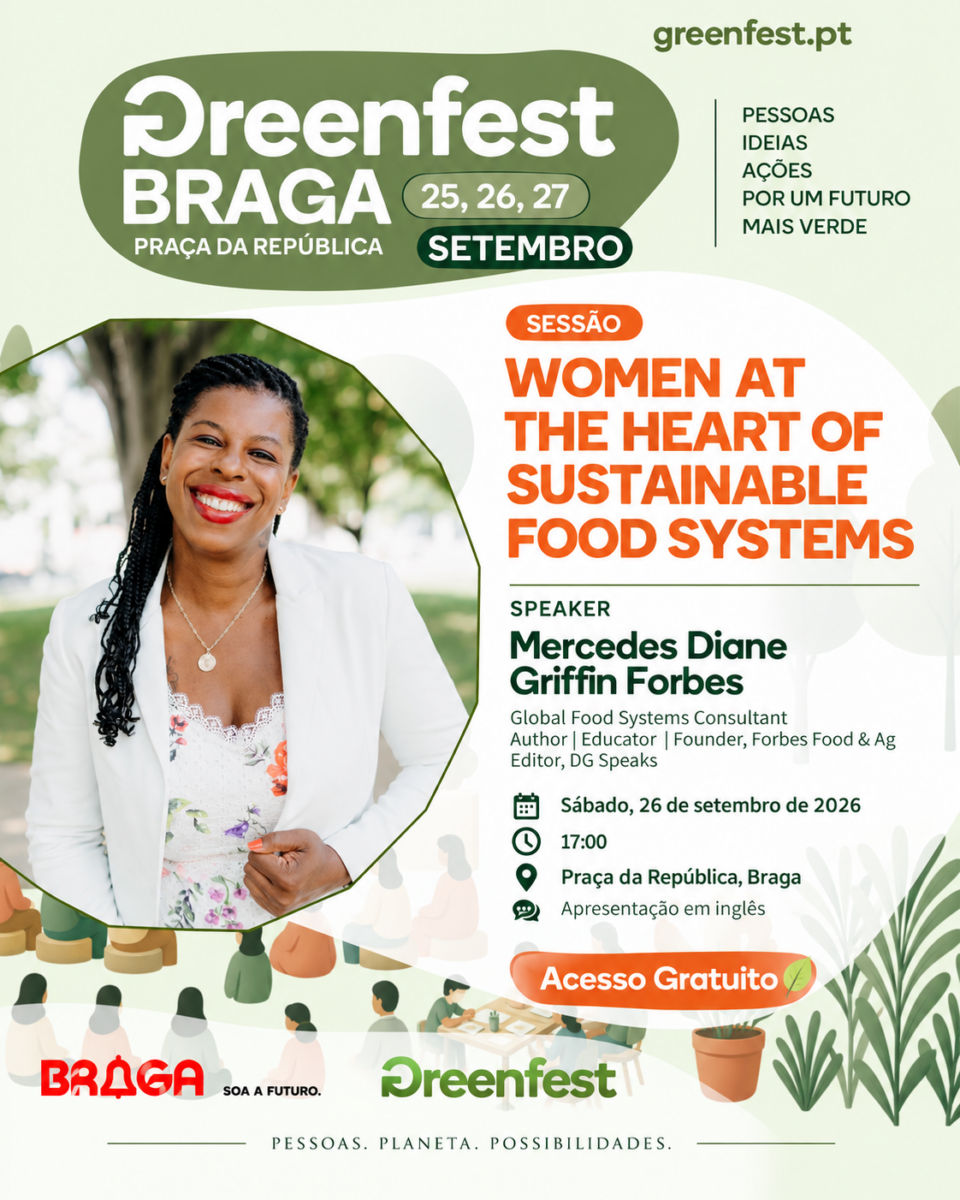
That was the conversation I wanted to have when I took the stage at Greenfest Braga for my presentation, Women at the Heart of Sustainable Food Systems. I wanted to move beyond celebrating women’s contributions and look more closely at the economic and social conditions surrounding them.
Once we do that, the conversation becomes considerably more complicated.
Twenty Years of Fieldwork Changes the Questions You Ask
I came into this conversation carrying more than a presentation.
I was carrying memories from years of working with farmers, entrepreneurs, cooperatives, communities, and development organizations across Africa, Latin America, and other parts of the world. Those experiences have taken me far beyond conference rooms and policy discussions, into places where the success or failure of a food system becomes deeply personal.
Over time, that changes how you listen.
When I began working in international development, I was naturally interested in programs, strategies, training, and interventions. I still am. However, years in the field have taught me to pay much closer attention to the distance between what looks good on paper and what people can realistically do with the circumstances surrounding them.
Women make that gap particularly visible.
Globally, women are deeply involved in agrifood systems, yet participation alone tells us surprisingly little about the quality of that participation. A woman may work in agriculture while lacking control over the land she cultivates. She may contribute to a family business without controlling the income. She may understand exactly what her farm needs but lack the financing, technology, market access, or authority required to act on that knowledge.
So when we say women are participating, I have learned to ask another question.
Participating as what?
Somewhere Between Participation and Power, the Story Changes
One of the ideas at the center of my Greenfest presentation was the difference between being present in a food system and having the ability to shape it.
According to the FAO figures I shared during my talk, agrifood systems employ roughly 36 percent of working women globally. That number confirms something many of us working in this field already know: women are not standing on the sidelines waiting to be invited into agriculture and food.
They are already doing the work.
Yet the numbers become much more revealing when we begin examining what women can access once they are inside the system. Agricultural productivity gaps remain. Wage disparities remain. Access to land, financing, technology, markets, and leadership opportunities remains uneven.
Suddenly, the question is no longer whether women participate.
The question becomes whether participation translates into economic power.
That distinction shaped much of what I wanted to discuss in Braga because sustainable development cannot depend indefinitely on women’s labor while treating women’s access to resources as a secondary issue.
A Farm Can Tell You More Than a Conference Room Ever Will
Some of the lessons that have stayed with me longest came from moments when communities identified something I hadn’t anticipated.
Years ago, while working with cacao farmers in Ecuador, I facilitated a SWOT analysis that asked farmers to identify the strengths, weaknesses, opportunities, and threats affecting their agricultural businesses.
Migration emerged as a threat.
At first glance, migration might appear to belong in an entirely different development conversation. We were talking about cacao farming and agricultural sustainability, after all.
But the farmers understood the connection immediately.
If younger people leave agricultural communities because they don’t see a viable future there, who continues farming? Who adopts new practices? Who carries agricultural knowledge forward? Who maintains the sustainability initiatives that development programs spend so much time designing?
Their answer forced the conversation beyond farming techniques and into livelihoods, opportunity, community stability, and the economic future people believed agriculture could offer them.
I have never forgotten it.
Experiences like that are why I have become increasingly skeptical of sustainability solutions designed too far away from the people expected to implement them. We can arrive with excellent research and impressive technical knowledge, but communities bring another form of expertise to the table: lived experience.
When we fail to listen to it, we can solve the wrong problem beautifully.
Land Is Never Just Land When You’re Talking About Power
Land became an important part of my Greenfest discussion because it illustrates how quickly economic inequality can become embedded in a food system.
Working on land is not the same as controlling it.
Secure access to land affects whether someone can make long-term decisions, invest in improvements, access certain forms of financing, determine what gets produced, and benefit from the value created over time. When women contribute substantial agricultural labor without having comparable control over productive resources, the imbalance reaches far beyond the farm itself.
The same pattern appears with technology, credit, training, transportation, and market access.
We can encourage women to become entrepreneurs, but entrepreneurship requires more than ambition. We can encourage farmers to innovate, but innovation becomes difficult when someone lacks the resources required to take the risk.
This is where I think conversations about women’s empowerment sometimes become too comfortable.
We celebrate resilience because resilience sounds positive. Yet after years of watching people accomplish extraordinary things with limited resources, I have become equally interested in asking why they had to be so resilient in the first place.
The Numbers Start Looking Different When You Follow the Money
One of the reasons I wanted to frame women as economic and social drivers of food-system transformation was that gender inequality is often discussed as though correcting it were primarily an act of generosity.
The economic evidence tells a different story.
During my Greenfest presentation, I shared FAO estimates showing the enormous potential associated with closing gender gaps in agrifood systems. Closing gaps in farm productivity and wages could add nearly $1 trillion to global GDPand reduce the number of food-insecure people by approximately 45 million.
Those are not marginal outcomes.
I also discussed the productivity gap between farms managed by women and men, as well as the wage disparity women experience in agricultural employment. Women working in agricultural wage employment earn roughly 82 cents for every dollar earned by men, according to the figures I presented.
Behind each percentage point sits a much larger story about opportunity.
What could a farmer produce with better access to inputs? What could an entrepreneur build with financing? What happens to a household when a woman’s income increases? What becomes possible in a community when women have greater control over economic resources?
At that point, gender equity stops looking like a niche issue within sustainable food systems.
It starts looking like part of the economic infrastructure.
Food Has a Long Journey Before It Reaches Our Plates
Another point I wanted to emphasize in Braga was that women in food systems cannot be understood only through the image of a woman standing in a field.
Agrifood systems stretch far beyond agricultural production.
Food moves through processing, storage, transportation, distribution, markets, restaurants, retail spaces, kitchens, and households before most of us ever sit down to eat it. Women participate throughout that journey, often moving between paid and unpaid roles that conventional economic measures don’t fully capture.
Looking at the entire system changes the conversation.
It allows us to see women not simply as beneficiaries of agricultural programs, but as entrepreneurs, workers, consumers, decision-makers, innovators, and potential leaders across an enormous economic ecosystem.
For me, this broader view is essential because sustainable food systems aren’t created at one point in the chain. They emerge from relationships between people, resources, markets, policies, communities, and the environment.
Ignoring gender within any of those relationships leaves part of the system unexplained.
Braga Gave Me a Stage, but the Women Gave Me the Story
There was something meaningful about bringing this conversation to Greenfest.
The festival created space to talk about sustainability across sectors, and that wider perspective reflects the way I have come to understand food systems themselves. Food connects environmental questions with economics, culture, public health, gender, community development, climate resilience, and the basic decisions people make every day.
My presentation gave me an opportunity to bring some of those connections together.
Still, the ideas I carried onto the stage didn’t begin in Braga.
They came from years of conversations with people whose experiences challenged assumptions I had carried into the field. They came from watching farmers identify barriers that weren’t written into a project plan. They came from seeing women solve problems with fewer resources than they should have had available to them.
Those experiences have also changed my understanding of expertise.
Technical knowledge is valuable. Research is valuable. Data is valuable.
But expertise can also belong to the woman who understands exactly why a program won’t work in her community because she has to live with the conditions the program designer only studied.
Sustainable development becomes stronger when those forms of knowledge meet.
After All These Years, I’m More Interested in Listening
More than 20 years in international development haven’t made me less interested in solutions.
They have made me more careful about how we arrive at them.
I no longer find it particularly useful to talk about women as though they are waiting for someone else to transform their role in food systems. I have seen too much evidence of women already producing, organizing, adapting, building, teaching, trading, managing, and solving problems.
What interests me now are the conditions surrounding all of that capability.
Who controls the land? Who gets the financing? Who has access to technology? Who reaches profitable markets? Who controls income? Whose knowledge influences a project before the strategy has already been written? Who gets invited into leadership, and who has enough authority once she arrives to actually change something?
Those are harder questions than asking how many women participated in a program.
They are also much closer to the questions I believe sustainable food systems require us to answer.
When I finished my talk at Greenfest Braga, I wasn’t leaving the audience with a story about what women might someday contribute to a more sustainable food future.
I’ve spent more than two decades watching women contribute already.
The opportunity in front of us is to build food systems in which their access to resources, economic opportunity, leadership, and decision-making power finally reflects the scale of that contribution.
That was the conversation I came to Braga to have.
And after all these years, I think we’re only getting started.