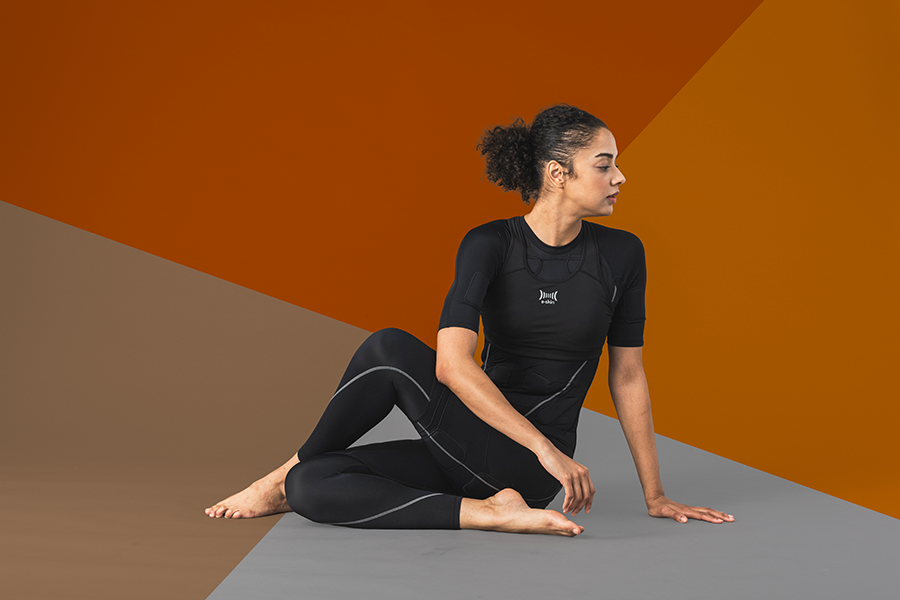
Xenoma e-skin EMStyle Brought Smart Clothing to CES 2021
Xenoma e-skin EMStyle immediately caught my attention at CES 2021 because it addressed one of my biggest frustrations with fitness technology.
I enjoy tracking my health, movement, and workouts. However, traditional wearables do not always fit naturally into daily life. Watches can feel uncomfortable, chest straps may become irritating, and small devices are easy to leave at home.
Clothing creates a different possibility.
Most of us already dress before exercising, working, sleeping, or leaving home. Therefore, smart apparel can collect information or support movement without asking people to remember an extra device.
That idea made Xenoma’s CES presentation especially interesting to me.
The Tokyo-based startup showcased e-skin EMStyle Professional, an electrical muscle stimulation suit developed for gyms and fitness trainers. The company also presented products connected to home fitness, sleep monitoring, elder care, motion capture, and everyday health.
CES 2021 took place entirely online because of the COVID-19 pandemic. Even without a physical show floor, the event gave companies such as Xenoma a global platform to show how technology could move beyond screens and become part of what people wear.
Why Smart Fitness Clothing Interested Me
The pandemic changed the way many of us thought about health and movement.
During 2020, I became more committed to my own fitness. Gyms closed, routines changed, and people had to find new ways to exercise at home.
Although that period increased my focus, I was not new to gym life. I had already spent years following fitness equipment, trackers, recovery tools, and other products designed to make workouts more effective.
Still, many fitness gadgets eventually end up inside a drawer.
A useful wearable must feel comfortable enough for repeated use. It should also survive sweat, movement, cleaning, and the ordinary demands of daily life.
Xenoma’s technology appealed to me because the company tried to build electronics directly into soft, flexible clothing. Instead of attaching a collection of rigid devices to the body, e-skin used stretchable circuitry that moved with the wearer.
That design choice pointed toward a future where health technology might feel less like equipment and more like something already familiar.
What Xenoma Showcased at CES 2021
Xenoma introduced e-skin EMStyle Professional as the gym-focused version of its electrical muscle stimulation clothing.
The professional system combined the EMStyle suit with software that allowed trainers to manage individual stimulation levels. Xenoma said one trainer could control several connected suits during a session, creating the possibility of personalized small-group training.
The company planned to release the professional version globally in March 2021, followed by e-skin EMStyle Personal for home workouts. Xenoma described both products as comfortable and machine-washable because of its stretchable electronics technology.
Rather than asking users to remain still while electrodes delivered stimulation, EMStyle paired electrical muscle stimulation with active exercise.
That distinction matters because the suit was not designed to perform the workout for the wearer. Instead, Xenoma positioned it as a tool for increasing stimulation while someone moved through a guided session.
How e-skin EMStyle Worked
The e-skin EMStyle suits used 24 electrodes positioned across the body.
Through electrical muscle stimulation, those electrodes sent controlled impulses to selected muscle groups while the wearer exercised.
Users could adjust the stimulation through an application. Meanwhile, the professional version gave trainers the ability to manage connected suits and tailor the intensity for each participant.
Xenoma promoted the system around efficient 20-minute training sessions. Its product materials described EMStyle as a suit-and-application service intended to support whole-body exercise within a shorter period.
For busy people, that promise naturally carries appeal.
A shorter session may make exercise easier to fit around work, travel, caregiving, and other responsibilities. However, efficiency should not be confused with a miracle solution.
Electrical muscle stimulation may support muscle conditioning, but it does not eliminate the importance of movement, cardiovascular activity, nutrition, rest, and consistent training.
Health claims also require caution. Consumers should not assume that electrical stimulation alone produces weight loss, major body transformation, or the equivalent of a complete fitness program.
People with pacemakers, implanted devices, injuries, or medical concerns should seek professional guidance before using electrical stimulation products.
That context allows us to appreciate the technology without turning marketing language into medical promises.
My Interview With Xenoma CEO Ichiro Amimori
To understand the vision behind the clothing, I interviewed Xenoma co-founder and CEO Ichiro Amimori.
His answers revealed that the company’s ambitions extended far beyond one fitness suit. Xenoma viewed clothing as a potential interface between the human body, healthcare systems, and connected technology.
What inspired you to start Xenoma?
I myself do not like to wear a watch, but I do wear clothes. I came to the idea that smart apparel can be an ideal interface to connect people to the internet, especially for healthcare data, when I saw the stretchable electronics technology at the University of Tokyo.
His answer captured the exact reason the product interested me.
Smart clothing removes the extra step of remembering a separate wearable. When designed well, it can collect or deliver information through something people already use every day.
Who did Xenoma hope to serve?
Ideally, we would like everyone on earth to wear e-skin. For the first target, we are focusing on those who have a strong motivation to use smart apparel, like fitness users, and those who need to be monitored, such as the elderly and babies.
That broad vision explains why Xenoma developed products for exercise, sleep, elder monitoring, and movement analysis rather than limiting itself to one market.
What was the company’s larger vision?
Our company vision is “e-skin makes everyone’s life HAPPIER and HEALTHIER.” To make this a bit more concrete, we aim to achieve data-driven preventive medicine with healthcare big data collected through e-skin.
Preventive health remains one of wearable technology’s most promising areas.
Clothing that tracks movement, sleep, breathing, or changes in physical function could help people notice patterns earlier. Nevertheless, gathering intimate health data also creates serious questions about consent, security, ownership, and access.
As smart apparel grows, companies must explain who receives the data, how long they keep it, and whether users can delete or transfer it.
How was Xenoma funding its growth?
Because the first stream of our business is the sales of our products, the simplest way to be profitable is for us to have enough users. We have been receiving investments from venture capital firms and company investors and are heading to be profitable next year.
As with many startups, Xenoma needed to balance a long-term technological vision with the practical need to sell products.
Smart apparel creates additional challenges because the company must succeed as both a technology developer and a clothing manufacturer.
The electronics must work reliably. At the same time, the garment must fit, move, wash, and remain comfortable enough for people to keep wearing it.
Which initiative felt most important?
One project we think is key is detecting frailty from walking analysis data gathered through e-skin MEVA, our smart motion capture system. It has great potential to contribute to the healthy longevity of people in this super-aging society.
That work may ultimately carry even greater social value than the fitness suit.
Changes in walking speed, balance, and movement can reveal important information about aging and physical decline. A wearable motion-capture system could support research, rehabilitation, or earlier intervention without requiring a full laboratory.
Xenoma described e-skin MEVA as a camera-free motion-capture system designed to measure natural body movement. Its sensors could support research and clinical work in a wider range of settings.
How did Xenoma drive innovation?
Not only do we work closely with academic researchers as a university startup, but from my own experience of working for Fujifilm for 18 years, we also collaborate proactively with large companies to move quickly into the market. At CES in previous years, we invited collaborators, including Hugo Boss, DNP, and Hitachi, to exhibit with us.
That combination of university research and corporate collaboration helped Xenoma move stretchable electronics from experimentation toward commercial products.
It also reflected one of the most valuable functions of CES. Startups can use the event to meet partners, demonstrate concepts, and show established companies what emerging technology might make possible.
Readers can explore more of my reporting on wearable technology, artificial intelligence, and global innovation through my broader CES coverage.
e-skin EMStyle Turned Clothing Into Fitness Equipment
The strongest feature of e-skin EMStyle was not simply the electrical stimulation.
Xenoma tried to build the technology into a garment light enough for normal movement and durable enough for repeated cleaning.
That combination matters in a gym environment. Any fitness wearable must handle sweat, stretching, frequent use, and hygiene concerns.
The professional model also created a new tool for trainers.
Instead of applying the same level of stimulation to everyone, the connected system allowed a fitness professional to adjust each suit separately. Beginners and experienced athletes could therefore participate in the same session while receiving different settings.
Smart Clothing Could Support Healthy Aging
Xenoma’s product line showed that smart clothing could reach far beyond the gym.
e-skin Sleep & Lounge looked like ordinary sleepwear, yet the clothing could monitor movement and sleep-related information.
Xenoma developed the product with older adults and caregivers in mind. The company said the sleepwear could track daily activity, analyze sleep, and detect falls. A connected application could then help relatives or caregivers monitor someone living independently.
That concept became especially relevant during the pandemic, when many families could not visit older relatives as often as they wanted.
Wearable monitoring may provide reassurance, but designers must avoid turning care into constant surveillance.
Older adults deserve privacy, dignity, informed consent, and meaningful control over who can view their information. Technology should support independence rather than quietly removing it.
e-skin MEVA Turned Clothing Into a Motion-Capture System
e-skin MEVA may have represented Xenoma’s most versatile professional tool.
Traditional motion capture often requires cameras, markers, laboratory space, and time-consuming preparation. In contrast, MEVA placed inertial sensors directly inside fitted clothing.
The system could track natural movement without requiring a camera-based studio. Consequently, researchers could study walking, rehabilitation, ergonomics, sports, or workplace movement in more realistic settings.
Potential applications included gait analysis, rehabilitation, posture, robotics research, activities of daily living, and ergonomic evaluation.
For older adults, this kind of technology could help professionals measure changes in mobility before a severe fall or loss of independence occurs.
For workers, it could reveal repetitive or unsafe movement. Athletes might also use the data to study performance, balance, and technique.
The Cool E. Mask Reflected a Very Specific Moment
Xenoma also presented its Cool E. Mask during the pandemic.
The washable face covering focused on comfort, breathability, and rapid drying. Like many companies in 2020 and 2021, Xenoma adapted its textile knowledge to respond to an urgent public need.
However, comfort should never become the only measure of a protective mask.
Fit, filtration, current public-health guidance, and the setting in which someone uses a mask all matter. Therefore, readers should evaluate protective equipment using health-authority recommendations rather than marketing language alone.
What Set Xenoma Apart at CES 2021
Xenoma did not simply attach electronics to clothing and call the result innovative.
The company focused on one of smart apparel’s hardest problems: creating circuitry that could stretch, move, and survive cleaning.
Its Printed Circuit Fabric technology allowed sensors and wiring to become part of the garment rather than bulky objects placed on top of it.
That difference improved comfort and made the products feel closer to normal clothing.
Amimori explained the company’s approach this way:
Our e-skin EMStyle suits are perfect workout solutions in the COVID-19 era to maximize the effect of home exercise or personal training because they can be washed easily in washing machines. What really sets our products apart is our proprietary Printed Circuit Fabric technology, which allows us to create comfortable and practical suits that people would want to wear in everyday life.
Ichiro Amimori, Xenoma co-founder and CEO
That everyday usability will determine whether smart clothing becomes widely adopted.
A technically impressive garment has little value when it feels awkward, requires complicated maintenance, or cannot survive repeated wear.
Smart Clothing Creates Important Privacy Questions
The more closely technology sits against the body, the more personal its data becomes.
A smart shirt might collect information about breathing, heart rate, sleep, posture, movement, exercise, or falls. Together, those details can reveal far more than a simple step count.
Consumers therefore need clear answers before adopting connected clothing.
Who owns the information? Where does the company store it? Can employers, insurers, gyms, caregivers, or outside businesses gain access?
Users should also understand what happens when a company closes, changes its software, or stops supporting the garment.
I explore similar tensions in my article about the rise of AI, its promise, and human responsibility. Innovation can expand our abilities, but responsible design must protect privacy, autonomy, and human dignity.
Could Smart Apparel Replace Traditional Wearables?
Smart clothing will not replace every fitness watch or medical device.
Watches remain convenient, portable, and easy to use across several activities. Meanwhile, clinical devices must meet strict standards for accuracy and safety.
Nevertheless, apparel offers advantages for measurements that require information from several parts of the body.
A garment can place sensors across the torso, arms, or legs without asking a user to attach each component separately. That structure may support richer movement analysis and more natural long-term monitoring.
The challenge involves making the clothing affordable, washable, durable, flattering, and available in a wide range of sizes.
Inclusive sizing matters especially in fitness and healthcare. A product cannot serve “everyone” when it only fits a narrow range of bodies.
My Takeaway From Xenoma at CES 2021
Xenoma’s CES presentation gave me a glimpse of a future where technology feels less separate from our bodies.
Instead of remembering another gadget, people could wear clothing that supports workouts, analyzes movement, tracks sleep, or helps families monitor changes in an older relative’s health.
That possibility excites me. However, smart clothing must earn trust.
The garments need to feel comfortable, survive normal life, protect personal data, fit diverse bodies, and support benefits that extend beyond clever marketing.
e-skin EMStyle stood out because Xenoma treated clothing as more than a place to attach sensors. The company viewed apparel as an interface capable of connecting movement, health, technology, and daily life.
For a fitness geek like me, that concept felt full of possibility.
For the broader healthcare world, Xenoma’s work in sleep, motion capture, rehabilitation, and healthy aging may prove even more significant.
The best wearable technology should not demand that we reorganize our lives around another device.
Instead, it should fit into the lives and routines we already have.