Empowering Change: Muslim Women Leaders Speak for Themselves
Sitting inside the National Museum of Women in the Arts Thursday evening, I kept thinking about how rarely Muslim women are allowed complexity in mainstream conversations.
Most public discussions flatten them into symbols. Victims. Rebels. Religious conservatives. Feminist icons. Headlines. Political talking points.
Anything except fully formed human beings.
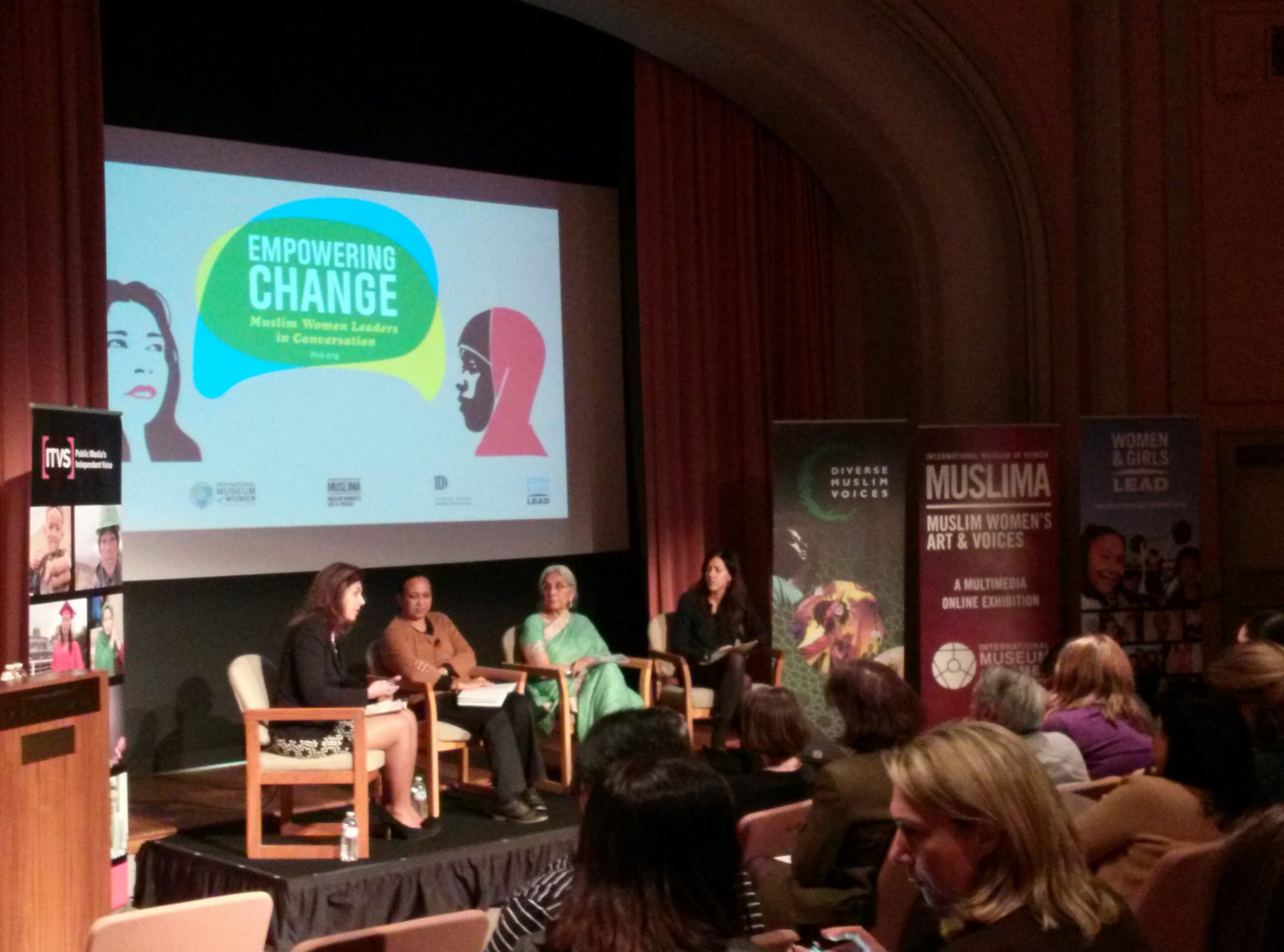
That is what made Empowering Change: Muslim Women Leaders in Conversation feel so refreshing. The event, presented by Independent Television Service (ITVS) and the International Museum of Women, brought together women whose experiences stretched across journalism, activism, policy, and international development. Instead of speaking in carefully packaged soundbites, the panel unfolded like an honest conversation about identity, power, culture, and the tensions that exist both outside and inside Muslim communities themselves.
The evening featured Alia Hogben of the Canadian Council of Muslim Women, journalist and author Azadeh Moaveni, and Sudanese women’s rights advocate Fahima Hashim, with Farah Pandith moderating the discussion.
Between Faith and Geography
One of the moments that stayed with me most came during the discussion surrounding culture and religion, particularly as the conversation turned toward Sudan and African Muslim communities.
There was an openness in the room about something that often goes unspoken publicly: the extent to which Arab culture frequently becomes positioned as the dominant expression of Islam, even in countries where Islam exists alongside deeply rooted African cultural traditions.
Listening to the discussion, I found myself thinking about how often dominant cultures present themselves as universal. Over time, cultural practices begin to blend so tightly with religion that people stop questioning where one ends and the other begins.
For African Muslim communities, that tension can become especially complicated.
The conversation was not framed as an attack on Islam. If anything, it was the opposite. The speakers seemed deeply invested in separating faith itself from the cultural hierarchies that can grow around it. Sudan emerged as one example of how identity, ethnicity, language, and religion intersect in ways that are impossible to separate neatly.
As someone who has spent years working internationally and studying development, gender, and culture, I appreciated that the discussion refused simplistic binaries. The panel did not divide the world into “oppressed women” and “liberated women,” or “religious” versus “modern.” Instead, the conversation moved through much messier territory where race, colonialism, nationalism, migration, and gender all overlap.
Muslim Women Speaking for Themselves
What made the evening especially powerful was how differently each woman approached these issues.
Azadeh Moaveni spoke with the perspective of a journalist who has spent years reporting throughout the Middle East. Her comments pushed back against the narrow frameworks Western media often relies on when discussing Muslim societies.
Fahima Hashim brought a perspective grounded in Sudanese activism and women’s rights organizing. Hearing her speak reminded me how often African Muslim voices get left out of global conversations about Islam altogether, despite the continent’s enormous diversity and long Islamic history.
Meanwhile, Alia Hogben focused heavily on advocacy work and the realities facing Muslim women in North America, particularly the persistence of stereotypes and misconceptions.
What emerged over the course of the evening was not a single narrative, but something far more interesting. The women on stage did not always frame issues in identical ways, and that honesty gave the discussion credibility. The conversation felt lived-in rather than rehearsed.
Beyond the Western Lens
Too often, conversations about Muslim women in the United States become trapped inside a Western gaze. The focus stays fixed on whether women are “free enough,” “covered too much,” or sufficiently aligned with Western feminist expectations.
This discussion pushed beyond that framework entirely.
Instead of centering how Muslim women are viewed by the West, the panel explored how Muslim women view themselves, their communities, their identities, and the structures around them. That shift changed the entire tone of the evening.
Walking out afterward, I realized the most important part of the event was not that these women represented Muslim voices.
It was that they represented their own voices.