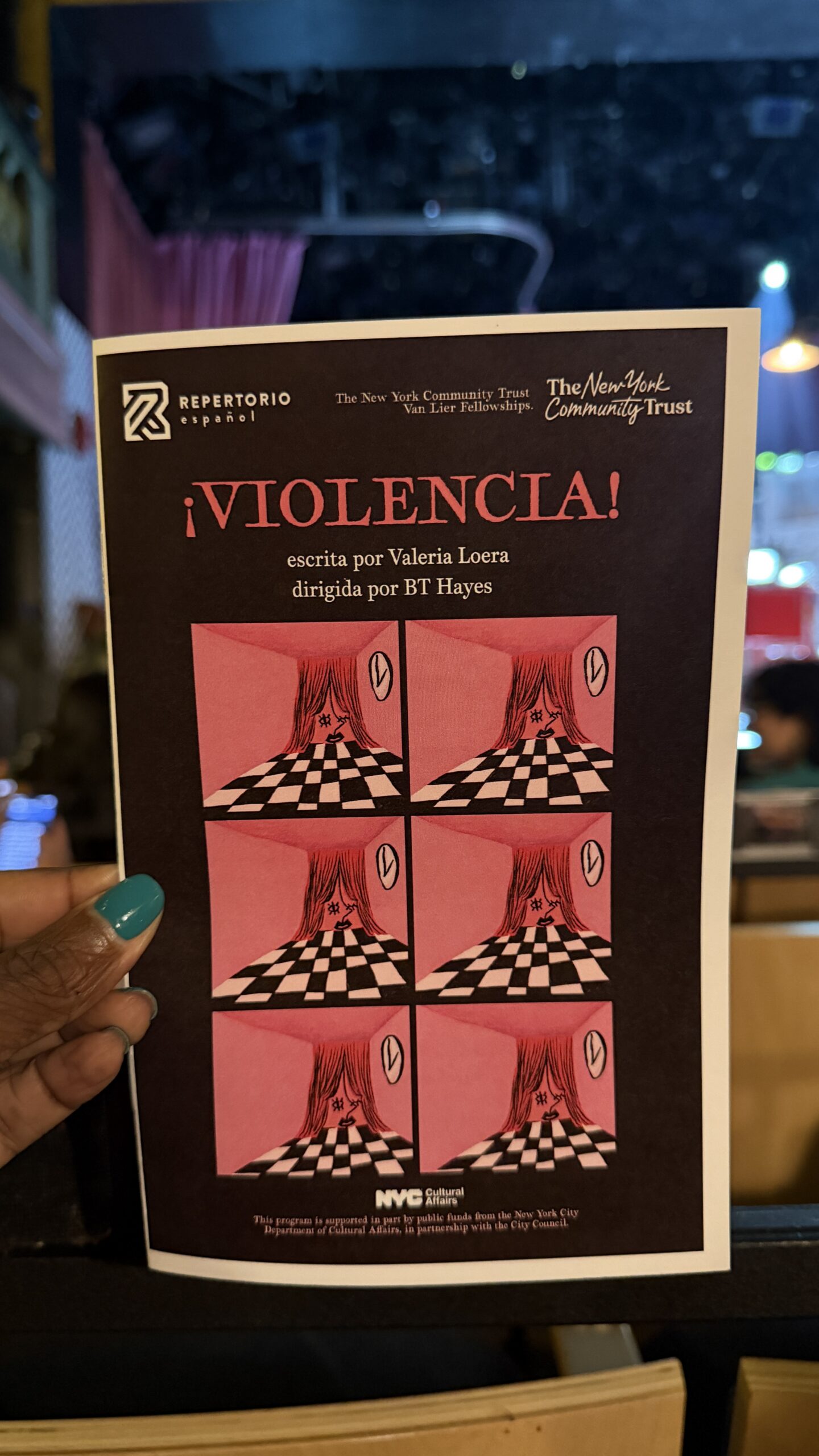
Love, Grief and Telenovela Energy in ¡Violencia!
I walked into ¡Violencia! expecting an interesting afternoon of Spanish-language theater. Instead, I found myself laughing, reflecting on my own relationships, and thinking deeply about the different women who can live inside one person.
My friend Melissa accompanied me to the Sunday performance, and we both loved the opportunity to practice our Spanish. The play unfolded in Spanish, with English subtitles displayed on a small screen.
Although I glanced at the subtitles occasionally, I felt proud that I followed most of the story without depending heavily on them.
That alone made the experience feel rewarding.
However, ¡Violencia! gave me much more than a language exercise. The production explored love, grief, family, obsession, cultural expectations, and the complicated ways our past continues to appear in our relationships.
When the Women on Stage Finally Made Sense
At first, I felt confused.
Different women kept appearing on the stage, and I could not immediately understand where the story intended to take us. I remember sitting there thinking, “Where are they going with this?”
Then everything clicked.
Each woman represented a different persona or aspect of Valencia’s personality.
Once I understood that, I thought, “Oh, this is so cool.”
The women did not simply support Valencia’s story. They revealed the many voices that existed inside her. One voice carried fear. Another carried desire. Others expressed humor, anger, insecurity, longing, and pain.
That choice gave the audience access to thoughts that normally stay hidden.
Most of us carry different versions of ourselves. We have the confident woman, the frightened girl, the romantic dreamer, the realist, and the woman who knows better but does it anyway.
¡Violencia! placed all of those women onstage together.
The Father She Lost and the Love She Kept Chasing
The play delved into Valencia’s relationship with her mother and the complex family dynamic that followed her father’s death.
Her mother had to raise her as a single parent after losing her husband. That experience shaped both women, although they carried the loss differently.
I appreciated how the play allowed Valencia to hold positive memories of her father. His presence did not disappear simply because he died.
Instead, his love continued to influence what she expected from other men.
One line stopped me completely.
One of Valencia’s personas said, “The only man that really loved us died.”
I remember thinking, “Oh, wow.”
That sentence explained so much about Valencia’s behavior. She did not only chase a boyfriend. She chased the emotional safety she once associated with her father.
Her romantic obsession came from a deeper wound.
The play understood that grief does not always look like sadness. Sometimes grief appears as attachment, jealousy, fear, or the refusal to release someone who has already begun to leave.
How the Play Turned Pain Into Laughter
A story about grief, a complicated mother-daughter relationship, and romantic obsession could easily become unbearably heavy.
Yet ¡Violencia! remained incredibly funny.
The writers found humor without dismissing the pain. That balance demonstrated excellent storytelling.
I laughed often, but I never forgot the emotional reality underneath the comedy.
Every joke revealed something about Valencia’s personality or coping mechanisms. The humor gave us space to breathe before the story returned to more difficult truths.
Rather than asking the audience to choose between comedy and heartbreak, the play allowed both to exist together.
Real life often works that way.
Some of the funniest moments happen during our messiest situations. We laugh because the alternative feels too painful.
Why Letting Go Never Comes Easily
Valencia’s obsessiveness about her boyfriend felt culturally familiar to me.
The relationship gave strong telenovela energy.
Her emotions ran high, and letting go never seemed like the obvious option. Instead, she kept returning to the relationship, the memories, and the hope that something might change.
From my own life experience, I found that very much on par.
Something within many of our cultures teaches women to hold on to relationships long after those relationships stop serving us. We romanticize struggle. We praise loyalty. Sometimes we confuse endurance with love.
Valencia demonstrated that tendency heavily.
She knew the relationship had problems. Her personas knew it too. Still, knowing better did not automatically give her the power to do better.
That contradiction made her feel human.
RODY, Romance and the Messiness of Desire
RODY added a comical and unexpected element to the story.
I do not want to explain exactly who or what RODY represented because that would reveal too much. Part of the pleasure comes from discovering the character within the context of Valencia’s relationship.
Let us simply say that relationships do not always follow expected norms.
RODY’s presence complicated the story in ways that felt funny, surprising, and strangely believable. The character also reminded us that people often create unusual arrangements to hold together relationships that no longer make sense.
Nothing about love remains simple for long.
The Ending That Changed Everything
The ending shocked me.
I did not see it coming, and I refuse to give it away.
Audiences need to experience that final moment without preparation. More importantly, they will need to sit with it after the play ends.
The conclusion changes how you understand parts of the story that came before it. It also raises uncomfortable questions about Valencia, her choices, and the emotional world she created.
Even after leaving the theater, I continued thinking about what happened.
A strong ending does not simply conclude a story. It follows you outside.
Following the Story Without Hiding Behind the Subtitles
Watching ¡Violencia! in Spanish added another layer to the experience.
Melissa and I enjoyed listening closely and recognizing how much we understood. The English subtitles made the production accessible, but I appreciated that I did not have to rely on them constantly.
Language carries emotion differently.
Certain jokes, romantic expressions, and cultural references feel more natural in Spanish. Translation can communicate the basic meaning, but tone often lives inside rhythm, emphasis, and familiar phrases.
Hearing the characters speak Spanish helped me connect more deeply with their personalities and emotions.
The performance also reminded me that practicing a language does not have to happen inside a classroom. Theater, music, food, travel, and conversation can teach us while entertaining us.
Why Valencia Stayed With Me
¡Violencia! delivers a funny, heartwarming, and emotionally complex exploration of Latina identity, romantic attachment, family, and grief.
The play took me from confusion to fascination within the first part of the performance. Once I understood that the women represented different aspects of Valencia, the production opened up in an entirely new way.
Its clever structure, memorable humor, and emotional honesty made the story feel both theatrical and deeply personal.
Valencia may appear extreme at times, much like the emotionally complex women featured throughout my culturally grounded film and performance reviews. However, anyone who has ever loved too hard, stayed too long, or carried childhood loss into an adult relationship will recognize something in her.
I certainly did.