Nuremberg Narratives: Tracing History and Heritage in Bavaria’s Historic City
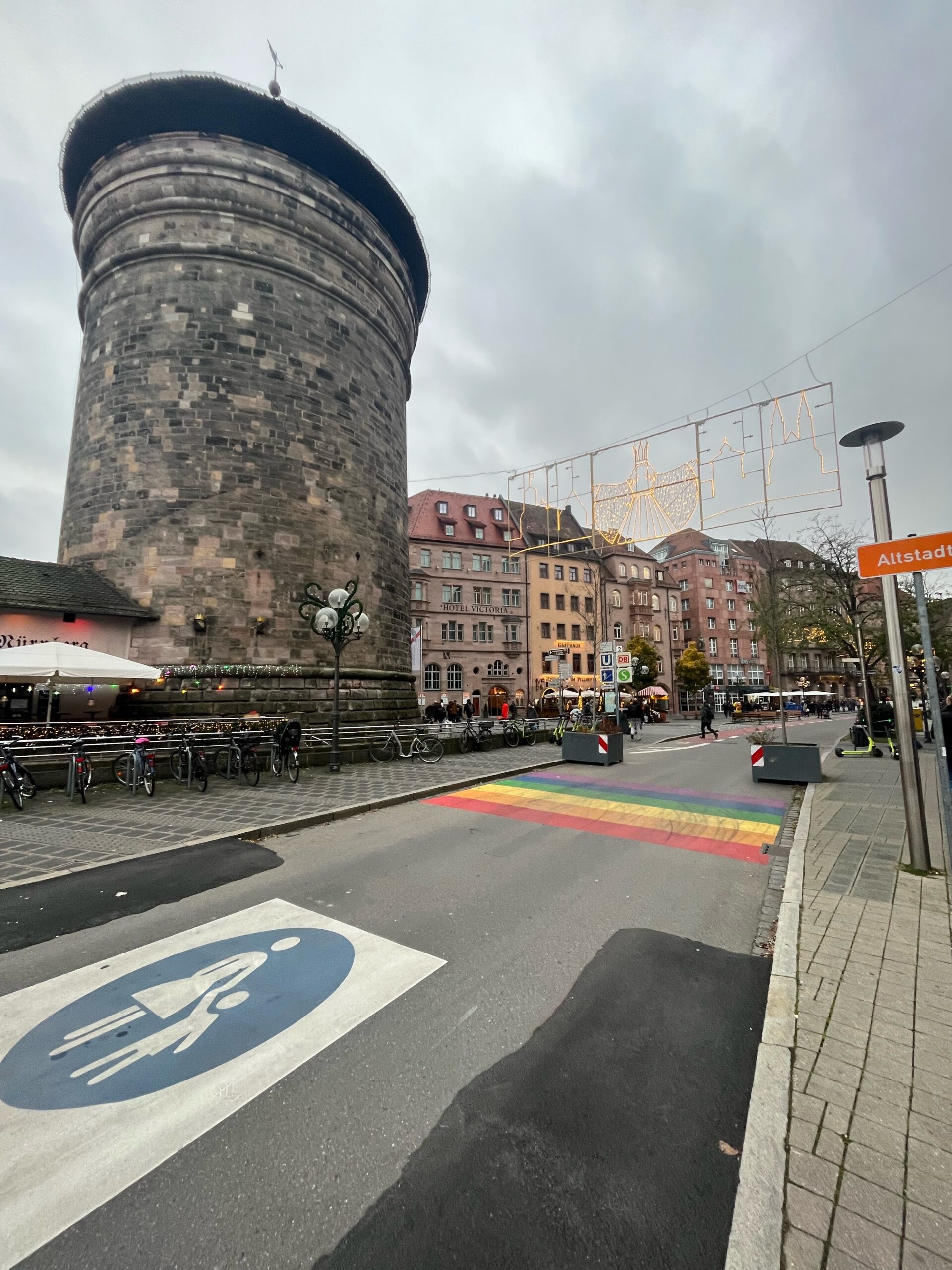
Nuremberg looked almost storybook beautiful when I first began walking through its historic center. A rainbow stretched above the street, a medieval tower rose in the distance, and centuries of history seemed to gather within one frame.
However, Nuremberg history cannot be understood through beauty alone. This Franconian city in northern Bavaria carries stories of imperial power, religious faith, artistic innovation, commercial success, racial persecution, war, justice, and reinvention. The more I explored, the more I realized that every picturesque corner seemed to open into another layer of the past.
I visited in November 2023, when rain darkened the stone walls and winter quiet settled over the streets. Although I came expecting medieval architecture and difficult twentieth-century history, I found much more. Nuremberg introduced me to Renaissance art, playful public sculptures, futuristic technology, Franconian food, multicultural restaurants, and a city that has refused to remain trapped within one period.
This was not simply a place I toured. It was a city I had to read carefully.
A Franconian City Within Bavaria
Nuremberg is located in the German state of Bavaria, but its cultural identity is distinctly Franconian. That difference matters. Franconia has its own food traditions, regional character, dialects, wines, and historical identity.
Munich may dominate many international ideas about Bavaria, particularly through images of beer halls, lederhosen, and Alpine landscapes. Nuremberg feels different. Its sandstone buildings, medieval walls, compact streets, and imperial history create another expression of the region.
Understanding that distinction helped me appreciate Germany as a collection of regional cultures rather than one uniform national experience. I encountered that diversity throughout my travels, which I explore further in my Germany travel guide.
The Imperial Castle Made Power Visible
My exploration of medieval Nuremberg began at the Imperial Castle, or Kaiserburg, which rises above the northern edge of the Old Town. The complex was one of the most important fortified imperial residences of the Holy Roman Empire.
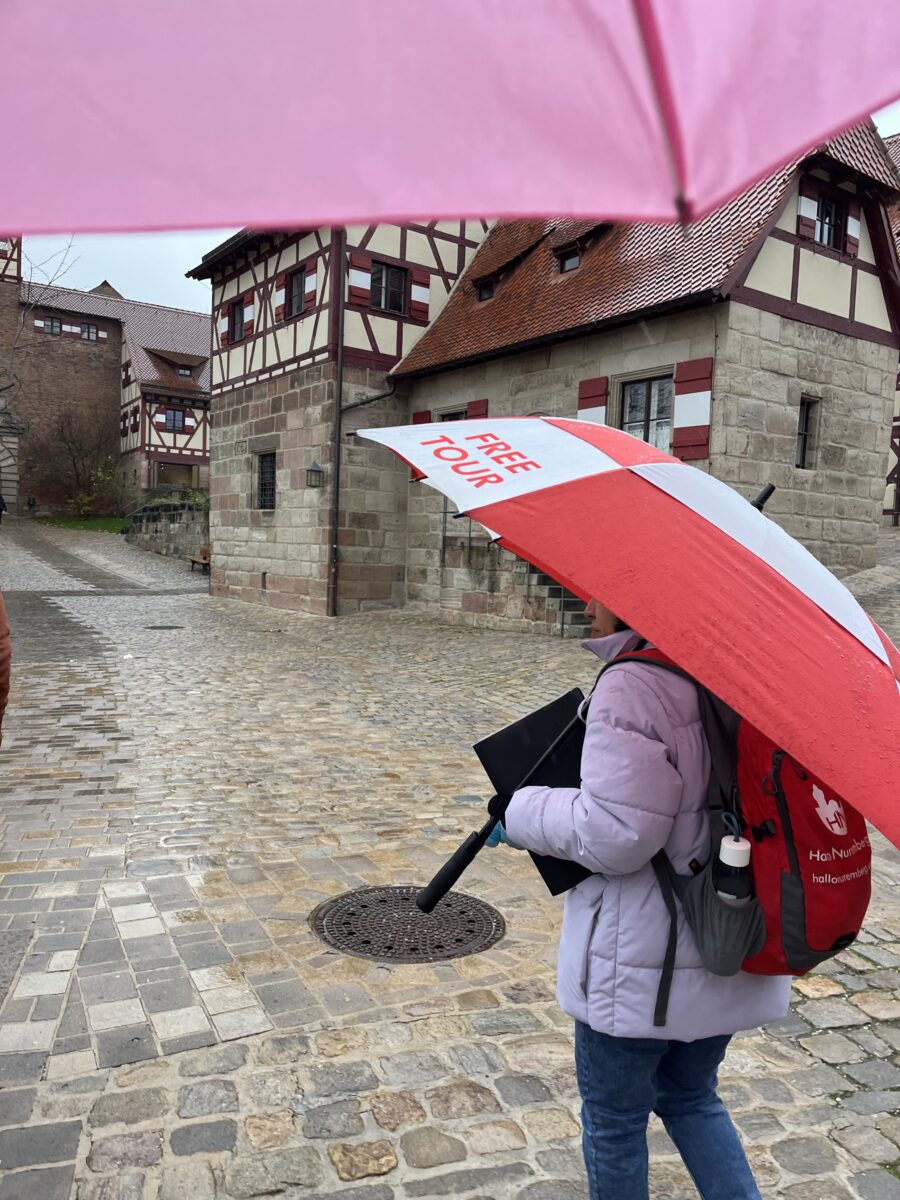
Rain followed us through parts of the castle tour. Umbrellas moved between half-timbered buildings, stone passageways, and red-and-white shutters. Instead of diminishing the experience, the gray weather made the castle feel more atmospheric.
The castle’s location communicated power before a ruler ever appeared. From its rocky elevation, the complex overlooked the city. Residents could also see its towers and fortifications from below.
Architecture often serves as political language. Thick walls communicate protection, but they also establish separation. Towers offer strategic visibility while reminding people who occupies the highest ground. Grand halls demonstrate wealth, authority, and access.
As I walked through the grounds, I thought about the labor required to create such a place. Craftspeople, builders, stonecutters, servants, guards, and countless unnamed workers made imperial life possible. Their contributions rarely receive the same attention as the rulers who occupied the castle.
The official Nuremberg tourism site provides more background on the castle and its role within the Holy Roman Empire.
Walls, Bridges, and the Rhythm of the Old Town
After leaving the castle, I followed the streets downhill into the Altstadt. Nuremberg’s Old Town is wonderfully walkable. Medieval walls still define much of the historic center, while narrow streets open into squares, churches, bridges, and unexpected works of art.
The Pegnitz River brought a softer rhythm to the city. Bridges linked neighborhoods and created views of buildings standing close to the water. I enjoyed pausing beside the river after the heavier concentration required by museums and historical sites.
Walking allowed me to notice details that disappear from a faster itinerary: carved doors, imperial eagles, weathered stone, decorative façades, religious figures, and surviving fragments of the city’s defensive architecture.
I stayed at Five Reasons Hotel & Hostel Nuremberg, which made exploring the center especially easy. Unlike my Munich hostel stay, where I relied on public transportation, I could reach most of Nuremberg’s major Old Town attractions on foot.
The Hauptmarkt Held Beauty and a Painful Foundation
The Hauptmarkt is one of Nuremberg’s most recognizable public spaces. The Frauenkirche, or Church of Our Lady, watches over the square with its ornate Gothic façade. Nearby, the Schöner Brunnen rises from the plaza like a slender church tower.
The name Schöner Brunnen means “Beautiful Fountain,” and the monument earns it. Pointed arches, painted figures, gold details, and layers of religious and political symbolism cover the structure.
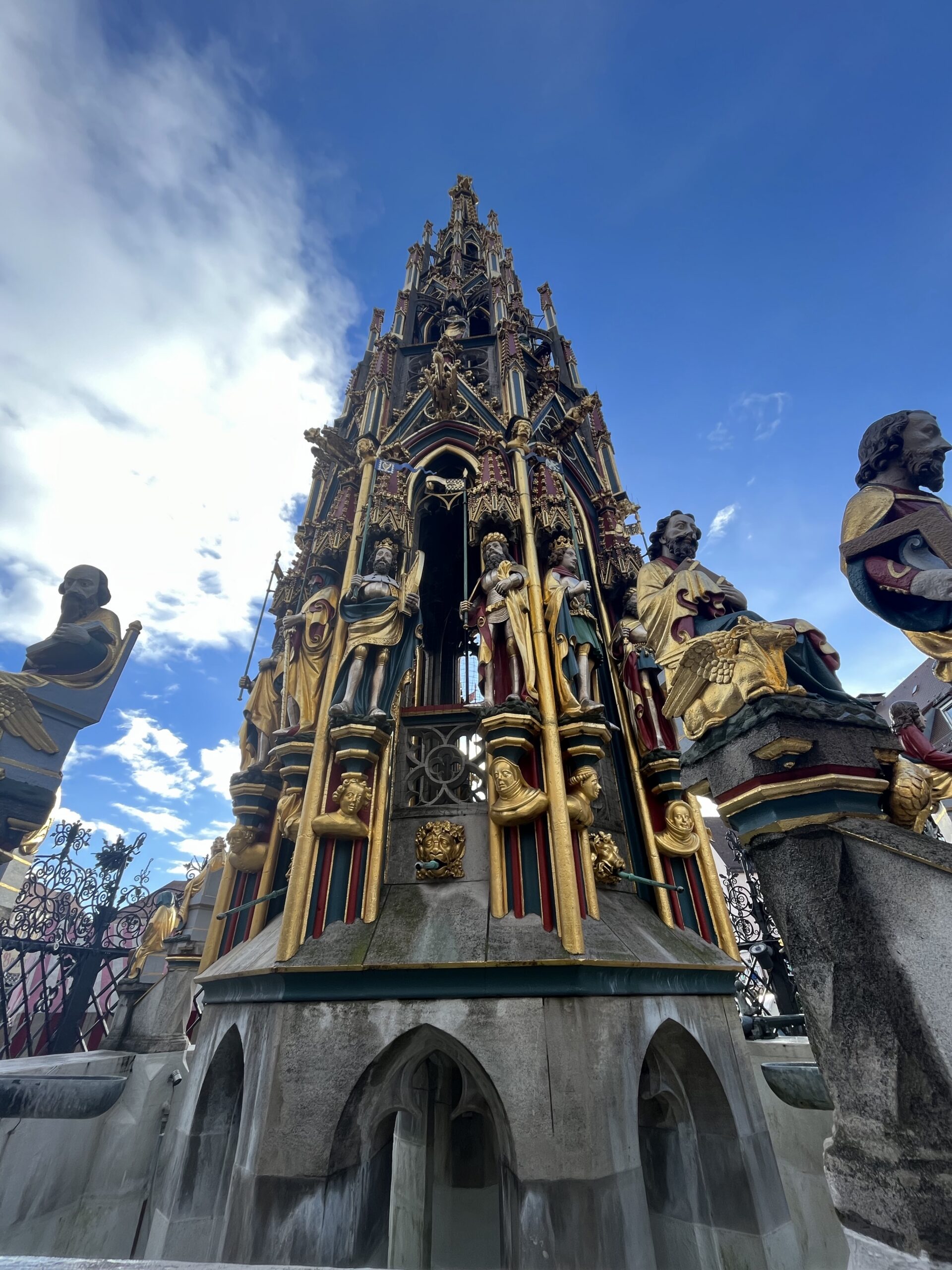
A famous ring is set into the fountain’s surrounding fence. According to local tradition, turning it can bring good luck or help grant a wish. Of course, I turned it. I could not pass through Nuremberg without participating in one of its best-known rituals.
Yet the beauty of the Hauptmarkt rests within a more difficult history. The Frauenkirche was built in the fourteenth century on land associated with Nuremberg’s former Jewish quarter after the community was destroyed during a medieval pogrom.
That knowledge changed how I viewed the square. The church remained visually magnificent, but its setting also reflected displacement, religious persecution, and the way dominant societies can build celebrated monuments over erased communities.
Travel becomes more meaningful when we allow those uncomfortable histories to remain visible. Beauty and injustice can occupy the same place. Recognizing one does not require denying the other.
Albrecht Dürer Gave Nuremberg a Renaissance Face
Nuremberg’s history also belongs to artists, printers, craftspeople, and merchants. During the late Middle Ages and Renaissance, the city grew into an important center of trade, publishing, skilled craftsmanship, and intellectual exchange.
Albrecht Dürer became the most internationally recognized artist associated with the city. His detailed prints, paintings, self-portraits, and studies of nature helped shape the Northern Renaissance.
Dürer lived and worked near the Imperial Castle from 1509 until his death in 1528. His half-timbered home survived the destruction that affected much of Nuremberg during the Second World War. Today, the Albrecht Dürer House connects his artistic legacy with the domestic and commercial life of the city.
I also encountered a portrait of Dürer’s mother, Barbara, during my museum exploration. Her face felt strikingly direct and human. The image pulled the Renaissance away from grand labels and returned it to an aging woman observed closely by her son.
That intimate portrait stayed with me because it revealed the attention behind Dürer’s work. He did not only study idealized beauty. He looked carefully at age, texture, vulnerability, and individual character.
Public Art Refused to Behave Politely
Nuremberg’s artistic identity did not end with the Renaissance. Some of the city’s most memorable public sculptures were humorous, unsettling, exaggerated, and intentionally difficult to ignore.
The Ehekarussell, often translated as the Marriage Merry-Go-Round, presents marriage as a cycle of attraction, conflict, aging, desire, children, and death. Its figures are grotesque, theatrical, and almost impossible to absorb in one glance.
The Ship of Fools offers another crowded vision of humanity, while Jürgen Goertz’s Der Hase transforms Dürer’s delicate hare into something enormous, distorted, and vaguely threatening.
I loved that these works disrupted the polished medieval setting. They reminded me that public art does not always need to flatter a city. It can tease, question, disturb, and invite people to reconsider familiar symbols.
Nuremberg History Includes Propaganda and Accountability
No thoughtful exploration of Nuremberg can ignore the twentieth century. Nazi leaders selected the city as the location for enormous party rallies and used its imperial image to support their mythology of racial destiny and national power.
The Nuremberg Laws, announced in 1935, stripped Jewish people of citizenship rights and formalized racial persecution. The city’s name therefore became attached not only to medieval empire, but also to one of the most destructive political movements in modern history.
After the Second World War, Nuremberg acquired another historical meaning. Leading Nazi officials were prosecuted at the Palace of Justice during the Nuremberg Trials. Those proceedings helped establish that political and military leaders could face individual accountability for war crimes and crimes against humanity.
The city became both a stage for propaganda and a setting for legal reckoning.
As a Black and Latina woman, I do not experience this history from a neutral distance. I remain conscious of the relationships among racial ideology, colonialism, nationalism, dehumanization, and state violence.
Still, historical awareness does not prevent me from appreciating the city’s architecture, craftsmanship, or art. It asks me to examine them more honestly. That approach connects with my broader reflection on why travel is a political act.
The Museum of the Future Looked Beyond the Medieval Walls
Nuremberg does not live only inside its past. At the Deutsches Museum Nürnberg, also known as the Museum of the Future, I explored questions about technology, cities, work, energy, space, and the choices that may shape human life.
The museum sits in the heart of the historic city, creating a fascinating contrast. I could spend part of the day walking beneath medieval towers and another part examining a Mars rover, orbital debris, and the possibilities of nuclear fusion.
I especially appreciated that the museum did not treat innovation as automatically beneficial. The exhibits asked visitors to consider who controls technology, who benefits from it, and what new risks may accompany scientific advancement.
That questioning spirit connected with what I experienced at the Deutsches Museum Munich. Both museums made science feel inseparable from ethics and society.
The official Museum of the Future website provides current exhibition and visitor information.
Franconian Sausages and the Multicultural City Beyond Them
Nuremberg’s culinary identity is closely tied to Nürnberger Rostbratwürste. These small grilled sausages are traditionally seasoned with marjoram and often served several at a time inside a crusty bread roll.
My sausage sandwich was simple, hot, and easy to eat while continuing through the city. It was exactly the kind of travel meal I appreciate: inexpensive, local, satisfying, and connected to place.
However, my food experience did not stop with traditional Franconian dishes. Near my hostel, I found PHỞ, where I ate Vietnamese stir-fried noodles with chicken, vegetables, herbs, bean sprouts, and chili.
That meal represented another part of contemporary Nuremberg. Modern German cities are multicultural, and their food landscapes reflect migration, changing communities, and international influence. A story about Nuremberg that includes only sausage, beer, and gingerbread would miss part of the city people live in today.
Five Reasons Gave Me a Quiet Winter Base
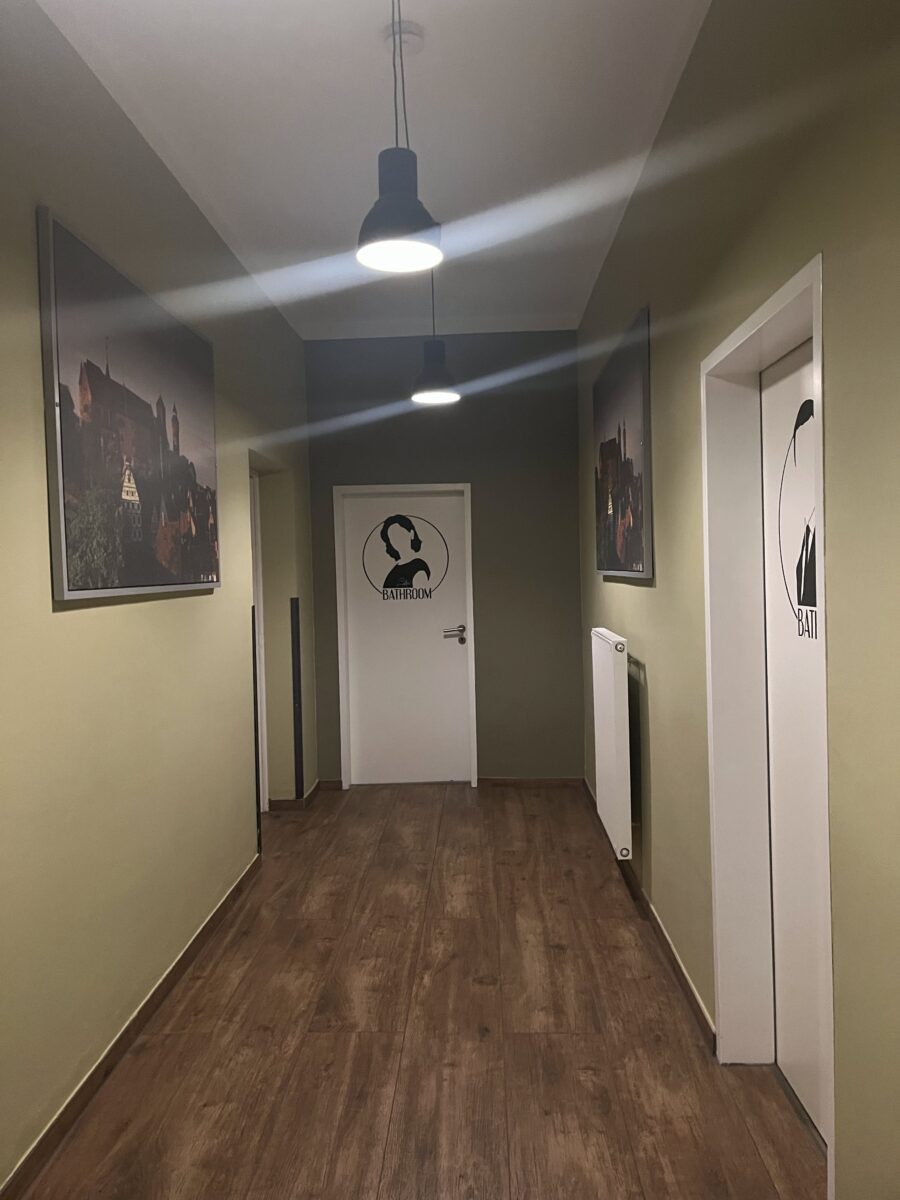
I stayed at Five Reasons Hotel & Hostel from November 23 to November 24, 2023. The hostel was clean, calm, and especially convenient for exploring the Old Town.
My room did not have an en-suite bathroom, but the shared bathrooms down the hall were well maintained. Because I visited during the colder season, the hostel was not crowded. The atmosphere felt laid-back rather than intensely social.
I still met interesting people, which remains one of my favorite parts of hostel travel. Yet I also had enough quiet to rest after long hours of walking.
The location became the property’s greatest advantage. I could easily reach the walls, river, markets, restaurants, public art, and historic attractions without planning my day around transportation.
Travelers can compare current Nuremberg accommodations through Hostelworld.
Why Nuremberg Stayed With Me
Nuremberg stayed with me because it resisted becoming one simple story.
I remember castle walls darkened by rain, the winding streets of the Old Town, Gothic figures rising above the Hauptmarkt, disturbing public sculptures, warm sausages, Vietnamese noodles, and a museum asking what humanity might build next.
Most of all, I remember how often the city required me to hold beauty and discomfort together.
Nuremberg history includes imperial ambition, artistic brilliance, commercial innovation, religious persecution, racial hatred, legal accountability, and cultural reinvention. No single period should erase the others.
That complexity made Nuremberg one of the most thought-provoking stops on my German journey. It is a city where the past remains visible, but where art, food, technology, and everyday life continue writing new narratives.
Continue planning with my Germany travel guide, or read Seeking Adventure and Finding Me in 2023 for the broader story of the year that brought me to Nuremberg.
Browse guided Nuremberg and Bavaria experiences through GetYourGuide.
Affiliate disclosure: This article contains affiliate links. If you book through one of these links, DG Speaks may earn a commission at no additional cost to you.