Good Tidings for the Road: Beer, Blueberry-Lemon and the First Steps to Canterbury
I met Katie at Southwark Cathedral on the morning we began our walk to Canterbury.
Before we took a single step toward the road, the cathedral gave our journey a sense of history, ritual, and connection that I had not expected to feel so strongly.

Sarah Kell from the cathedral team had arranged for us to meet Canon Michael Rawson, the Sub Dean and Canon Pastor, shortly after morning prayer. Michael welcomed us, talked with us about pilgrimage, showed us around the cathedral, and gave Katie and me a pilgrim’s blessing before we set out.
Then he gave us something neither of us expected.
Katie and I became the first two people to receive newly recreated pilgrim pendants modeled after a historic souvenir connected to the Canterbury journey.
Only after all of that did we go looking for doughnuts and beer.
That sequence felt perfect.
Beginning Where Pilgrims Came Before Us
Southwark Cathedral did not simply give us a convenient starting point.
Pilgrimage belongs to the history of the place.
An Augustinian priory took root there in 1106, and the community ministered to pilgrims, travelers, sick people, and others who needed care. Centuries later, Southwark still describes itself as a place of worship, prayer, pilgrimage, and welcome.
Knowing that history changed the way I moved through the cathedral.
Michael did more than point out beautiful architecture. Our conversation connected the building to the generations of people who had passed through Southwark before heading elsewhere.
I had come to London with a backpack, a walking plan, and my own reasons for going to Canterbury. Suddenly, the journey felt much older than me.

Chaucer Was Already Waiting for Us
Literature also lives inside Southwark Cathedral.
John Gower, the medieval poet and friend of Geoffrey Chaucer, rests there beneath an elaborate tomb. Chaucer placed the beginning of The Canterbury Tales in Southwark, where his fictional pilgrims gathered before setting off toward Canterbury.
That connection was important to me because I had read The Canterbury Tales growing up several times.
Now the stories had moved from my books into the landscape around me.
I could stand in Southwark, think about Chaucer’s pilgrims gathering nearby, and know that Katie and I would soon follow our own version of that road.
The cathedral also holds another literary connection I loved.
William Shakespeare spent much of his life in Southwark, and the cathedral honors him with a memorial and stained-glass window depicting scenes from his plays. Other figures from the theatrical world, including Edmund Shakespeare, John Fletcher, and Philip Massinger, also rest there.
Only days earlier, I had toured Shakespeare’s Globe and thought about the importance of art to civilization. Now Shakespeare had appeared again at the starting point of my pilgrimage.
London kept folding its stories into one another.
A Blessing Before the Road
Before we left, Michael gave Katie and me a pilgrim’s blessing.
I am not religious, but I appreciated the ritual and the intention behind it.
Someone did not need to share my worldview for me to recognize the beauty of wishing two travelers safety, strength, and good passage.
The moment also connected our departure to generations of people who had sought encouragement before leaving familiar ground.
People have carried all kinds of things toward Canterbury over the centuries. Faith, grief, gratitude, curiosity, obligation, hope, and uncertainty have all traveled that road.
Katie and I carried our own reasons.
For a few quiet moments inside Southwark Cathedral, those journeys seemed to overlap.
Good Tidings for the Road
Then came the pendant.
Early pilgrims sometimes returned from Canterbury carrying small metal pendants as souvenirs of their journeys. Some later threw them into the Thames as offerings of thanks.
A fragment from one of those historic pieces eventually surfaced along the riverbank and inspired a newly recreated version.
Michael gave the first two pendants to Katie and me.
The idea that we would carry them for good tidings along the path made the little objects feel far more meaningful than ordinary souvenirs.
I was not simply holding something designed to look medieval.
Instead, I carried a physical reminder that countless people had traveled toward Canterbury before us, each leaving traces of a journey that once mattered deeply to them.
My pendant would travel with me now.
Then Came the Doughnuts
Once we left the cathedral, the morning became considerably less solemn.
Katie and I headed to Rodeo Doughnuts and picked up something sweet before the real walking began.
I chose a blueberry-lemon doughnut.

After a morning filled with medieval poets, pilgrim history, blessings, and centuries-old traditions, a ridiculously good doughnut felt like exactly the right transition back into the present.
Pilgrimage can carry reflection without demanding seriousness every minute of the day.
Joy gets to come along too.
A Breakfast Beer at The George
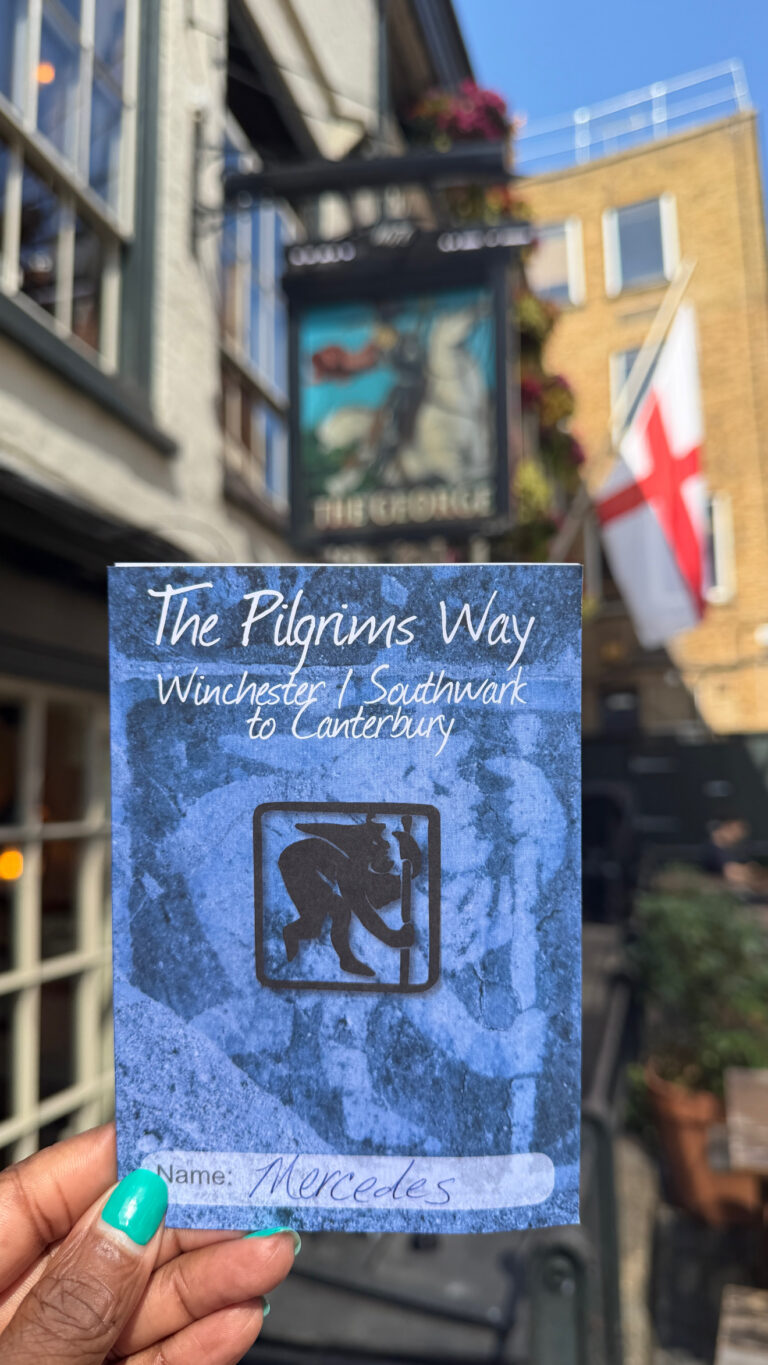
From Rodeo Doughnuts, we made our way to The George.
The pub felt like a fitting stop after beginning our morning inside Southwark Cathedral. We had already spent time thinking about travelers who moved through this part of London long before us, and now we sat in a place that still carried the atmosphere of an old inn, conversation, food, and journeys beginning or ending nearby.
I ordered a Peroni and raised the glass with The George sign and St George’s flag behind me.
Beer for breakfast is not part of my everyday routine.
On that particular morning, it felt like a toast.
We had received our blessing, tucked away our pendants, secured our doughnuts, and reached the point where planning had to become movement.
The road waited outside.
Leaving London With Something to Carry
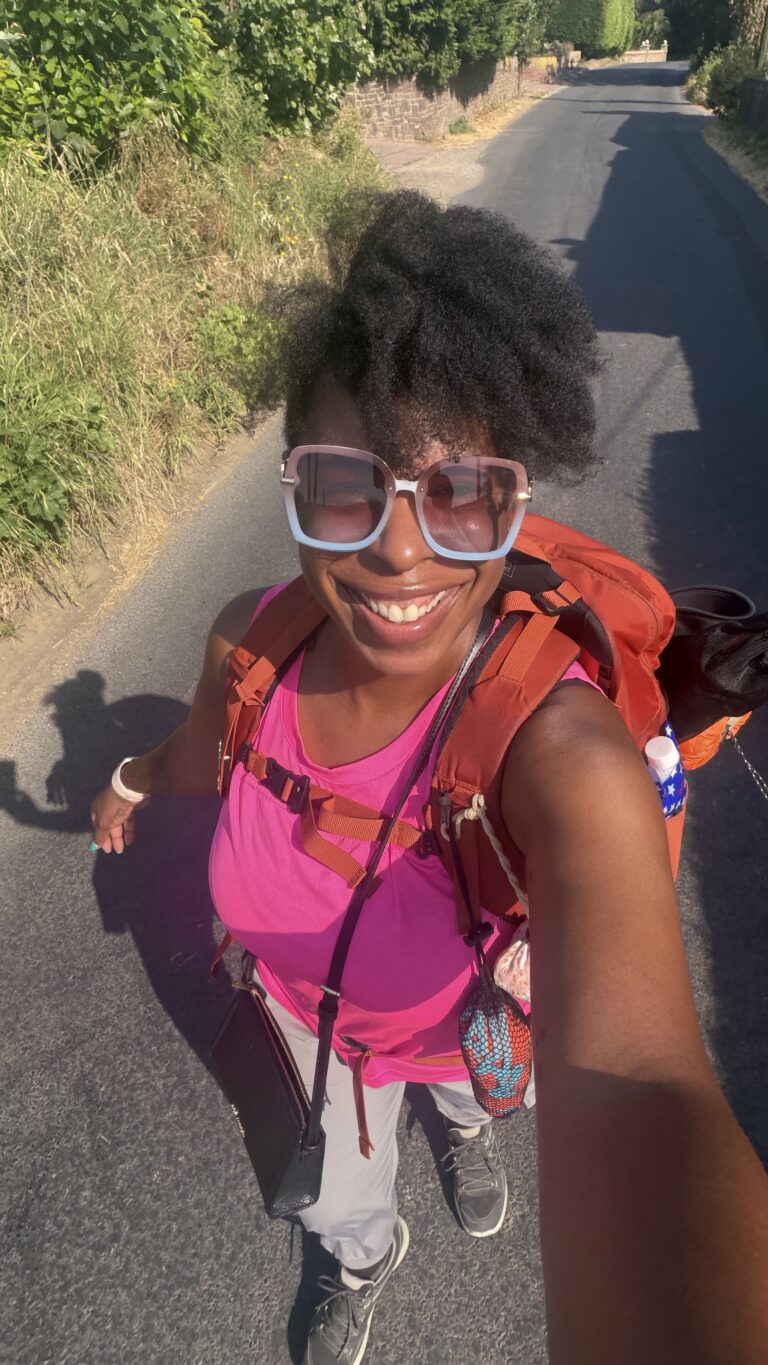
Katie and I started walking in a good mood.
London gradually shifted around us as familiar city streets gave way to the longer route toward Canterbury.
My backpack carried everything I would need for the next several days, but the morning had already given me a few less tangible things to take along.

The blessing connected our journey to the pilgrims who came before us.
Our pendants gave that history something physical I could hold.
Blueberry-lemon and beer reminded me that reflection does not require solemnity every minute of the day.
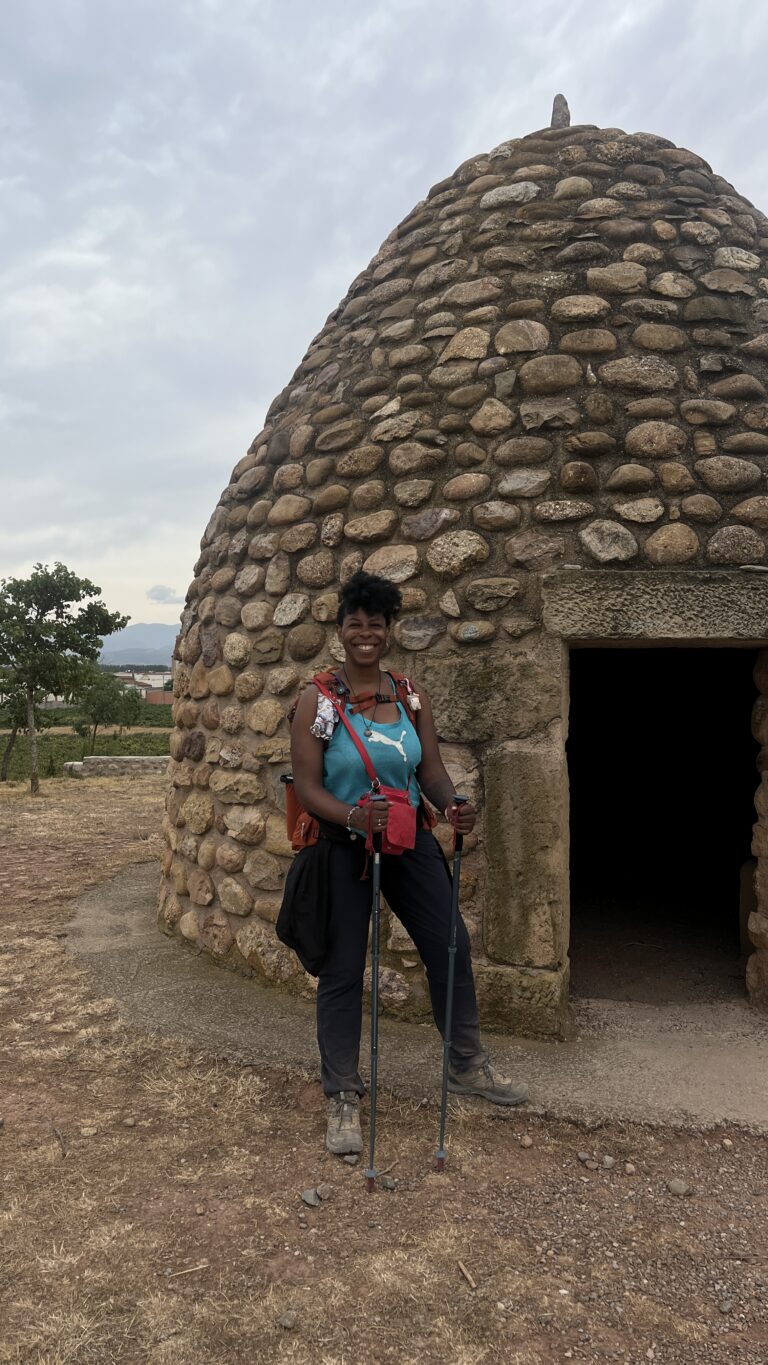
Long-distance walking always reveals discomfort, uncertainty, and limits that ordinary travel can hide. My previous Camino de Santiago experience had already taught me that.
Still, those first steps felt light.
Canterbury waited somewhere ahead. The taste of blueberry and lemon still lingered, and a tiny pilgrim pendant traveled with me.
For that morning, I did not need to know exactly what the road would bring.
Good tidings felt like enough to begin.